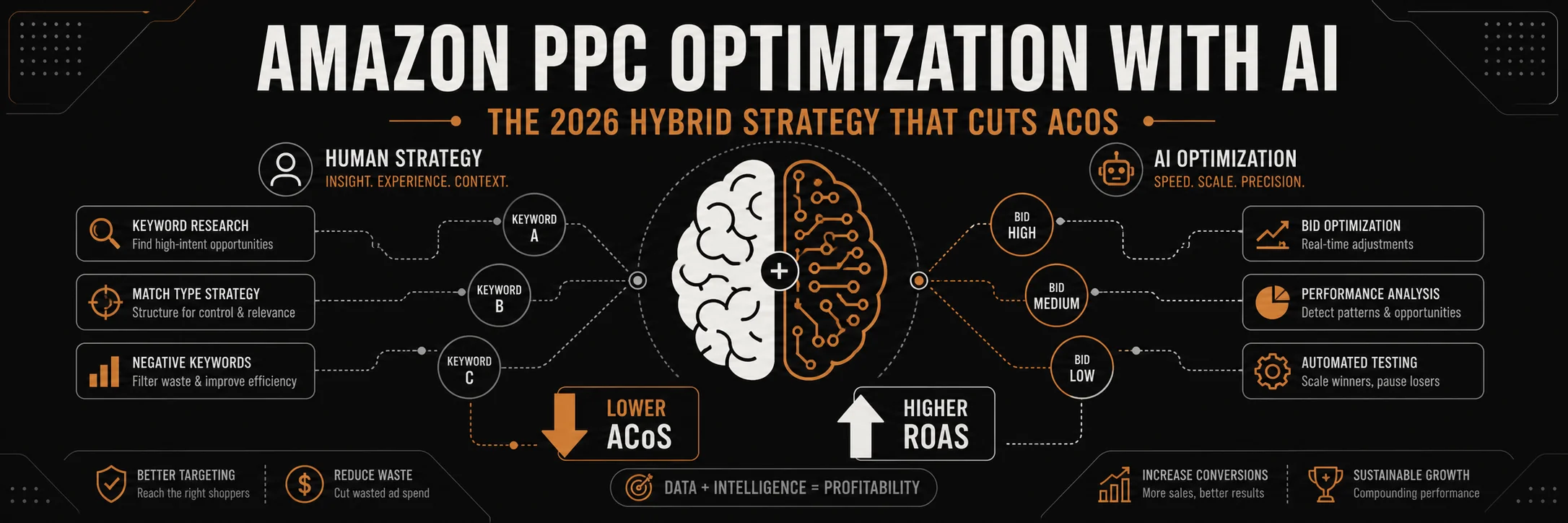
Amazon PPC optimization with AI is no longer a nice-to-have. It’s what separates sellers who scale profitably from those who burn budget and wonder why their ACoS keeps climbing. In 2026, the Amazon ad platform has grown into a $60 billion ecosystem, and the old way of managing bids by hand simply can’t keep up.
This guide breaks down exactly how the hybrid human-machine approach works. You’ll learn what AI handles best, what still needs a human brain, and how to build a system that grows your sales without wrecking your margins.
Table of Contents
- Why AI Matters for Amazon Advertising in 2026
- What AI Does Best in Amazon PPC Campaigns
- The Hybrid Human-Machine Strategy Explained
- How to Reduce ACoS with AI Without Losing Sales
- ROAS Optimization on Amazon: A Practical Breakdown
- Choosing the Right Amazon PPC Management Agency
- AI Tools vs Manual Management: Side-by-Side Comparison
- Frequently Asked Questions
- Conclusion
Why AI Matters for Amazon Advertising in 2026
AI Amazon advertising 2026 is a fundamentally different game from what sellers faced just two years ago. Amazon’s own algorithm now evaluates intent, creative quality, and historical performance signals all at once. Manual bid management can’t process that volume of data fast enough to stay competitive.
According to recent benchmarks, AI-managed accounts see a 34% improvement in ROAS compared to accounts relying purely on manual optimization. That gap grows wider every quarter as the platform gets more complex.
So what changed? Firstly, Amazon introduced Performance+ campaigns, which use deep-learning models to predict shopper behaviour. Secondly, the rise of Amazon’s Rufus AI assistant shifted how shoppers discover products. As a result, sellers who haven’t adapted their ad strategy are now competing at a structural disadvantage.
For example, a seller still using a basic exact-match-only structure will struggle against a competitor running an AI-supported system that adjusts bids every hour based on real conversion data. In short, the platform has outgrown the spreadsheet era.
Pro Tip: If your Amazon PPC campaigns haven’t been restructured in the past six months, you’re likely losing ground to sellers who have adopted AI-assisted bidding. Start by auditing your ACoS at keyword level before making any changes.
What AI Does Best in Amazon PPC Campaigns
AI tools genuinely excel at tasks that require processing enormous amounts of data in real time. That’s their core strength, and smart sellers use them for exactly that. Here’s what AI handles better than any human team:
- Real-time bid adjustments: AI systems evaluate conversion probability for every auction and adjust bids within milliseconds. No human team can match that speed.
- Keyword harvesting from auto campaigns: AI scans search term reports and promotes high-converting terms to exact-match campaigns automatically. This process used to take hours each week.
- Negative keyword identification: AI spots irrelevant traffic patterns faster than manual review. Cutting that waste directly helps reduce ACoS with AI-driven precision.
- Dayparting optimisation: AI identifies peak conversion windows by hour and day, then shifts budget toward those windows without any manual scheduling.
- Budget pacing: AI prevents budget from running out at 2pm and missing peak evening shopping periods, which is one of the most common and costly errors in manual management.
- Inventory-linked pausing: Advanced AI tools pause ads automatically when stock drops below a threshold. That stops wasted spend on products that can’t ship.
However, AI is not magic. It needs clean campaign structure, high-quality listings, and clear goals to perform well. Feed it a broken account and it optimises the chaos, not the results.
The Hybrid Human-Machine Strategy Explained
The most successful sellers in 2026 don’t choose between AI and human management. They combine both. Specifically, they let AI do the heavy data processing and humans do the thinking that machines still can’t replicate.
Here’s what the hybrid model looks like in practice:
- Humans set the strategy: Target ACoS, budget allocation, product launch priorities, and seasonal adjustments all need human judgment. AI doesn’t know your margin structure or your Q4 goals unless you tell it.
- AI runs the execution: Once goals are set, the automated bidding strategy takes over. Bids, dayparting, negative keyword additions, and budget pacing all happen without manual intervention.
- Humans review the outputs: Weekly, a human checks whether AI decisions align with business goals. If AI is scaling a product with a margin problem, a human catches it. AI won’t.
- AI scales what works: When a keyword or placement proves profitable, AI increases spend systematically. This is where AI earns its keep, because it scales faster and more consistently than manual adjustments.
- Humans handle creative: Ad copy, product images, A+ Content, and listing quality all remain human responsibilities. AI bidding performs poorly when the underlying listing is weak.
Most importantly, the hybrid model avoids the two biggest failure modes. One is the “set it and forget it” trap where sellers trust AI to manage everything and never review outputs. The other is the manual micromanagement trap where sellers change bids daily and disrupt the algorithm’s learning period.
Warning: Never make manual bid changes every few hours inside an AI-managed campaign. Experts recommend a 48 to 72 hour evaluation window to let the AI collect enough data. Constant manual overrides destroy the learning process and push your costs up, not down.
How to Reduce ACoS with AI Without Losing Sales
Reducing ACoS is the goal every seller chases. But cutting ACoS the wrong way just kills your sales velocity and drops your organic ranking. AI helps you reduce ACoS with AI-powered precision, targeting the specific levers that matter most.
Here are the most effective AI-driven ACoS reduction tactics you can implement right now:
Isolate converting keywords into exact match
AI tools identify which broad and phrase-match terms are actually converting. Then they push those terms into exact match campaigns where you control the bid precisely. This single step can cut wasted spend by 20 to 30 percent according to sellers who’ve made the switch.
Use search term reports as your primary data source
Your own campaign data is more reliable than any third-party tool. AI analyses search term performance daily and flags terms that get clicks but no sales. Removing those terms quickly stops budget drain before it compounds.
Improve Your listing conversion rate
AI bidding cannot fix a weak listing. If your main image is unclear or your bullets don’t answer shopper questions, every click costs more than it should. A stronger listing directly lowers your effective ACoS because more clicks convert into sales. In other words, listing quality and PPC performance are permanently linked.
Target TACoS, not just ACoS
Total Advertising Cost of Sale (TACoS) accounts for both paid and organic revenue. AI tools that integrate with Amazon Marketing Cloud can calculate lifetime TACoS and justify bidding more aggressively on products with strong repeat purchase rates. For example, a subscribe-and-save product might show a high initial ACoS but an extremely healthy 12-month customer value.
ROAS Optimization on Amazon: A Practical Breakdown
ROAS optimization Amazon requires a different mindset than chasing low ACoS. High ROAS means you’re generating more revenue per dollar spent. Sometimes that means accepting a slightly higher ACoS on high-volume, high-margin products.
AI tools approach ROAS optimization through three lenses:
Placement-level ROAS analysis
AI evaluates performance separately for top-of-search, rest-of-search, and product detail page placements. Then it shifts budget toward whichever placement delivers the strongest ROAS for each campaign. Most sellers run the same bid adjustment across all placements. That’s a significant efficiency loss.
Audience signal integration
Advanced AI platforms now integrate with Amazon DSP audience data. They identify which shopper segments convert at the highest rate and weight bids accordingly. Specifically, they can separate first-time buyers from repeat customers and bid differently for each group.
Dynamic budget reallocation
AI monitors ROAS across your full campaign portfolio in real time. When one campaign underperforms its ROAS target, AI shifts budget to campaigns that are hitting or exceeding their targets. As a result, your total portfolio ROAS improves without you having to manually shuffle budgets every day.
Still, ROAS optimization Amazon is not purely a numbers exercise. You also need to consider your product lifecycle. A new launch justifies lower ROAS expectations because you’re buying ranking momentum. An established hero product should be held to a strict ROAS floor. AI needs those goal parameters from a human strategist to work properly.
For a deeper look at how leading brands are implementing this, the 2026 AI Amazon PPC Playbook from Stormy AI breaks down real account data with specific ROAS gains by category. It’s worth reading before you restructure your campaigns.
Choosing the Right Amazon PPC Management Agency
Not every agency offering AI-powered Amazon PPC actually uses it effectively. Choosing the wrong Amazon PPC management agency can set your account back by months. Here’s how to evaluate your options clearly.
Ask about their AI stack
A credible Amazon PPC management agency names the tools it uses. Platforms like Teikametrics Flywheel, Quartile, BidX, and Helium 10 Adtomic are industry standards. If an agency says it uses “proprietary AI” but can’t explain what that means, treat that as a red flag.
Look for a hybrid model, not full automation
The best agencies combine AI execution with human strategy oversight. An agency that promises to “set it and let the AI handle everything” is describing a recipe for drift and budget waste. You want weekly human review built into the process.
Demand transparent reporting
A good agency shares search term reports, ACoS breakdowns by campaign type, and placement performance data. If reporting is a black box of summary numbers, you can’t verify whether the AI decisions are actually serving your goals.
Check for listing optimisation as part of the offering
As mentioned earlier, AI PPC performs poorly on weak listings. An agency that only manages ads without addressing listing quality is optimising one part of the machine while ignoring the engine. The best agencies audit your listings before scaling your ad spend.
Additionally, the Innels 2026 Amazon PPC guide on what’s changed and what works now provides a detailed breakdown of how agency management structures are evolving this year. It’s a useful benchmark for evaluating any agency pitch you receive.
AI Tools vs Manual Management: Side-by-Side Comparison
Below is a direct comparison of what AI-assisted management delivers versus pure manual management across the key performance factors sellers care about most.
Table: AI-Assisted Amazon PPC vs Manual PPC Management in 2026
| Factor | AI-Assisted Management | Manual Management |
|---|---|---|
| Bid adjustment speed | Real-time (milliseconds) | Daily or weekly |
| Keyword harvesting | Automated and continuous | Manual weekly review |
| Negative keyword management | AI flags and adds within hours | Relies on human review cycle |
| Dayparting optimisation | Fully automated by hour | Requires scheduled rules setup |
| ROAS improvement (average) | Up to 34% better than manual | Baseline performance |
| Time saved per week | 5 to 14 hours per account | Full manual workload |
| Creative and strategy decisions | Still requires human input | Fully human-controlled |
| Risk of unchecked spend drift | Medium without human review | Low with experienced manager |
| Scalability across SKUs | Excellent for large catalogues | Limited by human bandwidth |
| Best suited for | Sellers with 10+ active ASINs | Sellers with 1 to 5 ASINs |
To summarise, AI wins on speed and scale. Manual management wins on strategic nuance. The hybrid model combines both.
Frequently Asked Questions
Does AI really lower ACoS on Amazon?
Yes, AI lowers ACoS on Amazon when it’s implemented correctly. AI tools identify irrelevant search terms faster than manual review, remove them, and reallocate budget to keywords that actually convert. According to industry benchmarks, AI-managed accounts consistently outperform manual accounts on ACoS reduction. However, AI alone won’t fix a structural problem. If your campaign architecture is poor or your listing converts badly, AI optimises those problems rather than solving them. You need clean structure and a strong listing first. What is hybrid Amazon PPC management?
Hybrid Amazon PPC management combines AI automation with human strategic oversight. AI handles the tasks it does best: real-time bid adjustments, keyword harvesting, negative keyword management, and budget pacing. Humans handle the tasks that require judgment: goal-setting, creative decisions, listing quality, and weekly performance reviews. The hybrid model avoids two major failure modes. The first is over-relying on AI and never reviewing outputs. The second is micromanaging the AI and disrupting its learning cycle. Most top-performing seller accounts in 2026 use some version of this model. How do I lower Amazon advertising cost of sale in 2026?
Start by auditing your search term reports to find keywords that spend without converting. Add those as negatives immediately. Next, move your top-converting terms from broad or phrase match into exact match campaigns where you control the bid. Then improve your listing, because a stronger main image and clearer bullet points directly increase conversion rate and lower your effective ACoS. Finally, use an automated bidding strategy to maintain bid discipline around your target ACoS rather than adjusting manually. Combining those steps consistently brings ACoS down without sacrificing sales volume. Is manual Amazon PPC still worth it in 2026?
Manual Amazon PPC management still works for sellers with a small catalogue of one to five ASINs where the bid volume is manageable. In those cases, an experienced manager can often match what AI delivers because the data set is small enough to process by hand. But for sellers with ten or more active ASINs, manual management struggles to keep up. The volume of auctions, keywords, and placement decisions simply exceeds what a human can optimise in a reasonable amount of time. Most sellers find that an automated bidding strategy combined with weekly human review gives them better results with less effort than manual management alone. What is the best automated bidding strategy for Amazon PPC?
The best automated bidding strategy depends on your goal. If you’re launching a new product and want impressions and data, dynamic bids (down only) gives the algorithm room to learn without overspending. If you have an established product and want to maximise sales at a target ACoS, dynamic bids (up and down) lets AI push bids higher on high-conversion queries. For brand defence on your own product names, fixed bids give you total control over placement costs. Most serious sellers run a mix of all three across different campaign types, with AI monitoring performance across all of them simultaneously. How do I choose a good Amazon PPC management agency in 2026?
Look for an Amazon PPC management agency that names the AI tools it uses, shows you transparent reporting at keyword and placement level, and includes human strategic review as a regular part of its process. The agency should also address your listing quality, because AI bidding performs poorly on weak product pages. Ask specifically how often a human reviews campaign performance and what triggers a manual override of the AI’s decisions. Agencies that can answer those questions clearly are running a genuine hybrid model. Agencies that can’t are likely running full automation with minimal oversight. How long does it take for AI to improve Amazon PPC performance?
Initial signals from AI-managed campaigns typically appear within 7 to 14 days. However, meaningful optimisation requires 30 to 60 days of data because Amazon’s attribution window can extend up to two weeks depending on the ad format. Consequently, you should not judge AI performance within the first two weeks. Sellers who make major changes to campaigns during the learning period disrupt the algorithm and reset the data collection process. Give the system at least 30 days before drawing firm conclusions about performance improvement.
Ready to grow your Amazon business?
Get a free strategy call with Advertpreneur. Our team builds hybrid AI and human PPC systems that cut ACoS and scale your revenue without wasted spend.Book Your Free Consultation
Conclusion
Amazon PPC optimization with AI is the clearest competitive advantage available to sellers right now. The sellers who treat AI as a tool within a thoughtful human strategy are pulling ahead. Those who ignore it or over-rely on it without oversight are falling behind.
To summarise, the hybrid approach works because it plays to the strengths of both sides. AI processes data at a scale and speed no human team can match. Humans apply the judgment, creativity, and goal alignment that no AI has yet learned to replicate. Together, they produce better results than either can achieve alone. That’s the core principle behind every successful AI Amazon advertising 2026 strategy.
Finally, if you’re serious about growing your Amazon business, start with an honest audit of your current campaign structure. Fix your listing quality. Set clear ROAS and ACoS targets. Then introduce an automated bidding strategy with weekly human review built in. That process, applied consistently, is how profitable Amazon sellers are winning in 2026. Our team at Advertpreneur is ready to help you build it.
Architect Signature
Hasnain
Runs Amazon SEO and listing optimization for the Advertpreneur portfolio. He researches keywords and rebuilds listing architecture at the intersection of algorithm understanding and conversion copywriting.