If you are running Amazon ads and watching your ACOS climb every week without knowing why, you have probably asked yourself whether to outsource Amazon PPC management or keep grinding through it yourself. That question comes up constantly in seller communities, and the answer is rarely obvious.
This guide cuts through the noise. You will find the real signs that point toward hiring help, a breakdown of what Amazon PPC management actually costs, and an honest comparison of going with an agency versus a freelancer. By the end, you will know which path fits your situation.
What Outsourcing Amazon PPC Management Actually Means
Outsourcing your Amazon PPC means handing campaign strategy, bid management, keyword research, and performance reporting to someone outside your team. That person or team handles your Sponsored Products, Sponsored Brands, and Sponsored Display campaigns so you stop managing bids manually and start focusing on sourcing, inventory, or scaling your catalog.
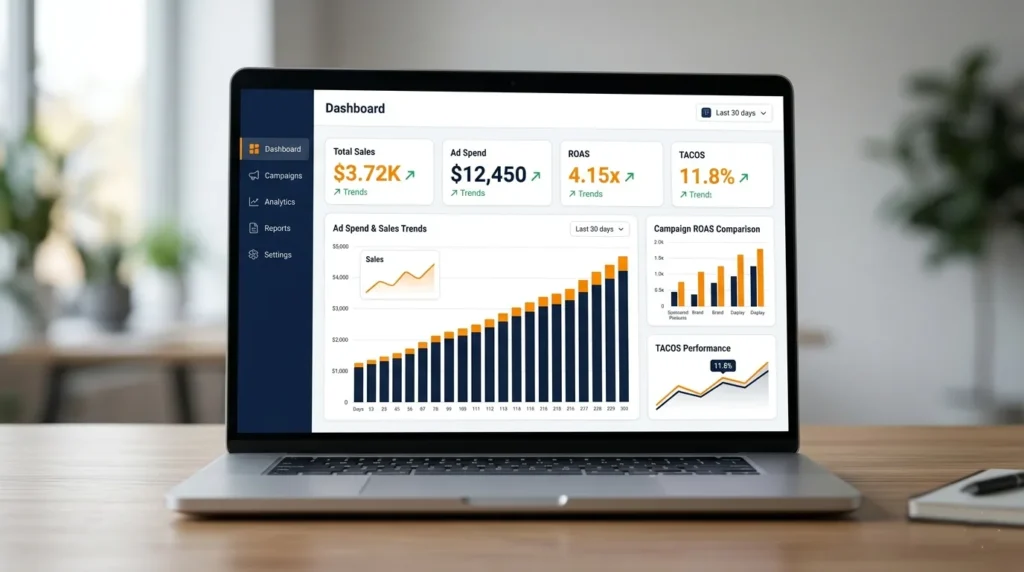
It is not about giving up control. A good Amazon advertising management service works with your goals and reports to you regularly. You stay in the loop on spend, ACOS, TACOS, and return on ad spend. The difference is that an expert who lives inside these dashboards all day is making the decisions instead of you fitting it in around everything else.
5 Signs You Should Outsource Amazon PPC Management
1. Your ACOS Is Rising but Sales Are Not
ACOS creeping up without a sales increase is the clearest signal that your campaigns need attention you are not giving them. Unmanaged keyword bids, broad match terms pulling irrelevant traffic, and neglected negative keywords all push ACOS up steadily. If you are not running weekly search term reports and adjusting, that number will keep climbing.
2. You Are Spending More Than 10 Hours a Week on PPC
Amazon Sponsored Products management takes real time done properly. Keyword harvesting, bid adjustments, campaign restructuring, dayparting tests, and placement modifier tuning are not quick tasks. If ads are eating your week, you are paying for it in time even if you are not paying an agency.
3. You Do Not Understand Your Own Campaign Structure
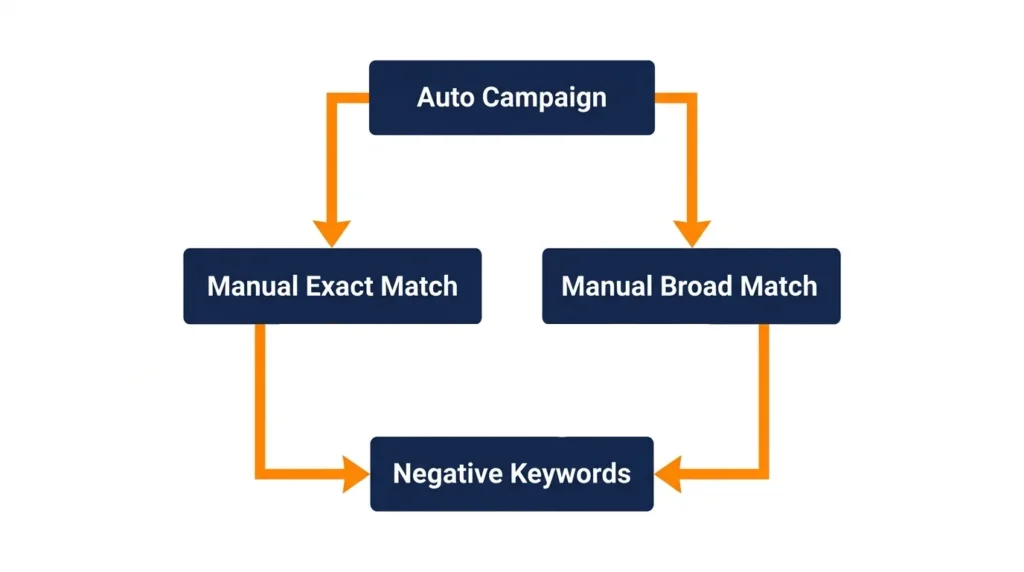
If you cannot explain why your auto campaigns feed your manual campaigns, or why you separate match types into different ad groups, the structure likely has gaps. Poor PPC campaign structure wastes budget at scale. Every dollar going to a poorly targeted keyword is a dollar not going to a converting one.
4. You Are About to Scale or Launch a New Product
This is the moment most sellers regret not hiring help earlier. Launching without a tested keyword strategy, without a launch budget model tied to your TACOS Amazon advertising targets, and without a bid ramp-up plan burns money fast. Getting a specialist in before the launch costs less than recovering from a bad one.
5. Your Competitor’s Ads Are Showing Up on Your Own Listings
If your competitors are stealing impressions on your own product pages, your defensive campaign strategy has gaps. This is a structural problem that requires a full audit, not just a bid increase. An experienced Amazon PPC professional spots this in an account review.
Amazon PPC Agency vs In-House: The Real Comparison
The Amazon PPC agency vs in-house debate comes down to volume, budget, and how much specialized knowledge your team already carries.
An in-house hire makes sense when you have 50 or more ASINs, ad spend above $30,000 per month, and enough work to keep someone busy full-time. You get full focus on your account, faster responses, and someone who learns your brand deeply over time. The cost is $4,000 to $8,000 per month in salary plus benefits, with a ramp-up period of several months before they operate independently.
An agency or freelancer makes more sense at lower volumes. You pay for the expertise without the overhead. You also benefit from pattern recognition across multiple accounts, which a new in-house hire simply does not have on day one.
Here is a practical breakdown:
| Factor | Agency | Freelancer | In-House |
|---|---|---|---|
| Cost per month | $800 to $5,000 | $500 to $2,500 | $4,000 to $8,000 |
| Expertise level | Team with specializations | Usually one generalist | Depends on hire |
| Response time | Business hours | Varies | Immediate |
| Best for | Scaling brands | Small to mid sellers | High-volume operations |
| Contract flexibility | Monthly or quarterly | Monthly | Full-time commitment |
How Much Does Amazon PPC Management Cost?
Amazon advertising agency pricing varies significantly based on ad spend, number of ASINs, and the service model. Here are the three most common structures:
Flat Monthly Retainer: Ranges from $800 to $3,000 per month for small to mid sellers. You get a defined scope of work regardless of how much you spend. Good when your budget is predictable.
Percentage of Ad Spend: Typically 10 to 20 percent of monthly ad spend. At $5,000 monthly spend, that is $500 to $1,000. At $20,000, it scales up to $2,000 to $4,000. Aligns the agency’s incentive with managing your budget carefully, though some agencies with this model have an incentive to grow spend rather than improve efficiency.
Hybrid Model: A base retainer plus a small percentage of ad spend. This is common with boutique agencies and full-service Amazon partners. It balances fixed costs with growth-linked fees.
For sellers spending under $3,000 per month on ads, an Amazon PPC freelancer is almost always the better starting point. Agencies at that spend level often have minimum fees that do not make economic sense.
What to Expect in the First 90 Days
The first 30 days of any new Amazon PPC engagement should be a full account audit. A competent specialist will review your campaign structure, search term reports, match type distribution, negative keyword gaps, bid history, and placement data before touching anything.
Days 30 to 60 are typically restructuring and testing. New campaigns get built, old inefficient structures get paused or cleaned up, and a fresh keyword strategy rolls out based on your product margins and your Amazon ad spend ROI targets.
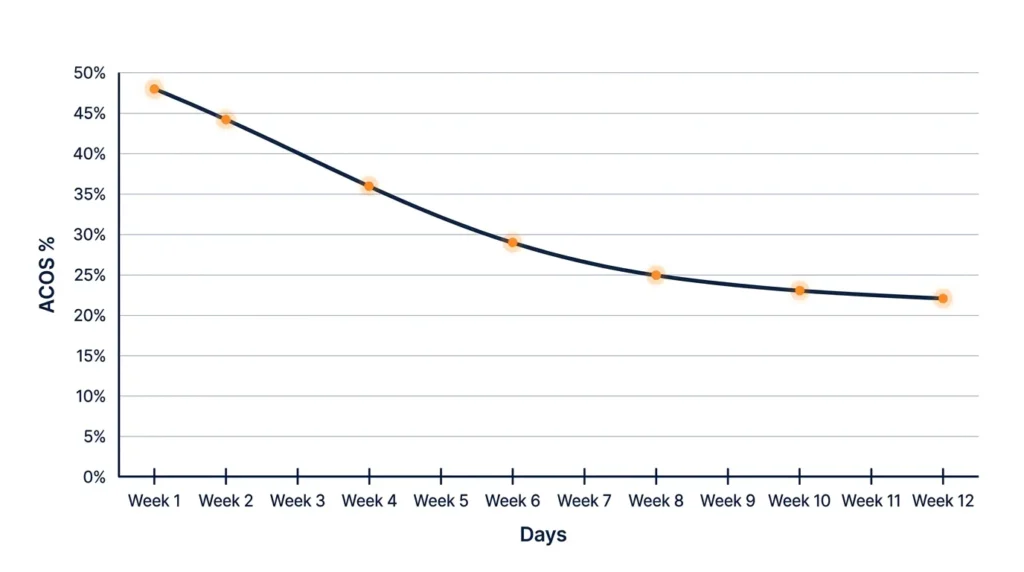
By day 60 to 90, you should start seeing ACOS stabilization. Not necessarily a dramatic drop, but the upward drift should stop. TACOS Amazon advertising improvements take longer because organic rank needs time to respond to improved relevance and conversion rate.
If an agency promises massive ACOS drops in 30 days, treat that as a red flag. Real improvement is methodical, not instant.
Amazon PPC Freelancer vs Agency: Which One Should You Hire?
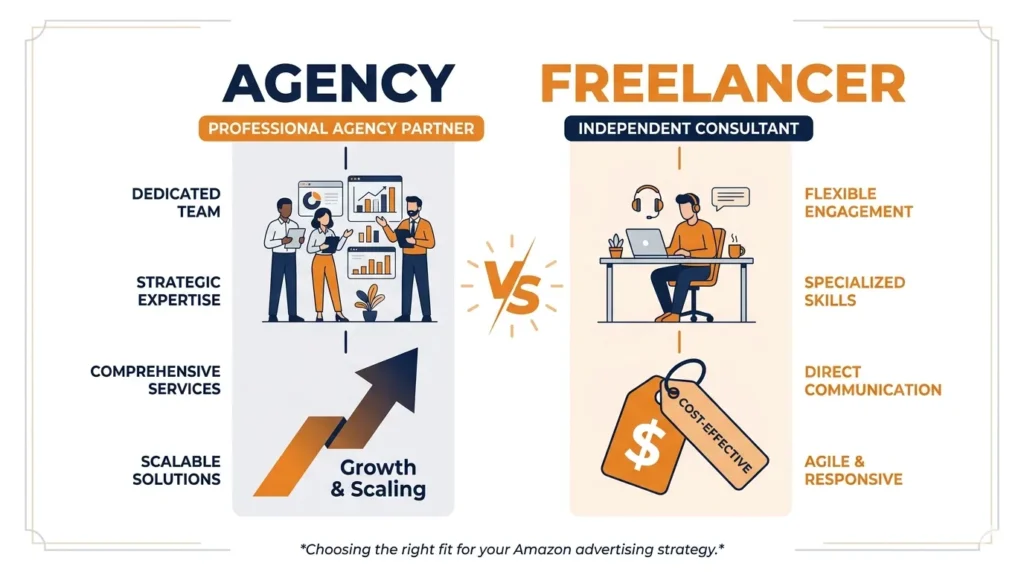
For sellers under $10,000 per month in ad spend, an Amazon PPC freelancer usually delivers better value. You get direct access to the person doing the work, lower fees, and more flexibility to adjust scope month to month.
For sellers above $10,000 monthly in spend with 30 or more active ASINs, a boutique Amazon advertising agency with a dedicated account manager is worth the higher cost. The team structure means someone is watching your campaigns even when your point of contact is unavailable.
When evaluating either, ask these questions:
- Can you show me a case study with ACOS before and after data?
- What does your campaign audit process look like?
- How do you structure Sponsored Products campaigns for a new ASIN?
- How often do you adjust bids, and what triggers an adjustment?
- Do you manage Sponsored Brands and Sponsored Display, or just Sponsored Products?
The answers reveal experience level quickly. Vague answers about “proprietary processes” without specifics are a warning sign.
What Happens When You Keep Managing PPC Yourself
Sellers who manage their own Amazon ads without the right training or time tend to fall into the same patterns. Bids set once and forgotten. Auto campaigns running without harvesting search terms into manual campaigns. Broad match terms eating budget on irrelevant queries. Sponsored Products campaigns structured around product groupings instead of match type logic.
None of this is immediately catastrophic, but it compounds. A 40% ACOS that should be 25% costs you hundreds or thousands in margin every month. At scale, that gap is the difference between a profitable brand and one that is funding Amazon’s revenue instead of your own.
If your Amazon ads are wasting money and you are not sure where the leak is, an audit is the right first step before committing to any management service. At Advertpreneur, we offer Amazon PPC audits that show you exactly where your ad spend is going and what a realistic ACOS target looks like for your category.
How Advertpreneur Handles Amazon PPC Management
Advertpreneur is a full-service Amazon agency built for small to mid-size sellers who want professional results without enterprise pricing. Our Amazon Sponsored Products management covers campaign builds, ongoing optimization, weekly reporting, and TACOS tracking tied to your organic ranking goals.
We work with sellers across a range of categories, from consumables to home goods to apparel, and our campaigns are built around your margin targets from day one. No generic templates, no set-it-and-forget-it management.
If you are considering whether to outsource Amazon PPC management, start with a conversation. You can learn more about our Amazon advertising management services and see how we structure campaigns for sellers at your stage.
Common Questions About Outsourcing Amazon PPC
Is outsourcing Amazon PPC worth it for small sellers? For sellers doing $5,000 to $15,000 per month in revenue, outsourcing often pays for itself within the first 60 days through ACOS reduction alone. The key is finding a freelancer or boutique agency that works at your scale, not an enterprise agency with minimum fees above your budget.
Can I outsource just part of my Amazon PPC? Yes. Some sellers keep basic Sponsored Products management in-house and outsource Sponsored Brands video campaigns or DSP to a specialist. A hybrid approach works when your team has some PPC knowledge but lacks expertise in a specific format.
How do I know if my current Amazon PPC management is underperforming? Compare your ACOS and TACOS against category benchmarks. Most categories perform well with an ACOS between 15 and 30 percent. If yours sits significantly above that with flat or declining sales, the current approach is not working.

Final Thoughts
Deciding to outsource Amazon PPC management is not admitting defeat. It is a business decision based on time, expertise, and the cost of not optimizing. The sellers who scale consistently are almost never the ones managing their own bids manually at $20,000 per month in ad spend.
If you are spending more than you should, missing launch windows, or simply running out of hours in the day, the math on hiring help is usually straightforward. Start with an audit, get clear on your ACOS targets, and choose a partner who can show you results from accounts similar to yours.
For more on building a profitable Amazon presence, read our guide on Amazon Listing optimization and our breakdown of how Amazon SEO works in 2025.
Why shopify-vs-wordpress-2026/”>your-products-on-page-1-in-2025/”>amazon marketplace Growth Outside Amazon Matters in 2026

The amazon marketplace no longer sits inside one store alone. Instead, Amazon now pushes its tools across the wider web. For sellers, that shift creates fresh reach, but also fresh risk. Therefore, you need a plan before bigger brands move first.
Table of Contents
- Why amazon marketplace is changing
- What Amazon is building outside its store
- Why this move matters for sellers
- The risks of staying Amazon only
- What sellers should do now
- A simple plan for 2026
- Reference points from Amazon and Shopify
- Frequently Asked Questions
- Conclusion
Why amazon marketplace is changing
Firstly, Amazon wants a larger share of online demand. It no longer wants to win only inside its own walls.
Secondly, brands want more control over traffic and customer data. So Amazon built tools that work beyond the main store.
Thirdly, customer trust already sits with Amazon. Therefore, Amazon can turn that trust into a wider service business.
That move changes how the amazon marketplace fits your growth plan. In other words, Amazon now acts like a sales channel and a logistics layer.
- Amazon can power checkout on brand owned sites.
- Amazon can ship orders from one inventory pool.
- Amazon can support growth across more channels.
Pro Tip: Treat Amazon as a profit channel and a support system. Build both at the same time.
Many sellers still think in old terms. However, 2026 needs a wider view.
If you only watch ranking inside the amazon marketplace, you miss the bigger shift. Meanwhile, stronger brands build reach across many touchpoints.
What Amazon is building outside its store
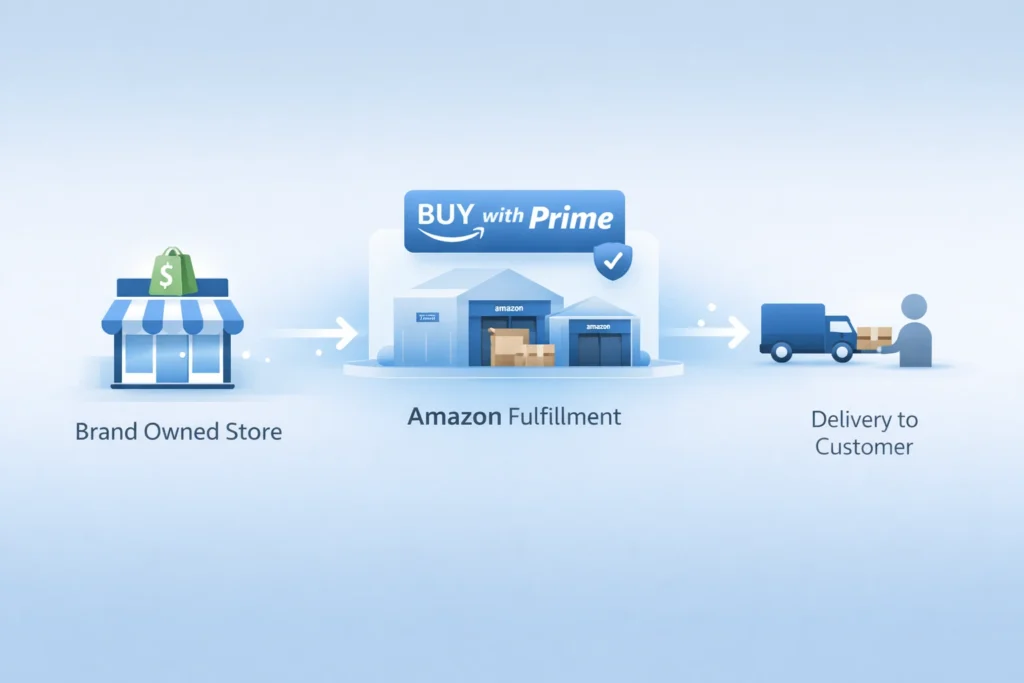
To begin with, Amazon offers Buy with Prime for brand sites. That tool adds Prime perks to direct sales pages.
Next, Amazon offers Multi Channel Fulfillment, often called MCF. That service ships orders from channels beyond Amazon.
In addition, Amazon now has a Shopify app for both tools. So sellers can connect store orders with Amazon fulfillment.
You can read more about Amazon Multi Channel Fulfillment for ecommerce brands. Also, Shopify explains setup in its guide for selling with Amazon tools on Shopify.
Buy with Prime changes the buying moment
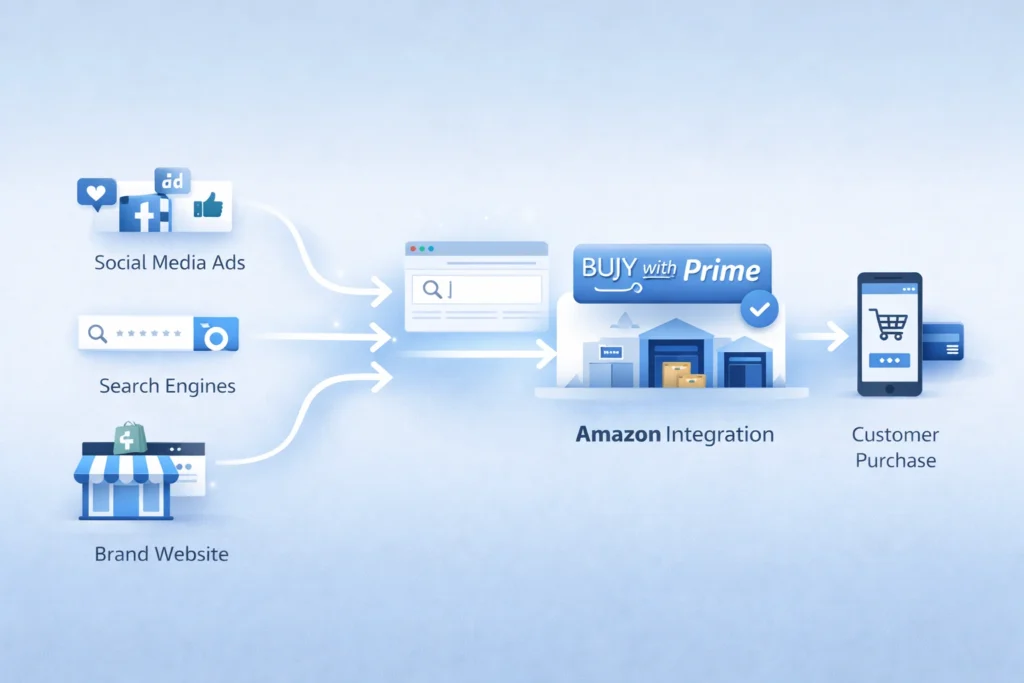
For instance, amazon buy with prime gives shoppers a familiar option. That can reduce doubt on a brand owned store.
As a result, Amazon can help brands convert traffic they already own. But the sale does not need to start inside Amazon.
MCF changes the fulfillment model
Similarly, MCF lets brands use Amazon stock for outside orders. That means one pool can serve many channels.
In fact, Amazon states MCF works for businesses that do not sell on Amazon. So the service reaches beyond the amazon marketplace itself.
Shopify links the two worlds
Specifically, the new app supports shopify amazon integration inside Shopify admin. Therefore, more sellers can test Amazon tools without leaving their core store. :contentReference[oaicite:6]{index=6}
That matters because many private label brands already use Shopify. So Amazon now meets them where they work.
Table: Amazon tools now serve more than one sales path.
| Tool | Main job | Where it helps | What sellers gain |
|---|---|---|---|
| Buy with Prime | Boosts trust and speed at checkout | Brand owned site | Higher chance of conversion |
| MCF | Ships non Amazon orders | Shopify and other channels | One stock pool, faster shipping |
| Amazon app for Shopify | Connects orders and setup | Shopify admin | Smoother daily operations |
Why this move matters for sellers
Most importantly, this move changes seller economics. You can now keep Amazon strengths without keeping all sales inside Amazon.
That opens a real amazon multi channel strategy. In other words, you can use Amazon where it helps, then own more of the customer journey elsewhere.
- Keep fast fulfillment without full marketplace dependence.
- Build a brand site with better customer control.
- Spread risk across channels and traffic sources.
However, this shift also raises the bar. Basic sellers will struggle because strong brands will move faster.
For example, one brand may rank on Amazon, run ads on Meta, and close sales on Shopify. Meanwhile, Amazon still fulfills those orders in the background.
That is an ecommerce omnichannel strategy in simple terms. You meet the buyer on many paths, but you keep the brand story strong.
If you want that kind of growth, fix your store basics first. Then Improve Your Amazon SEO so your catalog can pull demand from search.
Also, you need clean ad data to guide budget moves. So sharpen your Amazon PPC before you expand traffic.
Warning: More channels do not solve weak offers. Poor listings and weak margins still hurt growth.
The risks of staying Amazon only
Firstly, one channel can change your costs fast. A fee shift or ad spike can hit profit hard.
Secondly, one channel can limit brand memory. Many buyers remember Amazon first, not your brand.
Thirdly, one channel can limit customer data. So repeat sales get harder over time.
In contrast, sellers who sell outside amazon platform can build email lists and repeat demand. They can also test offers with more freedom.
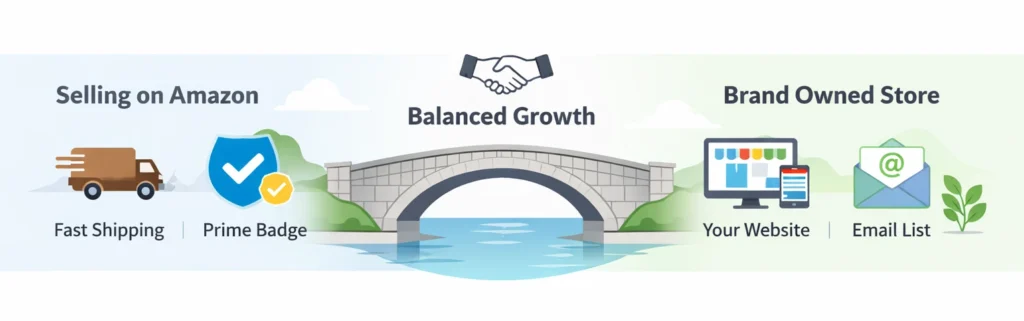
Still, you should not quit the amazon marketplace. Instead, you should stop treating it as your only home.
- Keep Amazon for search demand and trust.
- Use your own site for retention and bundles.
- Use outside traffic to lower total dependence.
That balance matters most in 2026. As a consequence, smart brands build both reach and control.
What sellers should do now
To clarify, you do not need a huge team. You need a clear order of moves.
1. Audit your catalog
Firstly, find products with steady reviews and good margins. Those items work best for wider expansion.
Next, check stock depth and shipping cost. You cannot scale if your core SKUs run thin.
2. Build a store that can convert
Secondly, fix your product pages before new traffic arrives. Add better photos, clear copy, and stronger proof.
For instance, show use cases, FAQs, and simple comparisons. That helps when buyers do not start inside the amazon marketplace.
3. Test Amazon powered fulfillment
Thirdly, review whether MCF fits your margins. Then test one small group of SKUs first.
You can start with the official page for fulfillment across multiple sales channels. Also, Amazon states MCF can fulfill in as fast as two days.
4. Add Buy with Prime where it helps
Additionally, use amazon buy with prime for items that need trust fast. This often works well for known hero products.
But do not force it on every SKU. Instead, test where the lift can cover the added cost.
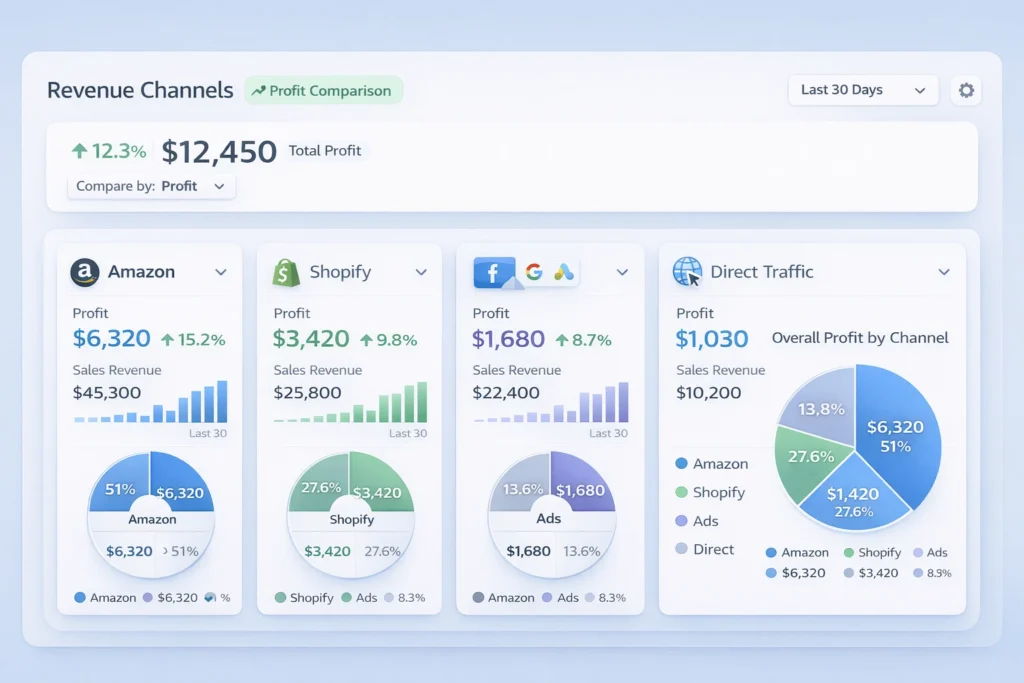
5. Track profit by channel
Most importantly, split reports by source. Otherwise, you will scale vanity sales and miss real profit.
Look at ad spend, refund rate, and repeat rate. Then compare each channel with Your Amazon marketplace results.
A simple plan for 2026
Above all, keep the plan simple. Complexity kills speed for small teams.
Phase one, fix the base
- Improve listing copy and images.
- Clean your PPC waste.
- Protect margin on core SKUs.
Phase two, expand one sales path
- Launch one strong product on Shopify.
- Test shopify amazon integration for operations.
- Send a small traffic batch to that page.
Phase three, widen the system
- Add bundles for your direct site.
- Collect email and SMS leads.
- Retarget visitors who do not buy first.
Finally, build process before scale. That means fewer surprises as orders rise.
In short, the best 2026 plan uses Amazon in two ways. It wins demand inside the amazon marketplace, and support outside sales too.
What good execution looks like
A strong brand ranks on Amazon and runs clean ads. Then it sends outside traffic to pages built to convert.
Meanwhile, the team watches profit by SKU and channel. Therefore, budget shifts follow real numbers.
- Pick one hero SKU.
- Build one strong landing page.
- Test one outside traffic source.
- Measure repeat buyers after thirty days.
Reference points from Amazon and Shopify
Amazon says its Shopify integration can sync orders, products, and returns in Shopify admin. It also says sellers can use the same Amazon inventory for Shopify orders.
Shopify says merchants in the United States can import and fulfill Shopify orders through the Amazon MCF and Buy with Prime app. It also outlines setup steps in Shopify admin.
Recent reporting also says Amazon has tested Prime shipping on outside sites without an Amazon login for some merchants. That points to an even wider push beyond the core amazon marketplace.
These points matter because they show direction, not hype. Amazon wants a bigger role in commerce infrastructure.
Frequently Asked Questions
Why is Amazon moving beyond its main store?
Amazon wants more order flow, more merchant ties, and more logistics volume. So it now supports sales outside its core store too. Does this mean Amazon Sellers need Shopify now?
No, but many sellers should test a brand site. That gives more control over repeat sales and customer data. What is amazon buy with prime in simple terms?
It adds Prime style delivery and checkout trust to your own site. As a result, some shoppers feel safer buying direct. Can brands use MCF if they do not sell on Amazon?
Yes. Amazon states MCF is open to businesses that do not sell on Amazon. Should I leave the amazon marketplace and focus only on my site?
No. Keep Amazon as a core channel. Then build your own site so you gain more control and reduce channel risk. What is the first step for private label brands?
Ready to grow your Amazon business?
Get a free strategy call with Advertpreneur.Book Your Free Consultation
Conclusion
The amazon marketplace still matters, but its role has changed. It now acts as a store, a trust layer, and a shipping engine.
Therefore, sellers who adapt early can win more control and better reach. They can keep Amazon strengths while building direct brand value.
To conclude, do not wait for the shift to become obvious. Build your amazon multi channel strategy now, test smart, and grow with intent.
Why amazon ppc costs Are Crushing Profits for Sellers in 2026
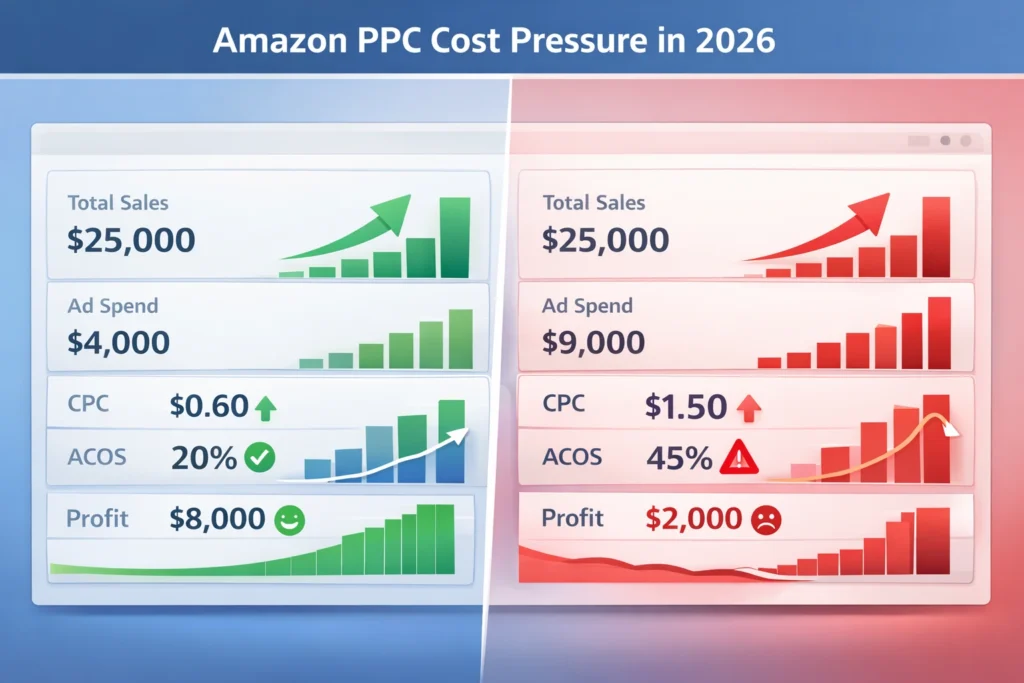
amazon ppc costs are rising fast in 2026. As a result, many sellers now struggle to stay profitable.
Firstly, ad competition keeps growing across every niche. Therefore, you must adapt your strategy or lose margins.
Table of Contents
- Why amazon ppc Costs Are Rising
- Impact on Profit Margins
- Common Seller Mistakes
- Winning amazon ads strategy 2026
- ppc optimization amazon Framework
- amazon ad bidding Explained
- FAQ
- Conclusion
Why amazon ppc Costs Are Rising
Firstly, more sellers enter Amazon every month. As a result, keyword bids rise quickly.
Secondly, brands invest heavily in ads to defend rankings. Therefore, small sellers feel pressure.
- More competition in every category
- Higher bid prices for main keywords
- Brands dominate top placements
In addition, retail media grows fast globally. That means Amazon pushes ads more aggressively.
For example, sponsored placements now fill most search results. Consequently, organic reach drops.
Meanwhile, many sellers share their struggles on real seller discussions on Reddit.
Warning: If you ignore rising CPC trends, your profits will shrink fast.
Impact on Profit Margins
Firstly, higher CPC means higher spend per sale. As a result, margins shrink quickly.
Secondly, many sellers chase revenue instead of profit. Therefore, they lose money without noticing.
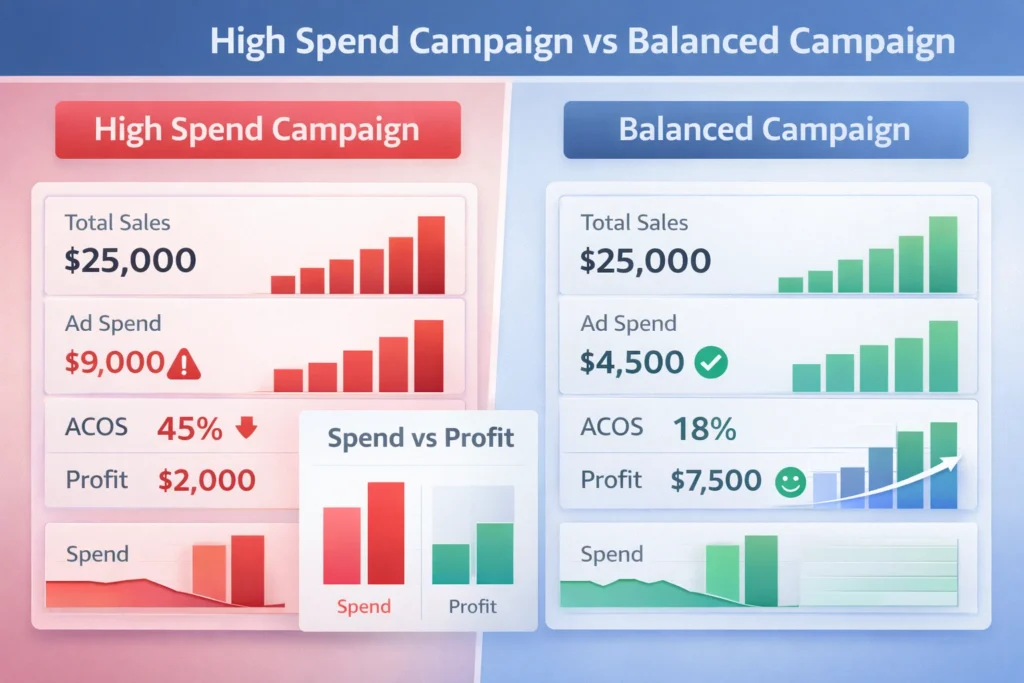
In fact, most sellers ignore true costs. That means they only track sales, not profit.
Similarly, rising fees add more pressure on margins. Consequently, ads become harder to justify.
| Metric | 2022 | 2026 |
|---|---|---|
| Average CPC | $0.75 | $1.40 |
| ACOS | 25% | 40% |
| Profit Margin | 20% | 8% |
Table: Rising PPC costs vs shrinking margins
Common Seller Mistakes
Firstly, sellers target broad keywords without control. As a result, spend increases fast.
Secondly, many ignore negative keywords completely. Therefore, waste keeps growing daily.
- No keyword segmentation
- Poor campaign structure
- Weak listing conversion
However, poor listings make ads expensive. That means low conversion leads to higher ACOS.
In contrast, strong listings reduce ad cost naturally. Consequently, better conversion lowers spend.
Pro Tip: Fix your listing before scaling ads. Conversion drives profit.
Winning amazon ads strategy 2026
Firstly, focus on intent based keywords only. As a result, you reduce wasted clicks.
Secondly, separate campaigns by match type clearly. Therefore, control improves.
- Exact match for profit keywords
- Phrase match for scaling
- Broad match for discovery
Additionally, test bids slowly instead of aggressively. That means better control over spend.
For instance, lowering bids slightly can protect margins. Consequently, efficiency improves.
To learn official guidance, check Amazon advertising platform insights.
ppc optimization amazon Framework
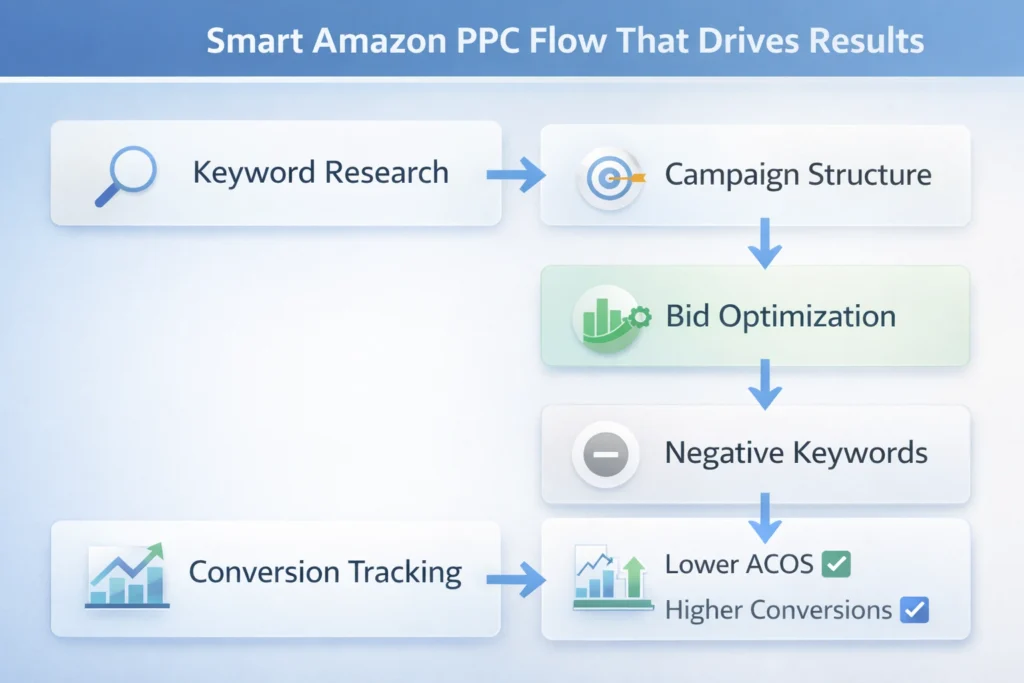
Firstly, review search term reports weekly. As a result, you find waste fast.
Secondly, move winning keywords into exact campaigns. Therefore, control increases.
- Identify high spend low conversion terms
- Add negative keywords quickly
- Increase bids on converting keywords
In addition, track TACOS not just ACOS. That means full business view improves decisions.
Meanwhile, focus on lowering acos amazon through better targeting. Consequently, profit grows.
Also, consider expert help from Amazon PPC specialists for faster results.
amazon ad bidding Explained
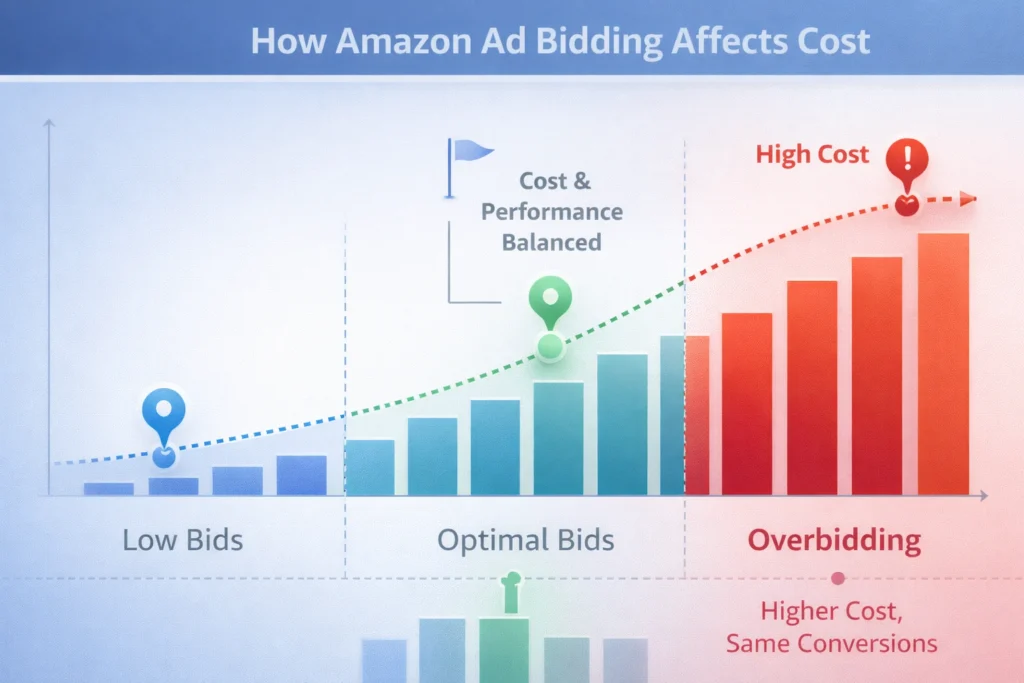
Firstly, Amazon uses auction based bidding system. As a result, higher bids win placements.
Secondly, bid strategy impacts cost directly. Therefore, control is critical.
- Dynamic bids up and down
- Fixed bids for stability
- Placement adjustments for visibility
However, many sellers overbid without reason. That means wasted budget increases.
In contrast, smart bidding improves efficiency. Consequently, results become predictable.
Frequently Asked Questions
Why is amazon ppc getting expensive?
Competition is increasing fast and more brands invest in ads. How can I reduce ACOS?
Focus on better targeting, strong listings, and proper keyword structure. Is PPC still worth it in 2026?
Yes, but only with strong strategy and strict cost control. What is the best bidding strategy?
Start with dynamic down and adjust based on performance data. Should beginners run ads?
Yes, but start small and test before scaling.
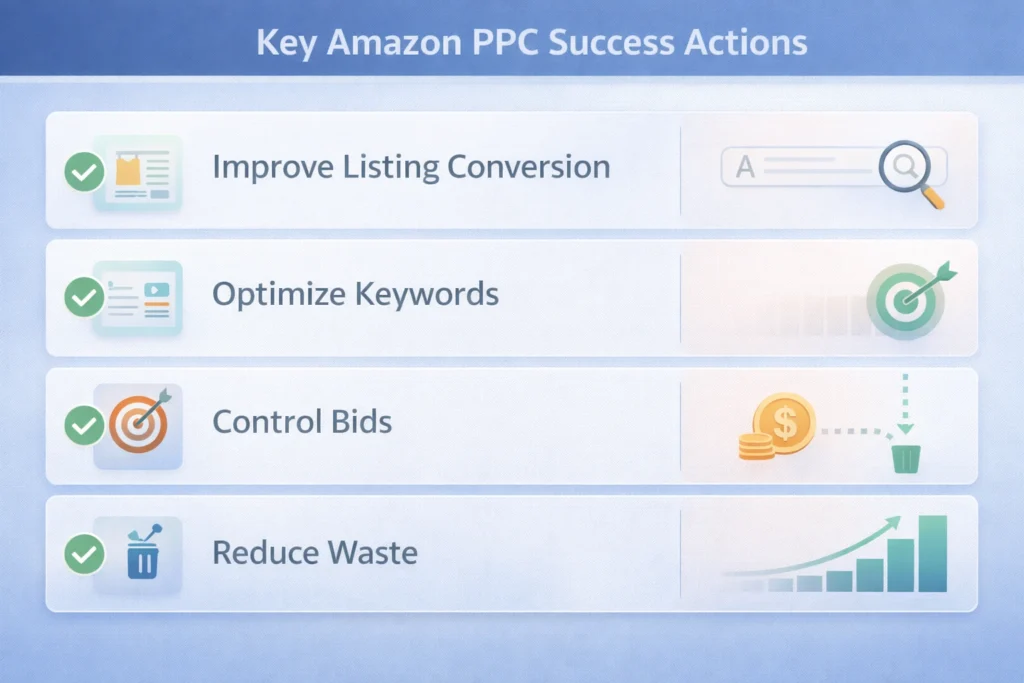
Conclusion
amazon ppc is no longer simple or cheap. As a result, strategy matters more than ever.
Firstly, you must focus on profit not just sales. Therefore, track every dollar carefully.
Secondly, smart optimization protects your margins. In short, better decisions drive growth.
Finally, sellers who adapt early will win. That means now is the time to act.
Ready to grow your Amazon business?
Get a free strategy call with Advertpreneur. Book Your Free Consultation
What is Amazon SEO?
Amazon SEO (Search Engine Optimization) is the process of optimizing product listings to rank higher in Amazon’s internal search results. When a shopper types a query into the Amazon search bar, Amazon’s A10 algorithm scans millions of listings and ranks them based on relevance, conversion history, and seller performance. Amazon SEO is the practice of aligning your listing with what the A10 algorithm rewards.
Amazon SEO is different from Google SEO. While Google optimizes for information, Amazon’s search engine optimizes for purchases. Every ranking signal Amazon weighs is tied to the likelihood that a listing will convert.
Why Amazon SEO Matters for US Sellers
More than 70% of Amazon shoppers never scroll past the first page of search results. For US sellers competing in crowded categories, appearing on page 1 is the difference between generating sales daily and going unnoticed. Amazon SEO is the organic, sustainable path to page 1 — without paying for every click.
How the Amazon A10 Algorithm Works
Amazon’s A10 algorithm (the successor to A9) ranks products based on several weighted signals:
- Click-Through Rate (CTR) — How often shoppers click your listing when it appears in search results. Your main image and title drive CTR.
- Conversion Rate (CVR) — The percentage of visitors who purchase. This is the most heavily weighted signal in A10.
- Sales Velocity — How many units you sell per day. Higher velocity signals demand and pushes rankings higher.
- Relevance — How closely your title, bullets, description, and backend keywords match the shopper’s query.
- Seller Authority — Your account health, review count, and feedback score.
- External Traffic — Traffic from outside Amazon (Google, social media) that converts on your listing now carries positive ranking weight in A10.
The 5 Core Elements of Amazon SEO
1. Keyword Research Keyword research is the foundation. Use tools like Helium 10’s Magnet or Jungle Scout’s Keyword Scout to identify high-volume, relevant search terms. Focus on: primary keywords (highest volume), secondary keywords (supporting terms), and long-tail keywords (lower competition, higher buyer intent).
2. Title Optimization Your Amazon product title is the most important SEO field. It should include your primary keyword within the first 80 characters, your brand name, key product attributes (size, color, material), and a conversion hook. Amazon allows up to 200 characters for most categories.
3. Bullet Points The five bullet points serve a dual purpose: keyword indexing for the algorithm and conversion copy for the shopper. Each bullet should start with a benefit keyword, not a feature. For example: “WATERPROOF PROTECTION: Sealed lining keeps contents dry in heavy rain” outperforms “Made from waterproof materials.”
4. Backend Search Terms The backend search term field (up to 250 bytes) is invisible to shoppers but indexed by Amazon. Include synonyms, alternate spellings, Spanish-language terms for US Hispanic buyers, and related search terms that didn’t fit in the visible copy.
5. A+ Content A+ Content (formerly Enhanced Brand Content) replaces the standard product description for Brand Registry members. It adds rich images, comparison charts, and brand storytelling. Amazon reports that A+ Content increases conversion rates by an average of 3-10%, and higher conversions directly improve organic rankings.
Amazon SEO vs Google SEO: Key Differences
| Factor | Amazon SEO | Google SEO |
|---|---|---|
| Primary goal | Purchase conversion | Information retrieval |
| Main ranking signal | Conversion rate + sales velocity | Backlinks + content authority |
| Timeframe for results | 2-6 weeks | 3-12 months |
| Keyword research tools | Helium 10, Jungle Scout, Brand Analytics | Ahrefs, Semrush, Google Keyword Planner |
| Content format | Titles, bullets, backend terms | Blog posts, pages, schema |
| External traffic impact | Positive (A10 rewards it) | Core requirement |
Common Amazon SEO Mistakes
- Keyword stuffing titles with commas and symbols (Amazon penalizes this)
- Ignoring the backend search terms entirely
- Writing bullets as feature lists instead of benefit-driven copy
- Using competitor brand names in backend terms (against Amazon TOS)
- Not updating listings when seasonal keywords shift
- Neglecting images — low CTR from poor images tanks SEO regardless of keyword quality
How Long Does Amazon SEO Take?
Most sellers see movement in rankings within 2-6 weeks of a full listing optimization. Sales velocity and conversion rate improvements are the fastest path to accelerated ranking. Pairing Amazon SEO with a PPC campaign during the initial launch period drives the sales velocity needed to push the algorithm faster.
FAQ: Amazon SEO
What is the difference between Amazon SEO and Amazon PPC? Amazon SEO improves your organic (unpaid) ranking through listing optimization. Amazon PPC (Pay-Per-Click) pays for ad placement in search results. They work best together: PPC drives immediate visibility and sales velocity while SEO builds sustainable long-term ranking.
Do I need Brand Registry for Amazon SEO? No — any seller can optimize titles, bullets, and backend keywords. However, Brand Registry unlocks A+ Content, which significantly improves conversion rates and supports SEO indirectly.
How many keywords should I target? Focus on 3-5 primary keywords for your title and bullets. Use your remaining keyword variations in the backend search terms. Quality and relevance matter more than quantity.
Can I hire an agency for Amazon SEO? Yes. A specialized Amazon SEO agency like advertpreneur conducts keyword research, writes optimized listings, and monitors ranking changes on your behalf. Get a free consultation here.
Amazon PPC Basics: Simple Guide for Beginners
Starting with Amazon PPC can feel overwhelming. However, understanding the basics makes everything easier. Therefore, this guide breaks down Amazon PPC basics in simple terms. Additionally, you’ll learn how to set up your first campaign successfully.
!Amazon PPC dashboard showing campaign setup interface
What is Amazon PPC?
Amazon PPC stands for Pay-Per-Click advertising. Essentially, you pay Amazon when someone clicks your ad. Meanwhile, your product appears in search results. Consequently, customers see your listing. If they click, you pay a small fee. Therefore, this is how Amazon PPC basics work.
Why Use Amazon PPC?
First, Amazon PPC increases visibility. Specifically, your products show up at the top of search results. Second, it drives sales quickly. Unlike organic ranking, results come fast. Third, you learn what works. Moreover, Amazon PPC provides valuable data about your customers. Finally, it’s scalable. Therefore, you can increase or decrease spending anytime.
Understanding Amazon PPC Campaign Types
Amazon offers three main campaign types. Additionally, each serves a different purpose. Therefore, understanding these Amazon PPC basics helps you choose wisely.
Automatic Campaigns
Automatic campaigns are perfect for beginners. Specifically, Amazon does the work for you. Meanwhile, the system matches your product to relevant searches. Therefore, you simply set a daily budget. Then, Amazon finds customers automatically. Consequently, this is the easiest way to start with Amazon PPC basics.
When to Use Automatic Campaigns:
- You’re new to Amazon PPC
- You want to discover keywords
- You need quick setup
- You’re testing a new product
Manual Campaigns
Manual campaigns give you full control. Specifically, you choose every keyword yourself. Additionally, you set individual bids. Moreover, you decide when ads show. However, this requires more work but offers better results. Therefore, mastering manual campaigns is essential for Amazon PPC success.
When to Use Manual Campaigns:
- You know your best keywords
- You want precise control
- You’re ready to optimize
- You have campaign experience
Product Targeting Campaigns
Product targeting shows ads on specific product pages. For example, you target competitor listings. Additionally, you target complementary products. Therefore, this advanced strategy captures ready-to-buy customers. However, it’s powerful but requires careful setup.
Setting Up Your First Amazon PPC Campaign
Follow these steps to create your first campaign. Therefore, this Amazon PPC basics guide makes it simple.
Step 1: Choose Your Campaign Type
Start with an automatic campaign. Specifically, it’s the easiest option for beginners. Later, you can add manual campaigns. For now, focus on learning Amazon PPC basics.
Step 2: Set Your Daily Budget
Begin with $10-20 per day. This gives you enough data without overspending. Additionally, you can increase it later. Remember, you only pay when someone clicks.
Step 3: Select Your Products
Choose 3-5 products to start. Specifically, pick your best sellers. These products already convert well. Therefore, they’ll perform better in Amazon PPC campaigns.
Step 4: Set Your Default Bid
Use Amazon’s suggested bid as a starting point. However, don’t bid too low. Low bids mean fewer impressions. Therefore, start with the suggested amount. Then, adjust based on performance.
Step 5: Launch and Monitor
Launch your campaign. Then, check it daily for the first week. Meanwhile, watch for clicks and sales. Additionally, look for any issues. Make small adjustments as needed.
Understanding Amazon PPC Metrics
Learning these metrics is crucial for Amazon PPC basics. Specifically, they tell you how your campaigns perform.
Impressions
Impressions show how many times your ad appeared. High impressions mean good visibility. However, low impressions suggest your bids are too low. Therefore, aim for consistent impressions.
Clicks
Clicks show customer interest. Specifically, people see your ad and click it. More clicks mean more traffic. However, clicks alone don’t guarantee sales.
Click-Through Rate (CTR)
CTR is clicks divided by impressions. A good CTR is 0.5% or higher. Additionally, higher CTR means better ad relevance. Therefore, improve your listing to increase CTR.
Conversion Rate
Conversion rate shows sales per click. A 5% conversion rate is good. Moreover, higher rates mean better product listings. Therefore, optimize your listing to improve conversions.
ACoS (Advertising Cost of Sale)
ACoS is your advertising cost divided by sales. Lower ACoS is better. Specifically, aim for 15-25% ACoS. This means you’re profitable. However, higher ACoS needs optimization.
ROAS (Return on Ad Spend)
ROAS shows revenue per dollar spent. For example, a 4:1 ROAS means $4 revenue for every $1 spent. Higher ROAS is always better. Therefore, track this metric closely.
Common Amazon PPC Mistakes to Avoid
Avoiding these mistakes saves money and time. Therefore, these Amazon PPC basics help you succeed faster.
Mistake 1: Setting and Forgetting
Many sellers create campaigns and ignore them. This wastes money. Instead, check campaigns weekly. Additionally, make adjustments regularly. Consequently, active management improves results.
Mistake 2: Bidding Too Low
Low bids seem safe but hurt performance. Specifically, your ads won’t show often. Therefore, you’ll get little data. Start with suggested bids. Then, increase for better visibility.
Mistake 3: Ignoring Search Terms
Search term reports reveal customer behavior. Specifically, they show what people actually search. Therefore, review these reports weekly. Additionally, use insights to improve campaigns.
Mistake 4: Not Using Negative Keywords
Negative keywords block irrelevant searches. Without them, you waste money. Therefore, add negatives from search term reports. Specifically, block terms that don’t convert.
Amazon PPC Optimization Tips
These tips improve your campaigns quickly. Therefore, apply them to see better results.
Tip 1: Start Small, Scale Gradually
Begin with a small budget. Then, learn how campaigns work. Once profitable, increase spending. However, scaling too fast wastes money.
Tip 2: Focus on Profitable Keywords
Identify keywords that convert well. Then, increase bids on these terms. Additionally, pause keywords with zero sales. Therefore, focus budget on winners.
Tip 3: Optimize Your Product Listing
Better listings convert more clicks. Specifically, improve your title and images. Additionally, write compelling bullet points. Consequently, higher conversions lower ACoS.
Tip 4: Test Different Bids
Experiment with bid amounts. For example, try increasing bids 20%. Then, monitor results. Adjust based on performance. Therefore, find the sweet spot.
Creating Your First Manual Campaign
Once comfortable with automatic campaigns, try manual campaigns. Therefore, this advanced step improves control.
Choose Your Keywords
Select 10-20 relevant keywords. Specifically, use Amazon’s keyword suggestions. Additionally, include your main product terms. Moreover, add related search terms.
Set Match Types
Start with exact match. Specifically, it’s most precise. Later, add phrase and broad match. However, each match type serves different purposes.
Set Individual Bids
Bid higher on important keywords. Meanwhile, lower bids on test keywords. Then, monitor performance closely. Adjust bids based on results.
Monitor and Optimize
Check performance daily initially. Additionally, pause non-performing keywords. Then, increase bids on winners. Therefore, continuously refine your approach.
When to Increase Your Amazon PPC Budget
Increase budget when campaigns are profitable. Specifically, look for these signs:
- ACoS is below your target
- Campaigns are generating sales
- You have room to scale
- Keywords are performing well
Increase budget gradually. However, don’t double it overnight. Instead, add 20-30% weekly. Then, monitor results carefully.
Amazon PPC Best Practices
Follow these practices for better results. Specifically, they’re essential Amazon PPC basics.
Practice 1: Regular Monitoring
Check campaigns at least weekly. Additionally, review metrics. Then, look for trends. Therefore, make data-driven decisions.
Practice 2: Continuous Testing
Test new keywords regularly. Meanwhile, try different bid amounts. Additionally, experiment with match types. Consequently, learning never stops.
Practice 3: Focus on Profitability
Don’t chase sales volume alone. Instead, focus on profitable campaigns. Specifically, lower ACoS means better margins. Therefore, profitability matters most.
Practice 4: Use Data to Decide
Base decisions on data, not guesses. Specifically, review reports carefully. Then, look for patterns. Therefore, let numbers guide you.
Tools to Help with Amazon PPC
Several tools make Amazon PPC easier. They help with optimization and management.
Amazon’s Built-In Tools
- Campaign Manager: Create and manage campaigns
- Search Term Reports: Find new keywords
- Performance Reports: Track metrics
- Bid+ Feature: Automatic bid increases
Third-Party Tools
- Helium 10: Keyword research and management
- Jungle Scout: Market research
- Sellics: Comprehensive PPC management
- AMZScout: Campaign optimization
Common Questions About Amazon PPC Basics
How much should I spend on Amazon PPC?
Start with $10-20 daily per campaign. Then, increase as you see results. However, there’s no set amount. Therefore, spend what you can afford to test.
How long until I see results?
Most campaigns show results within 1-2 weeks. However, optimization takes longer. Therefore, give campaigns 4-6 weeks to stabilize.
What’s a good ACoS?
Target 15-25% ACoS for most products. Specifically, lower is better. However, higher means you need optimization. Therefore, adjust based on your profit margins.
Should I use automatic or manual campaigns?
Start with automatic campaigns. Specifically, they’re easier for beginners. Once comfortable, add manual campaigns. Therefore, use both for best results.
Next Steps After Learning Amazon PPC Basics
Now that you understand Amazon PPC basics, take action. Specifically, create your first campaign today. Start small. Then, learn as you go. Additionally, optimize continuously. Therefore, success comes with practice.
Remember, every expert was once a beginner. However, don’t expect perfection immediately. Keep learning. Meanwhile, keep testing. Moreover, keep improving. Consequently, your Amazon PPC skills will grow over time.
Conclusion
Amazon PPC basics aren’t complicated once you understand them. Start with automatic campaigns. Then, learn the metrics. Additionally, avoid common mistakes. Moreover, optimize regularly. Therefore, with practice, you’ll master Amazon PPC and grow your sales.
The key is to begin. However, don’t wait for perfect knowledge. Instead, start your first campaign. Then, learn from experience. Additionally, adjust as you go. Therefore, success in Amazon PPC comes from taking action and learning continuously.
Need help with Amazon PPC? Contact advertpreneur for expert Amazon PPC management. We help beginners and experienced sellers optimize campaigns for better results.
Related Resources
- → 7 Amazon Sponsored Products Strategies That Lower ACoS by 40%
- → Amazon Listing Optimization: 15 Ways to Improve Your Product Listings
- → Complete Guide to Amazon SEO: How to Rank Your Products on Page 1 in 2025
- → Amazon A+ Content: How to Create Conversion-Optimized Enhanced Brand Content
- → Amazon Keyword Research: The Ultimate Guide to Finding Profitable Keywords
- → Amazon Product Title Optimization: How to Write Titles That Rank and Convert
7 amazon Sponsored Products Strategies That Lower ACoS by 40%
Amazon Sponsored Products campaigns can transform your sales, but only if optimized correctly. This guide reveals 7 proven Amazon Sponsored Products strategies that have helped sellers reduce ACoS by 40% while scaling revenue.
!Amazon Sponsored Products optimization dashboard showing campaign performance metrics
What Are Amazon Sponsored Products?
Amazon Sponsored Products are pay-per-click (PPC) ads that appear in Amazon search results and on product detail pages. These Amazon Sponsored Products ads help sellers increase visibility and drive sales through targeted advertising. When customers click your Amazon Sponsored Products ad, you pay a bid amount, making optimization crucial for profitability.
Why Sponsored Products Matter
- Increased Visibility: Products appear in top search results
- Higher Conversion Rates: Targeted ads convert better than organic listings
- Scalable Growth: Increase sales without waiting for organic rankings
- Data Insights: Learn which keywords drive sales
Table of Contents
- What Are Amazon Sponsored Products?
- Strategy 1: Start with Automatic Campaigns
- Strategy 2: Use Exact Match for High-Intent Keywords
- Strategy 3: Implement Negative Keywords
- Strategy 4: Optimize Bids Based on Time
- Strategy 5: Create Product-Specific Ad Groups
- Strategy 6: Leverage Product Targeting
- Strategy 7: Continuously Test and Optimize
Strategy 1: Start with Automatic Campaigns for Keyword Discovery
Automatic campaigns are your secret weapon for finding profitable keywords. Amazon’s algorithm automatically matches your products to relevant searches, revealing opportunities you might miss.
How Automatic Campaigns Work
Amazon uses three targeting methods:
- Close Match: Exact or close variations of your product
- Loose Match: Related searches and synonyms
- Substitutes: Alternative products customers consider
- Complements: Products bought together
Best Practices
- Run for 2-4 Weeks: Collect enough data (at least 1,000 impressions)
- Monitor Search Terms: Export search term reports weekly
- Extract Winners: Move high-performing keywords to manual campaigns
- Add Negatives: Block irrelevant terms immediately
Real Example
A seller running automatic campaigns discovered “wireless earbuds for gym” was converting at 8% with $0.45 CPC. They moved this to a manual campaign and scaled it to $5,000 monthly sales.
Strategy 2: Use Exact Match for High-Intent Keywords
Exact match targeting in Amazon Sponsored Products gives you complete control over when your ads appear. Use it for Amazon Sponsored Products keywords with proven conversion history.
When to Use Exact Match
- High-Converting Keywords: Terms that already convert well
- Branded Searches: Your brand name and product names
- Specific Products: Exact product model numbers
- Competitor Names: When customers search competitor brands
Exact Match Best Practices
- Start with High Bids: Bid 20-30% above suggested bid
- Monitor Closely: Check performance daily for first week
- Scale Winners: Increase budget on profitable keywords
- Pause Losers: Stop spending on keywords with 0 sales after 7 days
Strategy 3: Implement Negative Keywords Strategically
Negative keywords prevent wasted ad spend in Amazon Sponsored Products campaigns. This is one of the most overlooked Amazon Sponsored Products optimization strategies.
Finding Negative Keywords
- Search Term Reports: Export weekly and analyze
- High Spend, Zero Sales: These are your negative candidates
- Irrelevant Terms: Block terms that don’t match your product
- Competitor Brands: If you don’t sell competitor products
Negative Keyword Examples
For premium headphones ($200+):
- “cheap headphones”
- “budget headphones”
- “under $50”
- “free shipping headphones”
Implementation
Add negatives at both campaign and ad group levels:
- Campaign Level: Block terms irrelevant to entire campaign
- Ad Group Level: Block terms specific to product type
Strategy 4: Optimize Bids Based on Time of Day and Day of Week
Bid adjustments in Amazon Sponsored Products can significantly improve efficiency. Amazon allows bid modifiers for different times and days in your Amazon Sponsored Products campaigns.
Time-Based Optimization
Analyze your conversion data to identify peak performance times:
- Morning Hours: Often higher conversion for B2B products
- Evening Hours: Better for consumer products
- Weekends: May have different patterns than weekdays
How to Implement
- Export Performance Data: Get hourly and daily reports
- Identify Patterns: Find when conversions are highest
- Adjust Bids: Increase bids 20-30% during peak times
- Decrease Off-Peak: Lower bids 10-20% during slow periods
Example Bid Schedule
- Monday-Friday, 6 PM – 10 PM: +25% bid adjustment
- Saturday-Sunday, 10 AM – 2 PM: +20% bid adjustment
- Weekdays, 2 AM – 6 AM: -15% bid adjustment
Strategy 5: Create Product-Specific Ad Groups
Grouping similar products in dedicated Amazon Sponsored Products ad groups improves relevance and conversion rates for your Amazon Sponsored Products campaigns.
Ad Group Structure
Create separate ad groups for:
- Product Categories: Different product types
- Price Ranges: Budget vs. premium products
- Use Cases: Different customer needs
- Brands: If selling multiple brands
Benefits
- Better Relevance: Ads match customer intent more closely
- Easier Management: Optimize each group independently
- Improved Quality Score: Higher relevance = lower CPC
- Better Data: Clearer performance insights
Strategy 6: Leverage Product Targeting for Competitor Conquest
Amazon Sponsored Products product targeting lets you show ads on competitor product pages, capturing customers ready to buy. This advanced Amazon Sponsored Products feature helps you compete effectively.
Product Targeting Strategies
- Competitor Products: Target top-selling competitor listings
- Complementary Products: Products bought together
- Substitute Products: Alternative solutions
- Your Own Products: Cross-sell related items
Best Practices
- Target High-Review Products: Products with 100+ reviews
- Monitor Performance: Track which competitor pages convert
- Adjust Bids: Higher bids for high-converting pages
- Add Negatives: Block pages that don’t convert
Strategy 7: Continuously Test and Optimize
Amazon Sponsored Products optimization is ongoing. Regular testing and adjustments are essential for maintaining low ACoS in your Amazon Sponsored Products campaigns.
Weekly Optimization Checklist
Monthly Deep Dive
Common Amazon Sponsored Products Mistakes
Mistake 1: Setting and Forgetting
Many sellers create campaigns and never optimize them. Regular monitoring and adjustments are crucial for success.
Solution: Schedule weekly optimization sessions. Set calendar reminders to review performance.
Mistake 2: Ignoring Search Term Reports
Search term reports reveal what customers actually search for. Ignoring them means missing optimization opportunities.
Solution: Export search term reports weekly. Analyze and take action on findings.
Mistake 3: Bidding Too Low
Low bids mean your ads rarely show, limiting data collection and sales opportunities.
Solution: Start with suggested bids, then adjust based on performance. Don’t be afraid to bid higher for proven keywords.
Mistake 4: Not Using Negative Keywords
Without negative keywords, you’ll waste budget on irrelevant clicks that never convert.
Solution: Build negative keyword lists from search term reports. Add them proactively based on product knowledge.
Measuring Success: Key Metrics
Primary Metrics
- ACoS (Advertising Cost of Sale): Target 15-25% for most products
- ROAS (Return on Ad Spend): Aim for 4:1 or higher
- Conversion Rate: Track and improve over time
- Click-Through Rate (CTR): Higher CTR = better ad relevance
Secondary Metrics
- Impressions: Ensure adequate visibility
- Clicks: Monitor click volume trends
- Spend: Track daily and monthly budgets
- Sales: Total revenue from ads
Tools for Amazon Sponsored Products Management
Amazon Native Tools
- Campaign Manager: Built-in campaign management
- Search Term Reports: Keyword discovery
- Performance Reports: Detailed analytics
- Bid+: Automatic bid increases for top placements
Third-Party Tools
- Helium 10: Keyword research and campaign management
- Jungle Scout: Market research and optimization
- Sellics: Comprehensive PPC management
- PPC Entourage: Advanced campaign optimization
Advanced Tips for Lower ACoS
Tip 1: Use Broad Match for Discovery
Broad match helps find new keyword opportunities. Use it alongside exact and phrase match for comprehensive coverage.
Tip 2: Implement Dayparting
Adjust bids based on time of day when your customers are most active. This can reduce wasted spend during low-conversion periods.
Tip 3: Leverage Seasonal Trends
Increase bids and budgets during peak seasons (holidays, Prime Day, etc.) when conversion rates are typically higher.
Tip 4: A/B Test Ad Copy
Test different product images and titles in your listings to see which combinations drive better ad performance.
Real Success Story
A seller implementing these 7 strategies reduced their ACoS from 45% to 27% in 8 weeks while increasing ad sales by 60%. Key changes included:
- Systematic negative keyword management
- Time-based bid adjustments
- Product targeting on competitor pages
- Weekly optimization routine
Conclusion
Amazon Sponsored Products success requires strategy, not just spending. By implementing these 7 proven Amazon Sponsored Products strategies—starting with automatic campaigns, using exact match effectively, managing negative keywords, optimizing bids, creating proper ad groups, leveraging product targeting, and continuous testing—you can significantly reduce ACoS while scaling sales.
Remember, Amazon Sponsored Products optimization is an ongoing process. What works today may need adjustment tomorrow. Stay active, monitor your Amazon Sponsored Products performance, and continuously refine your approach to maximize ROI from your Amazon Sponsored Products campaigns.
Ready to optimize your Amazon Sponsored Products campaigns? Contact advertpreneur for expert Amazon PPC management services. We help sellers reduce ACoS, improve ROI, and scale profitable advertising campaigns.
Related Resources
- → Amazon PPC Basics: Simple Guide for Beginners
- → Amazon Listing Optimization: 15 Ways to Improve Your Product Listings
- → Complete Guide to Amazon SEO: How to Rank Your Products on Page 1 in 2025
- → Amazon A+ Content: How to Create Conversion-Optimized Enhanced Brand Content
- → Amazon Keyword Research: The Ultimate Guide to Finding Profitable Keywords
- → Amazon Product Title Optimization: How to Write Titles That Rank and Convert
Introduction
One of the most common questions Amazon sellers ask is: “Should I use Automatic or Manual PPC campaigns?”
The answer isn’t simple—both campaign types serve different purposes and work best when used together strategically. Understanding when and how to use each type is crucial for Amazon PPC success.
The truth: Most successful Amazon sellers use both Automatic and Manual campaigns in a coordinated strategy. Automatic campaigns discover keywords, while Manual campaigns scale profitable ones.
In this comprehensive guide, we’ll break down Automatic vs Manual campaigns, show you when to use each, and teach you how to create a winning campaign strategy that maximizes ROI.
What Are Amazon Automatic Campaigns?
Definition:
Amazon Automatic campaigns let Amazon’s algorithm automatically target your ads based on your product listing. You don’t choose keywords—Amazon does it for you.
How Automatic Campaigns Work:
- Amazon analyzes your listing:
- Product title
- Bullet points
- Product description
- Backend keywords
- Product category
- Amazon matches to searches:
- Related customer searches
- Similar product searches
- Category-based matching
- Algorithm-driven targeting
- You control:
- Daily budget
- Default bid
- Campaign name
- That’s it!
Automatic Campaign Features:
- No keyword management – Amazon handles targeting
- Broad reach – Targets many search variations
- Easy setup – Just set budget and bid
- Discovery focused – Finds keywords you’d never think of
- Low maintenance – Minimal ongoing management
What Are Amazon Manual Campaigns?
Definition:
Amazon Manual campaigns give you complete control. You choose exact keywords, set individual bids, and control match types.
How Manual Campaigns Work:
- You choose keywords:
- Specific search terms
- Based on research
- From Automatic campaigns
- Competitor analysis
- You set bids:
- Per keyword bids
- Bid adjustments
- Match type control
- Precise targeting
- You control everything:
- Which keywords to target
- How much to bid
- Match type (Broad, Phrase, Exact)
- Negative keywords
Manual Campaign Features:
- Full control – Choose every keyword
- Precise targeting – Exact search terms
- Bid optimization – Per-keyword bids
- Match type control – Broad, Phrase, Exact
- Higher maintenance – Requires ongoing optimization
Automatic vs Manual: Key Differences
Control Level:
| Aspect | Automatic | Manual |
|---|---|---|
| Keyword Selection | Amazon chooses | You choose |
| Bid Control | One default bid | Per-keyword bids |
| Match Types | Not applicable | Broad/Phrase/Exact |
| Negative Keywords | Limited | Full control |
| Optimization | Minimal | Extensive |
Use Cases:
| Scenario | Automatic | Manual |
|---|---|---|
| New Product | ✓ Best | ✗ Limited data |
| Keyword Discovery | ✓ Excellent | ✗ Need keywords first |
| Scaling Winners | ✗ Less control | ✓ Best |
| Precise Targeting | ✗ Broad reach | ✓ Best |
| Low Maintenance | ✓ Set and go | ✗ Requires work |
Performance Characteristics:
| Metric | Automatic | Manual |
|---|---|---|
| Reach | Wider | Narrower |
| Precision | Lower | Higher |
| ACoS | Often higher | Often lower |
| Volume | Can be high | More controlled |
| Efficiency | Lower | Higher |
When to Use Automatic Campaigns
Best For:
1. New Products
Why:
- No keyword data yet
- Amazon finds relevant searches
- Discovers long-tail opportunities
- Low effort, high value
Strategy:
- Start with Automatic
- Run for 1-2 weeks
- Extract search terms
- Move winners to Manual
2. Keyword Discovery
Why:
- Finds keywords you’d never think of
- Discovers search variations
- Identifies long-tail opportunities
- Reveals customer language
Strategy:
- Run Automatic continuously
- Weekly search terms review
- Harvest converting terms
- Add to Manual campaigns
3. Low Competition Niches
Why:
- Less need for precise control
- Amazon’s algorithm works well
- Lower maintenance required
- Good for testing
Strategy:
- Use Automatic as primary
- Monitor performance
- Optimize bids
- Add Manual for top keywords
4. Limited Time/Resources
Why:
- Minimal setup required
- Low maintenance
- Amazon handles optimization
- Good starting point
Strategy:
- Start with Automatic
- Learn from data
- Gradually add Manual
- Scale what works
When to Use Manual Campaigns
Best For:
1. Scaling Profitable Keywords
Why:
- Precise bid control
- Better ACoS management
- Optimize per keyword
- Maximum efficiency
Strategy:
- Move winners from Automatic
- Set optimal bids
- Use Exact Match
- Scale budget
2. High Competition Keywords
Why:
- Need precise control
- Competitive bidding required
- Strategic bid management
- Better ROI potential
Strategy:
- Manual campaigns only
- Exact Match for control
- Aggressive bidding
- Continuous optimization
3. Brand and Competitor Campaigns
Why:
- Specific keyword targeting
- Brand name protection
- Competitor targeting
- Strategic positioning
Strategy:
- Separate Manual campaigns
- Brand keywords: Lower bids
- Competitor keywords: Higher bids
- Monitor closely
4. Advanced Optimization
Why:
- Per-keyword optimization
- Match type testing
- Negative keyword control
- Maximum efficiency
Strategy:
- Full Manual setup
- Extensive optimization
- Daily monitoring
- Data-driven decisions
The Hybrid Strategy: Best of Both Worlds
Recommended Approach:
Use Both Together Strategically
Phase 1: Discovery (Weeks 1-2)
- Automatic Campaigns: Primary
- Budget: 60-70% of total
- Let Amazon find keywords
- Extract search terms weekly
- Manual Campaigns: Secondary
- Budget: 30-40% of total
- Known high-value keywords
- Brand and competitor terms
Phase 2: Optimization (Weeks 3-4)
- Automatic Campaigns: Continue
- Ongoing discovery
- Lower budget: 40-50%
- Focus on new keywords
- Manual Campaigns: Scale
- Higher budget: 50-60%
- Winners from Automatic
- Optimize bids and match types
Phase 3: Scaling (Weeks 5+)
- Automatic Campaigns: Maintenance
- 20-30% of budget
- Continuous discovery
- Harvest new opportunities
- Manual Campaigns: Primary
- 70-80% of budget
- Scaling profitable keywords
- Maximum efficiency
How to Set Up Automatic Campaigns
Step 1: Campaign Creation
- Go to Seller Central → Advertising → Campaign Manager
- Click “Create Campaign”
- Choose “Sponsored Products”
- Select “Automatic targeting”
- Name your campaign (e.g., “Auto – Discovery”)
Step 2: Campaign Settings
Settings:
- Campaign Name: Descriptive (e.g., “Auto – [Product Name]”)
- Daily Budget: Start with 10-15% of target revenue
- Start Date: Immediate or scheduled
- End Date: None (ongoing)
Step 3: Ad Group Setup
Ad Group:
- Name: Match campaign or product-specific
- Default Bid: Start conservative (e.g., $0.50-1.00)
- Products: Select products to advertise
Step 4: Launch and Monitor
After Launch:
- Let run for 1-2 weeks
- Don’t make changes too quickly
- Collect data first
- Then optimize
How to Set Up Manual Campaigns
Step 1: Campaign Creation
- Go to Seller Central → Advertising → Campaign Manager
- Click “Create Campaign”
- Choose “Sponsored Products”
- Select “Manual targeting”
- Name your campaign (e.g., “Manual – Brand Keywords”)
Step 2: Campaign Settings
Settings:
- Campaign Name: Descriptive by goal
- Daily Budget: Based on strategy
- Start Date: Immediate
- End Date: None
Step 3: Ad Group and Keywords
Ad Group Setup:
- Name: Match keyword theme
- Default Bid: Starting bid for keywords
- Products: Select products
Add Keywords:
- Research-based keywords
- From Automatic campaigns
- Competitor keywords
- Brand terms
Step 4: Match Types
Choose Match Types:
- Broad Match: Discovery, high volume
- Phrase Match: Balanced
- Exact Match: Precise, converting
Strategy:
- Start with Exact Match
- Add Phrase for testing
- Use Broad for discovery
Step 5: Bid Management
Set Bids:
- New keywords: Start conservative
- From Automatic: Based on performance
- Brand keywords: Lower bids
- Competitor keywords: Higher bids
Optimizing Automatic Campaigns
Optimization Strategies:
1. Bid Optimization
- High ACoS: Lower default bid
- Low ACoS: Raise default bid
- Test adjustments: Small changes
- Monitor impact: Weekly review
2. Search Terms Analysis
- Export weekly: Search Terms Report
- Identify winners: Converting terms
- Find losers: High-ACoS terms
- Harvest keywords: Move to Manual
3. Negative Keywords
- Add irrelevant terms: Prevent wasted clicks
- High-ACoS searches: Exclude non-converting
- Regular review: Weekly updates
- Save money: Reduce wasted spend
4. Budget Allocation
- Winners: Increase budget
- Losers: Decrease or pause
- Test new products: Allocate budget
- Scale what works: Focus on profitable
Optimizing Manual Campaigns
Optimization Strategies:
1. Keyword Performance Analysis
- Track per keyword: ACoS, conversions
- Pause losers: High ACoS, no sales
- Scale winners: Low ACoS, high sales
- Test new keywords: Regular additions
2. Bid Optimization
- Per-keyword bids: Individual optimization
- High performers: Raise bids 10-20%
- Low performers: Lower bids 20-30%
- Break-even: Test adjustments
3. Match Type Strategy
- Exact Match: Converting keywords
- Phrase Match: Testing new terms
- Broad Match: Discovery only
- Optimize based on performance
4. Negative Keywords
- Full control: Exclude irrelevant searches
- Regular updates: Weekly review
- Save money: Prevent wasted clicks
- Improve ACoS: Better targeting
Automatic vs Manual: Performance Comparison
Typical Performance:
Automatic Campaigns:
- ACoS: 25-35% (often higher)
- Volume: High (broad reach)
- Efficiency: Lower (less control)
- Maintenance: Low
Manual Campaigns:
- ACoS: 20-30% (often lower)
- Volume: Moderate (precise targeting)
- Efficiency: Higher (more control)
- Maintenance: High
Why Manual Often Has Lower ACoS:
- Precise targeting – Only relevant searches
- Bid control – Optimize per keyword
- Negative keywords – Exclude irrelevant
- Match type control – Exact = better conversion
Why Automatic Can Be Valuable:
- Keyword discovery – Finds opportunities
- Low maintenance – Set and monitor
- Broad reach – More visibility
- Time savings – Less management
Common Mistakes to Avoid
Automatic Campaign Mistakes:
- Set and Forget
- ❌ Create and never optimize
- ✅ Weekly search terms review
- Ignoring Search Terms Report
- ❌ Not harvesting keywords
- ✅ Extract winners weekly
- Too High Default Bid
- ❌ Max bid on everything
- ✅ Start conservative, adjust
- No Negative Keywords
- ❌ Wasting money on irrelevant clicks
- ✅ Regular negative keyword updates
Manual Campaign Mistakes:
- Starting with Manual Only
- ❌ Missing keyword opportunities
- ✅ Start Automatic, add Manual
- Too Many Keywords
- ❌ 100+ keywords per campaign
- ✅ Focus on 20-30 high-value keywords
- Same Bid for All Keywords
- ❌ No bid optimization
- ✅ Optimize per keyword
- Ignoring Match Types
- ❌ Only using one match type
- ✅ Test all three, optimize
Which Should You Use? Decision Framework
Use Automatic If:
- ✅ New product with no keyword data
- ✅ Want keyword discovery
- ✅ Limited time for management
- ✅ Low competition niche
- ✅ Testing new products
Use Manual If:
- ✅ Have keyword data from Automatic
- ✅ Want precise control
- ✅ High competition keywords
- ✅ Scaling profitable terms
- ✅ Brand/competitor campaigns
Use Both If:
- ✅ Want maximum results (recommended)
- ✅ Have time for optimization
- ✅ Serious about PPC success
- ✅ Multiple products
- ✅ Scaling business
Conclusion: Use Both Strategically
The Automatic vs Manual debate misses the point: You should use both strategically. Automatic campaigns discover keywords, while Manual campaigns scale profitable ones.
Recommended Strategy:
- Start with Automatic – Discover keywords
- Harvest winners – Move to Manual
- Scale Manual – Focus budget on profitable
- Keep Automatic – Continuous discovery
- Optimize both – Regular improvements
Remember: Automatic and Manual aren’t competitors—they’re teammates. Use Automatic for discovery, Manual for scaling, and both for maximum Amazon PPC success.
Need Help with Amazon PPC Campaign Strategy?
Our Amazon PPC management service creates and optimizes both Automatic and Manual campaigns. We’ll discover profitable keywords, scale winners, and manage your campaigns for maximum ROI.
Related Resources
- → Amazon PPC Basics: Simple Guide for Beginners
- → 7 Amazon Sponsored Products Strategies That Lower ACoS by 40%
- → Amazon Listing Optimization: 15 Ways to Improve Your Product Listings
- → Complete Guide to Amazon SEO: How to Rank Your Products on Page 1 in 2025
- → Amazon A+ Content: How to Create Conversion-Optimized Enhanced Brand Content
- → Amazon Keyword Research: The Ultimate Guide to Finding Profitable Keywords
Introduction
ACoS (Advertising Cost of Sale) is the most important metric in Amazon PPC advertising. Understanding what ACoS means and how to achieve profitable ACoS is the difference between profitable advertising and wasted ad spend.
Many Amazon sellers struggle with ACoS because they don’t understand:
- What ACoS actually means
- What a “good” ACoS is for their product
- How to calculate target ACoS
- How to optimize campaigns to achieve it
In this comprehensive guide, we’ll demystify Amazon ACoS. You’ll learn how to calculate it, determine your target, and implement strategies to achieve profitable ACoS that drives sustainable growth.
What is Amazon ACoS?
ACoS Definition:
ACoS = (Advertising Spend ÷ Advertising Revenue) × 100
In simple terms: ACoS is the percentage of your ad sales that goes to advertising costs.
ACoS Example:
Scenario:
- You spend $100 on Amazon ads
- Those ads generate $500 in sales
- ACoS = ($100 ÷ $500) × 100 = 20%
This means: For every $1 in ad sales, you spent $0.20 on advertising.
ACoS vs ROAS:
ACoS (Advertising Cost of Sale):
- Lower is better
- Shows cost as percentage of sales
- Example: 20% ACoS = $0.20 cost per $1 sale
ROAS (Return on Ad Spend):
- Higher is better
- Shows revenue per $1 spent
- Example: 5x ROAS = $5 revenue per $1 spent
- Conversion: ROAS = 1 ÷ (ACoS ÷ 100)
Example:
- 20% ACoS = 5x ROAS
- 25% ACoS = 4x ROAS
- 33% ACoS = 3x ROAS
What is a Good ACoS on Amazon?
The Answer: It Depends on Your Profit Margin
There’s no universal “good” ACoS because it depends on your product’s profit margin. Here’s how to determine your target:
ACoS by Profit Margin:
| Product Profit Margin | Target ACoS | Healthy Range | Maximum ACoS |
|---|---|---|---|
| 50%+ | 25-35% | 20-40% | 40% |
| 40-50% | 20-30% | 15-35% | 35% |
| 30-40% | 15-25% | 10-30% | 30% |
| 20-30% | 10-20% | 5-25% | 25% |
| 10-20% | 5-15% | 0-20% | 20% |
| Under 10% | 0-10% | 0-15% | 15% |
General Rule:
Target ACoS = Profit Margin – 10-15%
Example:
- Product profit margin: 35%
- Target ACoS: 35% – 10% = 25%
- Healthy range: 20-30%
Why This Formula Works:
At target ACoS:
- You maintain profitability
- Leave room for other costs
- Allow for fluctuations
- Enable sustainable growth
How to Calculate Your Target ACoS
Step 1: Calculate Your Profit Margin
Profit Margin Formula: Profit Margin = ((Selling Price – Total Costs) ÷ Selling Price) × 100
Total Costs Include:
- Product cost
- Amazon fees (referral, FBA)
- Shipping costs
- Advertising (current)
- Returns and refunds
- Other overhead
Example:
- Selling Price: $50
- Product Cost: $15
- Amazon Fees: $7.50 (15%)
- FBA Fees: $5
- Shipping: $2
- Returns (2%): $1
- Total Costs: $30.50
- Profit: $19.50
- Profit Margin: ($19.50 ÷ $50) × 100 = 39%
Step 2: Determine Target ACoS
Target ACoS = Profit Margin – 10-15%
From example above:
- Profit Margin: 39%
- Target ACoS: 39% – 12% = 27%
- Healthy Range: 22-32%
Step 3: Set Campaign Targets
Campaign Structure:
- Brand Campaign: Lower ACoS (15-20%) – Brand searches convert well
- Generic Campaign: Target ACoS (25-30%) – Category keywords
- Competitor Campaign: Higher ACoS (30-35%) – Competitive but valuable
- Discovery Campaign: Highest ACoS (35-40%) – Finding new keywords
Factors That Affect ACoS
1. Product Profit Margin
Higher margin = Higher ACoS tolerance:
- 50% margin can sustain 30-35% ACoS
- 20% margin needs 10-15% ACoS
- Calculate your margin first
2. Competition Level
High competition = Higher ACoS:
- Competitive niches require higher bids
- Lower competition = lower ACoS possible
- Research your competition
3. Keyword Intent
Commercial intent = Better ACoS:
- Brand keywords: Lower ACoS (high intent)
- Generic keywords: Higher ACoS (broader)
- Long-tail keywords: Lower ACoS (specific)
4. Listing Quality
Better listing = Better ACoS:
- High conversion rate = Lower ACoS
- Poor listing = Wasted clicks = Higher ACoS
- Optimize listing for conversions
5. Seasonality
Peak seasons = Higher ACoS:
- Holiday seasons: More competition
- Off-season: Lower competition
- Adjust targets seasonally
How to Lower Your Amazon ACoS
Strategy 1: Optimize Your Listing
Impact: Can improve ACoS by 10-20%
How:
- Improve conversion rate
- Better images
- Compelling copy
- Social proof (reviews)
- Clear value proposition
Why it works:
- Higher conversion = More sales per click
- Lower cost per sale = Lower ACoS
Strategy 2: Use Negative Keywords
Impact: Can reduce ACoS by 10-15%
How:
- Export Search Terms Report weekly
- Identify high-impression, zero-sale terms
- Add as negative keywords
- Prevent wasted clicks
Example:
- Search: “headphones repair” (100 impressions, 0 sales)
- Add “repair” as negative
- Save money on irrelevant clicks
Strategy 3: Optimize Bids
Impact: Can improve ACoS by 15-25%
Bid Strategy:
- High ACoS keywords: Lower bids 20-30%
- Low ACoS keywords: Raise bids 10-20%
- Break-even keywords: Test adjustments
- New keywords: Start conservative
Bid Adjustment Formula:
- If ACoS is 40% and target is 25%: Lower bid by 30-40%
- If ACoS is 15% and target is 25%: Raise bid by 20-30%
Strategy 4: Focus on Converting Keywords
Impact: Can improve efficiency by 20-30%
How:
- Pause high-ACoS, low-converting keywords
- Scale low-ACoS, high-converting keywords
- Focus budget on winners
- Test new keywords regularly
Strategy 5: Improve Match Type Strategy
Impact: Better control = Lower ACoS
Approach:
- Exact Match: Lower ACoS (precise targeting)
- Phrase Match: Moderate ACoS (balanced)
- Broad Match: Higher ACoS (discovery)
Strategy:
- Use Exact for converting keywords
- Use Phrase for testing
- Use Broad for discovery only
Strategy 6: Product Targeting
Impact: Can lower ACoS by 10-20%
How:
- Target competitor ASINs
- Target complementary products
- Lower competition than keywords
- Often higher conversion
Strategy 7: Seasonal Optimization
Impact: Maintain profitability year-round
How:
- Adjust targets for peak seasons
- Increase budgets strategically
- Focus on high-converting keywords
- Plan for seasonality
ACoS by Campaign Type
Brand Campaign ACoS:
Target: 15-20%
- Brand searches have high intent
- Lower competition
- Higher conversion rates
- Can sustain lower ACoS
Generic Campaign ACoS:
Target: 25-30%
- Category keywords
- Moderate competition
- Balanced intent
- Standard target range
Competitor Campaign ACoS:
Target: 30-35%
- Competitive keywords
- Higher bids required
- Still valuable for visibility
- Accept higher ACoS
Discovery Campaign ACoS:
Target: 35-40%
- Finding new keywords
- Testing new terms
- Acceptable for learning
- Optimize after data
Common ACoS Mistakes
1. Chasing Unrealistic ACoS
❌ Mistake: Trying to achieve 10% ACoS on 20% margin product ✅ Solution: Set realistic targets based on margin
2. Ignoring Profit Margin
❌ Mistake: Using same ACoS target for all products ✅ Solution: Calculate target per product based on margin
3. Focusing Only on ACoS
❌ Mistake: Pausing all high-ACoS keywords ✅ Solution: Consider total profit, not just ACoS
4. Not Accounting for Organic Boost
❌ Mistake: Ignoring organic ranking improvements from PPC ✅ Solution: Factor in long-term organic value
5. Seasonal ACoS Confusion
❌ Mistake: Same ACoS target year-round ✅ Solution: Adjust for seasonality and competition
Advanced ACoS Optimization
1. Total Profit Analysis
Look beyond ACoS:
- Total Profit = Revenue – Costs
- High ACoS keyword might still be profitable
- Low ACoS keyword might have low volume
- Focus on total profit, not just ACoS
Example:
- Keyword A: 30% ACoS, $1000 sales = $300 profit
- Keyword B: 20% ACoS, $200 sales = $160 profit
- Keyword A is better despite higher ACoS
2. Lifetime Value (LTV) Consideration
Factor in repeat customers:
- First purchase might have high ACoS
- Repeat customers = no ad cost
- Calculate LTV, not just first sale
- Accept higher ACoS for new customers
3. Organic Ranking Boost
PPC improves organic:
- Sales from ads boost organic rankings
- Organic sales = no ad cost
- Factor in organic value
- Accept higher ACoS for ranking boost
4. Break-Even Analysis
When to accept higher ACoS:
- New product launches
- Competitive positioning
- Market share growth
- Long-term strategy
Measuring ACoS Success
Key Metrics to Track:
- Overall ACoS
- Total ad spend ÷ Total ad sales
- Primary profitability metric
- Monitor daily
- ACoS by Campaign
- Track per campaign type
- Identify best/worst performers
- Optimize accordingly
- ACoS by Keyword
- Individual keyword performance
- Pause high-ACoS, low-converting
- Scale low-ACoS, high-converting
- ACoS Trends
- Improving or declining?
- Seasonal patterns?
- Optimization impact?
- Total Profit
- Revenue – Total Costs
- More important than ACoS alone
- Focus on profitability
ACoS Optimization Checklist
Calculation Phase
Optimization Phase
Monitoring Phase
Conclusion: Achieve Profitable ACoS
Amazon ACoS is the key to profitable PPC advertising. Understanding what ACoS means, calculating your target based on profit margin, and implementing optimization strategies will transform your advertising from a cost center into a profit driver.
Key Takeaways:
- ACoS depends on profit margin – No universal “good” ACoS
- Target = Margin – 10-15% – Ensures profitability
- Optimize continuously – Daily monitoring, weekly optimization
- Focus on total profit – Not just ACoS percentage
- Factor in long-term value – Organic boost, LTV, market share
Remember: ACoS is a tool, not a goal. The goal is profitability and growth. Use ACoS to guide optimization, but always consider total profit and long-term value.
Need Help Achieving Profitable ACoS?
Our Amazon PPC management service helps you achieve and maintain profitable ACoS targets. We’ll optimize your campaigns, manage bids strategically, and scale profitable keywords that drive sustainable growth.
Related Resources
- → Amazon PPC Basics: Simple Guide for Beginners
- → 7 Amazon Sponsored Products Strategies That Lower ACoS by 40%
- → Amazon Listing Optimization: 15 Ways to Improve Your Product Listings
- → Complete Guide to Amazon SEO: How to Rank Your Products on Page 1 in 2025
- → Amazon A+ Content: How to Create Conversion-Optimized Enhanced Brand Content
- → Amazon Keyword Research: The Ultimate Guide to Finding Profitable Keywords
Introduction
Amazon PPC (Pay-Per-Click) advertising is essential for Amazon success. But most sellers waste money on unprofitable campaigns because they don’t understand how to properly manage Amazon PPC.
The difference between profitable and unprofitable Amazon PPC campaigns comes down to one thing: strategic management. Understanding ACoS, keyword optimization, bid management, and campaign structure can transform your advertising from a money drain into a profit driver.
In this comprehensive guide, we’ll teach you everything you need to know about Amazon PPC management. You’ll learn proven strategies to lower ACoS, maximize ROI, and scale profitable campaigns that drive real sales growth.
What is Amazon PPC?
Amazon PPC (Pay-Per-Click) is Amazon’s advertising platform that allows sellers to promote products at the top of search results and on product detail pages. You only pay when someone clicks your ad.
Types of Amazon Ads:
1. Sponsored Products
- Most common – Individual product ads
- Appear in: Search results, product pages
- Best for: Direct product promotion
- Control: Keywords, bids, targeting
2. Sponsored Brands
- Brand-focused – Showcase multiple products
- Appear in: Top of search, brand store
- Best for: Brand awareness and store traffic
- Control: Brand keywords, product selection
3. Sponsored Display
- Retargeting – Show ads to previous visitors
- Appear in: Product pages, off-Amazon sites
- Best for: Retargeting and remarketing
- Control: Audience targeting, product targeting
Why Amazon PPC Management Matters
The Challenge:
- Average ACoS: 25-35% (many sellers see 40%+)
- Wasted ad spend: Up to 50% on non-converting keywords
- Poor campaign structure: Leads to inefficient spending
- Lack of optimization: Set it and forget it = money down the drain
The Opportunity:
- Profitable ACoS: 15-25% achievable with proper management
- ROI potential: 3-5x return on ad spend
- Organic boost: PPC can improve organic rankings
- Scalable growth: Profitable campaigns can scale infinitely
Understanding ACoS (Advertising Cost of Sale)
What is ACoS?
ACoS = (Ad Spend ÷ Ad Sales) × 100
Example:
- Ad Spend: $100
- Ad Sales: $500
- ACoS: ($100 ÷ $500) × 100 = 20%
What is a Good ACoS?
It depends on your profit margin:
| Product Margin | Target ACoS | Healthy Range |
|---|---|---|
| 50%+ | 25-35% | 20-40% |
| 30-50% | 20-30% | 15-35% |
| 20-30% | 15-25% | 10-30% |
| Under 20% | 10-20% | 5-25% |
General Rule: Target ACoS should be 10-15% below your profit margin to ensure profitability.
ACoS vs ROAS:
ACoS (Advertising Cost of Sale):
- Lower is better
- Shows cost as % of sales
- Example: 20% ACoS = $0.20 cost per $1 sale
ROAS (Return on Ad Spend):
- Higher is better
- Shows revenue per $1 spent
- Example: 5x ROAS = $5 revenue per $1 spent
- Formula: ROAS = 1 ÷ (ACoS ÷ 100)
Amazon PPC Campaign Structure
Campaign Types:
1. Automatic Campaigns
- Purpose: Keyword discovery
- How it works: Amazon targets based on your listing
- Best for: New products, finding keywords
- Control: Limited (just budget and bid)
2. Manual Campaigns
- Purpose: Precise keyword targeting
- How it works: You choose exact keywords
- Best for: Scaling profitable keywords
- Control: Full (keywords, bids, match types)
Match Types:
Broad Match
- Reach: Widest (includes variations)
- Control: Least precise
- Use for: Discovery, high-volume terms
- Example: “headphones” matches “wireless headphones”, “bluetooth headphones”
Phrase Match
- Reach: Moderate (must include phrase)
- Control: More precise
- Use for: Balanced reach and control
- Example: “wireless headphones” matches “best wireless headphones” but not “headphones wireless”
Exact Match
- Reach: Narrowest (exact term only)
- Control: Most precise
- Use for: High-intent, converting keywords
- Example: “wireless headphones” only matches exact search
Amazon PPC Management Strategy
Phase 1: Discovery (Weeks 1-2)
Goal: Find profitable keywords
Actions:
- Start with Automatic Campaigns
- Budget: 10-15% of target revenue
- Let Amazon find keywords
- Run for 1-2 weeks
- Analyze Performance
- Identify converting keywords
- Find high-ACoS keywords to pause
- Extract search terms report
- Harvest Winners
- Move profitable keywords to Manual campaigns
- Start with Exact Match
- Set bids based on Automatic performance
Phase 2: Optimization (Weeks 3-4)
Goal: Lower ACoS and improve efficiency
Actions:
- Negative Keywords
- Add non-converting search terms
- Exclude irrelevant searches
- Reduce wasted spend
- Bid Optimization
- Lower bids on high-ACoS keywords
- Raise bids on low-ACoS keywords
- Use bid adjustments strategically
- Keyword Refinement
- Pause unprofitable keywords
- Scale profitable keywords
- Test new keyword variations
Phase 3: Scaling (Weeks 5+)
Goal: Grow profitable campaigns
Actions:
- Increase Budgets
- Scale winning campaigns
- Expand to new keywords
- Test new match types
- Campaign Expansion
- Add related keywords
- Test new products
- Explore new match types
- Advanced Strategies
- Product targeting
- Competitor targeting
- Seasonal optimization
Amazon PPC Best Practices
1. Start with Automatic Campaigns
Why:
- Amazon finds keywords you’d never think of
- Discovers long-tail opportunities
- Identifies converting search terms
- Low effort, high value
How:
- Set reasonable budget
- Let run for 1-2 weeks
- Extract search terms report
- Harvest winners to Manual
2. Use Negative Keywords Strategically
Purpose: Exclude irrelevant searches
How to Find:
- Search Terms Report
- High impressions, zero sales
- High ACoS keywords
- Irrelevant search terms
Example:
- Selling “wireless headphones”
- Negative: “cheap”, “free”, “used”, “repair”
3. Optimize Bids Based on Performance
Bid Strategy:
- High ACoS keywords: Lower bids or pause
- Low ACoS keywords: Raise bids to get more traffic
- Break-even keywords: Test bid adjustments
- New keywords: Start conservative, adjust up
Bid Adjustment Formula:
- If ACoS is 40% and target is 25%: Lower bid by 30-40%
- If ACoS is 15% and target is 25%: Raise bid by 20-30%
4. Structure Campaigns by Goal
Campaign Organization:
- Brand Campaign: Your brand name keywords
- Competitor Campaign: Competitor brand keywords
- Generic Campaign: Product category keywords
- Long-tail Campaign: Specific, low-competition terms
Benefits:
- Easier management
- Better performance tracking
- Clearer optimization
- Scalable structure
5. Monitor and Adjust Daily
Daily Tasks:
- Check campaign performance
- Review search terms report
- Add negative keywords
- Adjust bids
- Pause unprofitable keywords
Weekly Tasks:
- Analyze overall performance
- Review ACoS trends
- Plan optimizations
- Test new strategies
6. Use Product Targeting
Beyond Keywords:
- Target competitor ASINs
- Target complementary products
- Target category pages
- Lower competition, higher conversion
7. Optimize for Mobile
Mobile Considerations:
- 70%+ of Amazon traffic is mobile
- Mobile users convert differently
- Test mobile-specific bids
- Optimize for mobile experience
Lowering ACoS: Proven Strategies
Strategy 1: Negative Keyword Optimization
Impact: Can reduce ACoS by 10-20%
How:
- Export Search Terms Report weekly
- Identify high-impression, zero-sale terms
- Add as negative keywords
- Monitor impact on ACoS
Example:
- Search term: “headphones repair” (100 impressions, 0 sales)
- Add “repair” as negative keyword
- Save wasted spend on irrelevant clicks
Strategy 2: Bid Management
Impact: Can improve ACoS by 15-25%
Bid Optimization:
- High performers: Raise bids 10-20% to get more traffic
- Low performers: Lower bids 20-30% or pause
- New keywords: Start 20% below average bid
- Test adjustments: Small changes, measure impact
Strategy 3: Keyword Harvesting
Impact: Can improve efficiency by 20-30%
Process:
- Run Automatic campaigns
- Extract Search Terms Report
- Identify converting keywords
- Move to Manual Exact Match
- Set bids based on performance
- Scale profitable keywords
Strategy 4: Match Type Strategy
Impact: Better control = lower ACoS
Approach:
- Broad Match: Discovery, high volume
- Phrase Match: Balanced reach/control
- Exact Match: High-intent, converting
Strategy:
- Start with Exact Match for control
- Use Broad for discovery
- Use Phrase for balance
- Optimize based on performance
Strategy 5: Campaign Segmentation
Impact: Better management = better results
Structure:
- Separate campaigns by goal
- Different budgets per campaign
- Easier optimization
- Clearer performance tracking
Amazon PPC Management Tools
Free Tools:
- Amazon Seller Central – Built-in PPC dashboard
- Amazon Brand Analytics – Search term insights (Brand Registry)
Paid Tools (Worth It):
Helium 10 – Adtomic
- Best for: Comprehensive PPC management
- Features: Keyword research, bid optimization, automation
- Cost: $97-397/month
- Why: Saves hours, improves performance
Sellics (now Perpetua)
- Best for: Automated bid management
- Features: AI-powered optimization, automation
- Cost: $99-499/month
- Why: Set it and optimize automatically
Jungle Scout – Ad Manager
- Best for: Keyword tracking and optimization
- Features: Keyword research, performance tracking
- Cost: $49-129/month
- Why: User-friendly, effective
Common Amazon PPC Mistakes
1. Set It and Forget It
❌ Mistake: Create campaigns and never optimize ✅ Solution: Daily monitoring and weekly optimization
2. Ignoring Negative Keywords
❌ Mistake: Wasting money on irrelevant clicks ✅ Solution: Weekly negative keyword review
3. Bidding Too High
❌ Mistake: Max bids on all keywords ✅ Solution: Start conservative, adjust based on performance
4. Not Using Automatic Campaigns
❌ Mistake: Only Manual campaigns from start ✅ Solution: Start Automatic to discover keywords
5. Poor Campaign Structure
❌ Mistake: All keywords in one campaign ✅ Solution: Organize by goal and match type
6. Ignoring Search Terms Report
❌ Mistake: Not reviewing actual search terms ✅ Solution: Weekly analysis and optimization
7. Not Testing
❌ Mistake: Same strategy forever ✅ Solution: Continuous testing and optimization
Measuring PPC Success
Key Metrics:
- ACoS (Advertising Cost of Sale)
- Primary profitability metric
- Target: 10-15% below profit margin
- Monitor daily
- ROAS (Return on Ad Spend)
- Revenue per $1 spent
- Target: 3-5x minimum
- Higher = better
- Impressions
- How many times ad shown
- Indicates visibility
- More = better reach
- Click-Through Rate (CTR)
- Clicks ÷ Impressions
- Target: 0.5-1%+
- Higher = better ad relevance
- Conversion Rate
- Sales ÷ Clicks
- Target: 10-15%+
- Higher = better listing quality
- Total Sales
- Revenue from ads
- Track growth over time
- Scale profitable campaigns
Amazon PPC Management Checklist
Campaign Setup
Ongoing Management
Optimization
Conclusion: Master Amazon PPC Management
Amazon PPC management is the difference between profitable advertising and wasted ad spend. With proper strategy, optimization, and ongoing management, you can achieve profitable ACoS and scale campaigns that drive real growth.
Key Principles:
- Start with Automatic – Discover keywords first
- Optimize continuously – Daily monitoring, weekly optimization
- Use negative keywords – Reduce wasted spend
- Manage bids strategically – Based on performance data
- Structure campaigns well – Easier management and optimization
Remember: Amazon PPC is a tool for growth, not a cost center. When managed properly, it drives sales, improves organic rankings, and scales your business profitably.
Need Professional Amazon PPC Management?
Our Amazon PPC management service handles everything from campaign setup to ongoing optimization. We’ll help you achieve profitable ACoS, maximize ROI, and scale campaigns that drive sustainable growth.
Related Resources
- → Amazon PPC Basics: Simple Guide for Beginners
- → 7 Amazon Sponsored Products Strategies That Lower ACoS by 40%
- → Amazon Listing Optimization: 15 Ways to Improve Your Product Listings
- → Complete Guide to Amazon SEO: How to Rank Your Products on Page 1 in 2025
- → Amazon A+ Content: How to Create Conversion-Optimized Enhanced Brand Content
- → Amazon Keyword Research: The Ultimate Guide to Finding Profitable Keywords
Amazon Negative Keywords: How to Use Them to Reduce Wasted Ad Spend
Amazon negative keywords are one of the most powerful yet underutilized tools in PPC management. When used correctly, they can dramatically reduce wasted ad spend, lower your ACoS, and improve campaign profitability. This guide will show you exactly how to implement negative keywords effectively.
What Are Amazon Negative Keywords?
Amazon negative keywords are search terms that you explicitly tell Amazon not to show your ads for. When a customer searches using a negative keyword, your ad won’t appear, even if the keyword matches your product.
Why Negative Keywords Matter
- Reduce Wasted Spend: Stop paying for clicks that won’t convert
- Lower ACoS: Improve your advertising cost of sale by eliminating irrelevant traffic
- Better Targeting: Focus your budget on high-intent customers
- Improved ROI: Increase return on ad spend by showing ads only to qualified buyers
Types of Negative Keywords on Amazon
1. Exact Match Negative Keywords
Exact match negative keywords prevent your ads from showing when customers search for that exact phrase. For example, if you sell premium headphones, you might add “cheap headphones” as a negative keyword.
2. Phrase Match Negative Keywords
Phrase match negatives block your ads when the negative keyword appears as part of a search query. For instance, “wireless” as a negative would block searches like “wireless headphones” but not “headphones wireless.”
3. Broad Match Negative Keywords
Broad match negatives prevent ads from showing for variations, synonyms, and related terms. This is the most aggressive form of negative keyword targeting.
How to Add Negative Keywords to Amazon Campaigns
Step 1: Access Campaign Manager
- Log into Amazon Seller Central
- Navigate to Advertising → Campaign Manager
- Select the campaign you want to modify
- Click on Negative Keywords tab
Step 2: Add Negative Keywords
- Click Add negative keywords
- Enter your negative keywords (one per line or comma-separated)
- Choose match type (exact, phrase, or broad)
- Click Add to save
Step 3: Review and Optimize
- Monitor search term reports weekly
- Add new negative keywords based on poor-performing search terms
- Remove negative keywords if they’re blocking profitable traffic
Where to Find Negative Keyword Opportunities
1. Search Term Reports
The most valuable source for negative keywords is your search term report. Look for:
- Search terms with high spend but zero sales
- Search terms with high ACoS (above your target)
- Irrelevant search queries that don’t match your product
2. Competitor Analysis
Review competitor listings to identify keywords they’re targeting that don’t apply to your product. If competitors are bidding on terms that don’t match your offering, add those as negatives.
3. Product-Specific Exclusions
Consider your product’s unique features and add negatives for:
- Competing product types you don’t sell
- Price ranges you don’t compete in
- Features your product doesn’t have
Amazon Negative Keyword Best Practices
1. Start Broad, Then Get Specific
Begin with broad negative keywords to eliminate entire categories of irrelevant traffic, then add specific terms based on search term report data.
2. Use Negative Keywords at Campaign and Ad Group Level
- Campaign level: Block terms that don’t apply to any products in the campaign
- Ad group level: Block terms that don’t apply to specific products
3. Regular Review Schedule
Set a weekly or bi-weekly review schedule to:
- Analyze search term reports
- Add new negative keywords
- Remove negatives that might be blocking profitable traffic
4. Document Your Strategy
Keep a spreadsheet of:
- Negative keywords added
- Date added
- Reason for adding (high ACoS, irrelevant traffic, etc.)
- Performance impact after adding
Common Negative Keyword Mistakes to Avoid
Mistake 1: Being Too Aggressive
Adding too many negative keywords can block profitable traffic. Start conservatively and add negatives based on data.
Mistake 2: Not Reviewing Regularly
Negative keywords need ongoing optimization. Set aside time weekly to review and update your negative keyword lists.
Mistake 3: Ignoring Search Term Reports
Your search term report is gold for finding negative keyword opportunities. Review it regularly to identify wasted spend.
Mistake 4: Copying Competitors Blindly
Don’t copy negative keyword lists from competitors without understanding why those terms are negative. Your product and strategy may differ.
Real-World Examples of Negative Keywords
Example 1: Premium Product Seller
If you sell premium headphones ($200+), add negatives like:
- “cheap headphones”
- “budget headphones”
- “affordable headphones”
- “under $50”
Example 2: Brand-Specific Seller
If you only sell your own brand, add competitor brand names as negatives:
- Competitor brand names
- Generic product terms that competitors use
Example 3: Size-Specific Products
If you only sell large sizes, add negatives for:
- “small”
- “medium”
- “petite”
- “compact”
Measuring Negative Keyword Performance
Key Metrics to Track
- ACoS Reduction: Measure ACoS before and after adding negatives
- Click-Through Rate: Should improve as ads become more relevant
- Conversion Rate: Should increase with better-targeted traffic
- Total Spend: Should decrease while maintaining or improving sales
A/B Testing Negative Keywords
Test negative keyword strategies by:
- Running two similar campaigns (one with negatives, one without)
- Comparing performance over 2-4 weeks
- Implementing winning strategy across all campaigns
Advanced Negative Keyword Strategies
1. Seasonal Negative Keywords
Add seasonal terms as negatives when they don’t apply:
- “Christmas” (if selling non-holiday items)
- “summer” (if selling winter products)
- “gift” (if targeting non-gift buyers)
2. Intent-Based Negatives
Block search terms that indicate wrong intent:
- “free” (if you don’t offer free products)
- “tutorial” (if selling products, not education)
- “review” (if you want purchase intent, not research)
3. Competitor Brand Negatives
If customers searching for competitor brands won’t buy your product, add those brand names as negatives.
Negative Keywords and Campaign Structure
Automatic Campaigns
For automatic campaigns, use negative keywords to:
- Block irrelevant automatic targeting
- Refine broad automatic placements
- Improve automatic campaign efficiency
Manual Campaigns
In manual campaigns, negatives help:
- Refine keyword targeting
- Prevent overlap between ad groups
- Improve budget allocation
Tools for Negative Keyword Research
1. Amazon Search Term Reports
Your primary tool – export and analyze weekly to find negative opportunities.
2. Google Keyword Planner
Use to find related terms that might be irrelevant to your product.
3. Amazon Brand Analytics
Access search query data to identify terms customers use that don’t match your product.
Checklist: Implementing Negative Keywords
Common Questions About Amazon Negative Keywords
Can I add too many negative keywords?
Yes, being too aggressive can block profitable traffic. Start with obvious negatives and add more based on data.
How often should I review negative keywords?
Weekly or bi-weekly reviews are ideal. Monthly minimum for active campaigns.
Do negative keywords work in automatic campaigns?
Yes, negative keywords can help refine automatic campaign targeting and reduce wasted spend.
Can I remove negative keywords later?
Absolutely. If you find a negative keyword is blocking profitable traffic, remove it immediately.
Conclusion
Amazon negative keywords are essential for optimizing PPC campaigns and reducing wasted ad spend. By regularly reviewing search term reports, adding strategic negatives, and monitoring performance, you can significantly improve your campaign ROI and lower ACoS.
Start implementing negative keywords today by reviewing your search term reports and identifying the top 10-20 terms causing wasted spend. Even small improvements in negative keyword management can lead to substantial cost savings and better campaign performance.
Ready to optimize your Amazon PPC campaigns? Contact advertpreneur for expert Amazon PPC management services. We help sellers reduce ACoS, improve ROI, and scale profitable advertising campaigns.
Related Resources
- → Amazon PPC Basics: Simple Guide for Beginners
- → 7 Amazon Sponsored Products Strategies That Lower ACoS by 40%
- → Amazon Listing Optimization: 15 Ways to Improve Your Product Listings
- → Complete Guide to Amazon SEO: How to Rank Your Products on Page 1 in 2025
- → Amazon A+ Content: How to Create Conversion-Optimized Enhanced Brand Content
- → Amazon Keyword Research: The Ultimate Guide to Finding Profitable Keywords