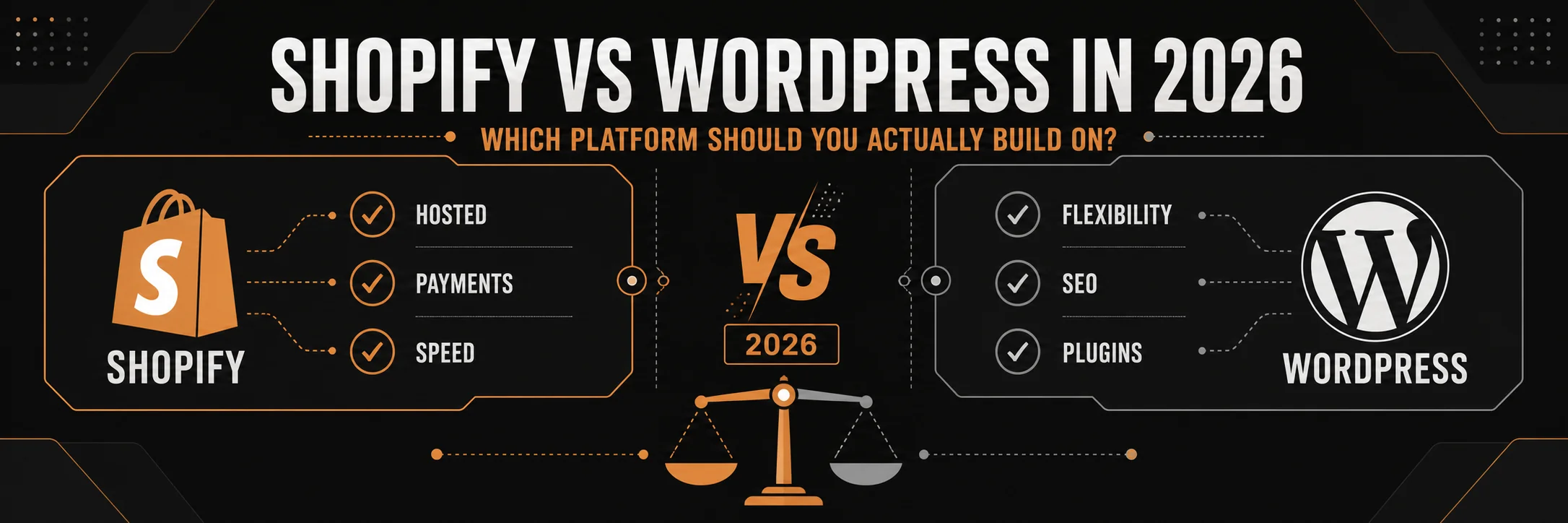
Every week, a business owner asks some version of the same question: Should I build on Shopify or WordPress?
It feels like a technical question. It is not. It is a business decision with a three-year tail and picking the wrong answer costs more to fix than it cost to build in the first place.
This guide gives you a straight comparison. No platform loyalty. No vague “it depends.” Just the information you need to make the call before you spend a dollar on development.
The Core Difference Nobody Explains Clearly
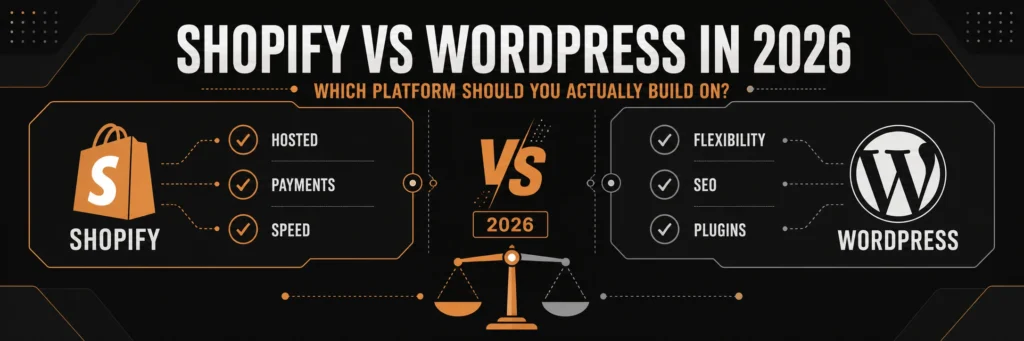
Shopify is a hosted commerce platform. You rent space on Shopify’s infrastructure, follow Shopify‘s rules, and in exchange, you never think about servers, security patches, or uptime.
WordPress is a self-hosted content management system. You own the code, the database, and the infrastructure. You control everything and you are responsible for everything.
If your business primarily sells services, content, or information, WordPress is almost always the right choice. If your business primarily sells physical or digital products, Shopify is almost always the right choice. That one sentence filters about 70% of the decisions correctly.
The other 30% is where the nuance lives.
Ease of Use and Time to Launch
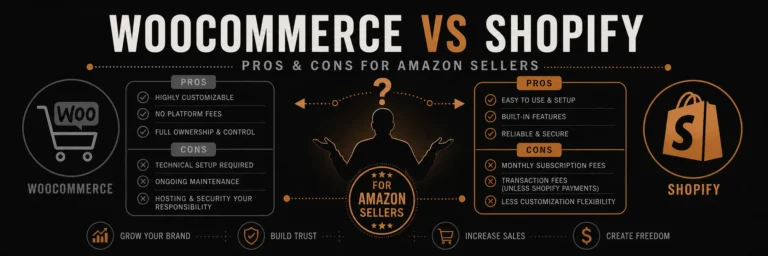
Shopify is best for beginners who want a fast, all-in-one ecommerce setup with minimal technical work. WordPress with WooCommerce offers greater flexibility, customization, and long-term scalability.
The launch timeline difference is significant. A non-technical owner can have a Shopify store accepting payments within 24 hours, with basic setup complete in one to five days. WordPress/WooCommerce requires two to three weeks minimum for basic setup, with realistic timelines extending to three to four weeks or longer for typical non-technical users.
For business owners wearing ten hats, that gap matters. For businesses with a development partner handling the build, it matters less.
What this means for you: If you need to generate revenue in 30 days, Shopify gets you there faster. If you have a six-week runway and a clear growth vision, WordPress gives you a foundation you will not outgrow.
Real Costs in 2026 (Not the Marketing Numbers)
Both platforms mislead on pricing Shopify by burying transaction fees, WordPress by advertising a $0 entry point.
Shopify’s True Cost
Shopify’s pricing is predictable: Basic plans start at $39 per month, but realistic budgets including payment processing (2.9% plus $0.30 per transaction), essential apps, and backups typically reach $89 to $549 per month depending on sales volume. At $10,000 in monthly revenue, total costs land around $240 to $520 per month in fees alone.
There is also a checkout wall. Checkout customization is severely limited on standard plans and requires Shopify Plus with custom pricing starting around $2,300 per month. Most brands never hit that ceiling, but fast-growing stores do.
WordPress’s True Cost
For WordPress with WooCommerce, the marketing claim of “$150 per year” masks true operating costs. Competitive small business stores cost $1,200 to $1,600 in Year 1 when including domain, hosting, essential plugins like security and abandoned cart recovery, and payment processing fees.
Year two costs more when promotional hosting rates expire typically $1,500 to $2,000 annually.
The long-term math favors WordPress for volume sellers. WordPress does not charge platform transaction fees; high-volume stores can save tens of thousands of dollars annually. Over a three-year perspective, the lower recurring fees often make WordPress the more profitable choice for established brands.
SEO: Where WordPress Still Wins
This is the clearest category in the comparison.
WordPress dominates when it comes to search engine optimization. With the right plugins — like Yoast SEO, Rank Math, or All in One SEO you can fine-tune every aspect of your site’s SEO strategy.
Shopify has improved significantly in recent years, but structural limitations remain. Shopify has limited ability to edit robots.txt, canonical tags, or implement advanced schema without custom coding or apps. These restrictions do not ruin your chances of ranking, but they can be a challenge for advanced SEO users.
For content-heavy strategies blogs, resource libraries, educational hubs WordPress is the stronger foundation. WordPress was built for content publishing. Creating, organizing, and optimizing large volumes of content is significantly easier on WordPress than on Shopify, which treats blog functionality as secondary to the shopping experience.
If you are investing in organic traffic as a core growth channel, this point alone often makes the decision.
Customization and Flexibility
Businesses looking for flexibility, SEO strength, content marketing, and long-term digital ownership should choose WooCommerce. It is also the number one choice for developers and agencies customizing ecommerce solutions and building bespoke customer experiences for clients with complex requirements.
Shopify handles standard commerce exceptionally well. The limits show up when your store needs something unusual. Shopify’s Liquid templating language lets you customize how content displays but restricts access to core business logic meaning you are customizing presentation, not business logic.
WordPress runs on open-source code. With 60,000 plus plugins available, WordPress can be extended to do almost anything: membership sites, online booking systems, course platforms, client portals, appointment scheduling, multi-language sites, and complex directory structures. If your website needs to do something unusual or highly specific to your business workflow, WordPress almost certainly has a plugin for it.
Custom integrations, third-party APIs, unique checkout flows all significantly easier to execute on WordPress.
Scalability and Infrastructure
Shopify’s infrastructure scales automatically. Shopify automatically configures servers to allocate resources based on your traffic, SKU count, and order volume. This low-maintenance scalability is hugely beneficial for fast-growth brands that lack a dedicated technical team.
WordPress scales according to your hosting infrastructure and technical architecture. A store running on a properly configured managed WordPress environment including object caching, a CDN, database optimization, and a staging pipeline handles millions of monthly visitors. But you need the right hosting setup from the start, or you will hit performance walls at inconvenient moments.
For DTC brands scaling fast with a lean team: Shopify. For brands that want full infrastructure control and have a technical partner: WordPress.
Which Platform Fits Which Business?
| Business Type | Recommended Platform |
|---|---|
| Product-only store, fast launch needed | Shopify |
| Content-driven brand, SEO is a priority | WordPress |
| High order volume, complex checkout | WordPress / WooCommerce |
| Service business or agency site | WordPress |
| Beginner, solo founder, no technical team | Shopify |
| Multi-vendor marketplace or custom integrations | WordPress |
| Scaling DTC brand, minimal dev overhead | Shopify |
The Question Most People Skip
Before choosing a platform, ask yourself: What does this site need to do in 18 months that it cannot do today?
Most businesses choose their platform for the wrong reason, usually because someone they know uses it end up limited by that choice within 18 months, and pay significantly more to migrate than they would have paid to choose correctly the first time.
That migration cost is real. Moving a store with product history, customer data, SEO equity, and established integrations from one platform to another is a five-figure project. It is not a weekend task.
Build for where your business is going, not where it is today.
How Advertpreneur Approaches Both Platforms
At Advertpreneur, we build and optimize on both. Shopify development for brands that need speed, clean product management, and reliable uptime. WordPress development for clients who need content depth, SEO flexibility, and custom functionality that off-the-shelf solutions do not cover.
The platform recommendation always comes after understanding the business not before. There is no universal winner. There is only the right tool for your specific situation.
If you are unsure which platform suits your goals, reach out. We will give you a straight answer.
Architect Signature
Haseeb
Leads all web development and design at Advertpreneur. With a background in graphic design since 2009, he builds storefronts that rank on Google and convert the traffic they earn through speed and SEO-structured architecture.