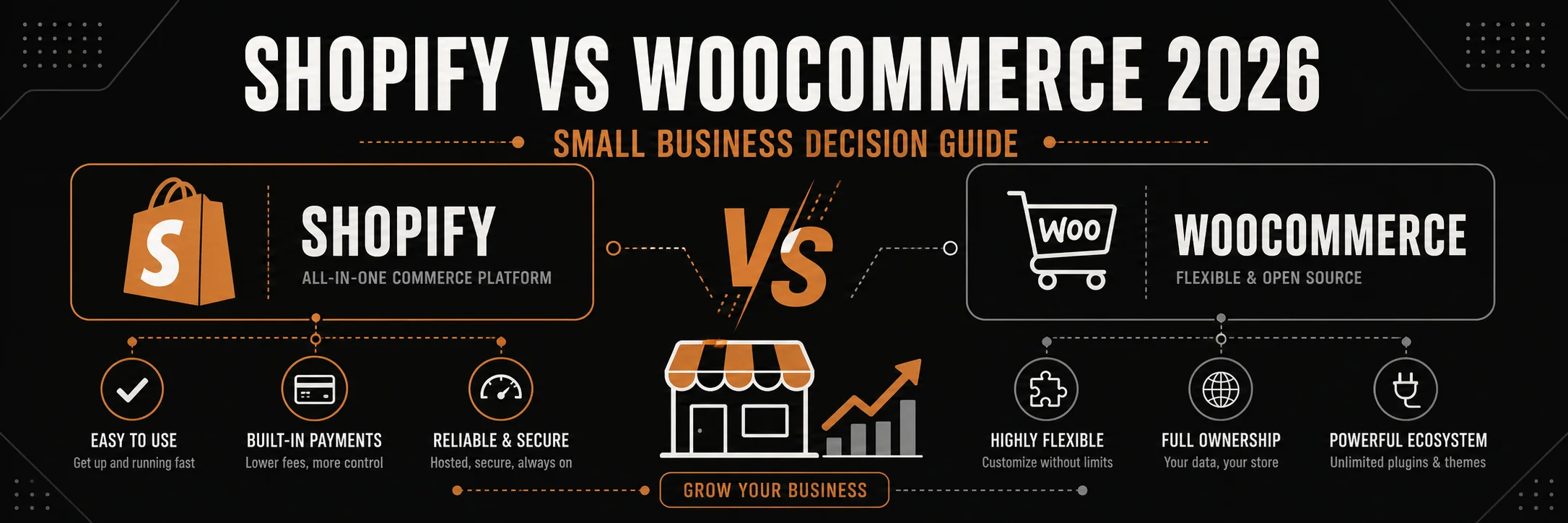
The Shopify vs WooCommerce 2026 small business debate is one of the most searched questions in eCommerce right now. WooCommerce powers 36% of all online stores globally, while Shopify controls 28% of market share. Picking the wrong one will cost you real money and real time.
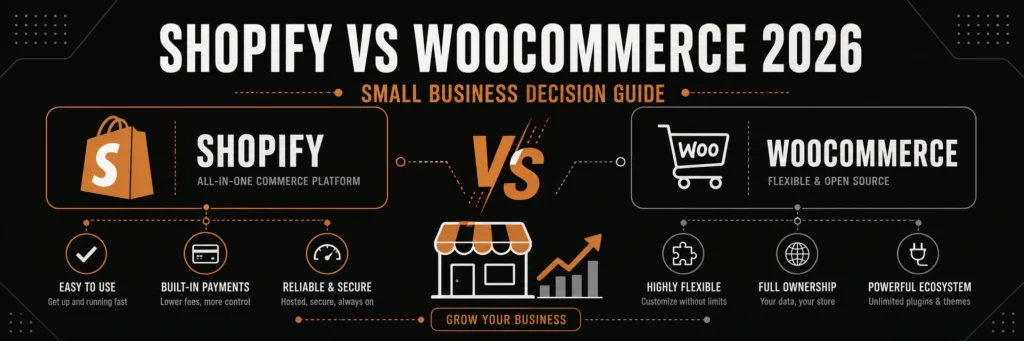
Table of Contents
- Why This Decision Matters More in 2026
- Shopify and WooCommerce: A Quick Overview
- True Cost Comparison for Small Businesses
- WooCommerce SEO Flexibility vs Shopify SEO
- Shopify vs WooCommerce 2026 Small Business: Ease of Use
- Vendor Lock-In and Platform Ownership
- Which Platform Wins for Your Business Type?
- Full Platform Comparison Table
- Common Mistakes When Choosing a Platform
- Frequently Asked Questions
- Conclusion
Why This Decision Matters More in 2026
Choosing your eCommerce platform is not a technical decision. It’s a business decision that affects your monthly costs, your SEO results, and how much control you have over your own store.
In 2026, that decision carries more weight than ever before. AI-powered shopping, rising ad costs, and shifting platform pricing have changed what each option actually costs you over time.
Specifically, Shopify raised its subscription prices in recent years and added more transaction fees for third-party payment gateways. As a result, small businesses that chose Shopify for its low entry cost now face significantly higher monthly bills as they scale.
On the other hand, WooCommerce remains free to install. But the total cost of ownership grows quickly once you add hosting, security plugins, premium extensions, and developer time.
So, the Shopify vs WooCommerce 2026 small business question is really about two things. Firstly, how much technical management can you handle? Secondly, how important is long-term cost control to your business?
Pro Tip: Before you choose a platform, calculate your projected monthly costs at three stages: launch, $10,000 per month in revenue, and $50,000 per month in revenue. The cheapest option at launch is often not the cheapest option at scale.
Shopify and WooCommerce: A Quick Overview
Shopify is a fully hosted SaaS platform. You pay a monthly subscription and Shopify handles your servers, security, SSL certificates, CDN, and uptime. You don’t touch any of that infrastructure.
WooCommerce is a free plugin for WordPress. You install it on your own hosting account and manage everything yourself. That includes updates, security patches, plugin compatibility, and backups.
This fundamental difference drives almost every other comparison between the two platforms. Shopify gives you predictability. WooCommerce gives you control.
For example, a new Shopify store can go from signup to live in 2 to 4 hours. A WooCommerce Store typically takes 2 to 5 days for someone with WordPress experience, or 1 to 3 weeks for a complete beginner.
Additionally, Shopify’s admin interface is consistent and intuitive across all features. WooCommerce requires you to learn WordPress, then WooCommerce, then each individual plugin you add.
True Cost Comparison for Small Businesses
Most cost comparisons only show the platform fee. That number alone is misleading. You need to look at the full picture.
Shopify Costs
Shopify’s Basic plan starts at $39 per month. The standard Shopify plan runs $105 per month and the Advanced plan costs $399 per month. These prices cover hosting, SSL, and core features.
However, Shopify charges transaction fees of 0.5% to 2% on every sale if you don’t use Shopify Payments. For small businesses processing $20,000 per month, that’s $100 to $400 extra per month on top of your subscription.
In addition, essential Shopify apps for subscriptions, advanced search, bundles, and SEO tools can add $100 to $200 per month to your bill. As a result, a Basic Shopify store can realistically cost $250 to $400 per month once you add the tools you actually need.
WooCommerce Costs
WooCommerce itself is free. But your real WooCommerce costs come from hosting, premium extensions, and maintenance.
- Quality managed WordPress hosting: $20 to $100 per month depending on traffic.
- Premium WooCommerce extensions for subscriptions, memberships, or advanced shipping: $100 to $300 per year each.
- Security plugin and backup solution: $50 to $150 per year.
- Developer time for updates, fixes, and customisation: variable, often $500 to $2,000 per year for small stores.
Therefore, a well-maintained WooCommerce store can run $80 to $200 per month at small business scale. That’s lower than Shopify in most cases, but only if you can handle the technical management yourself or have a developer on call.
Consequently, WooCommerce total cost of ownership is lower for technically capable teams. Shopify’s total cost of ownership is lower for teams who want zero infrastructure responsibility.
WooCommerce SEO Flexibility vs Shopify SEO
WooCommerce SEO flexibility is one of the most significant advantages for content-driven small businesses. WordPress, which powers WooCommerce, gives you full control over every SEO element.
Specifically, with WooCommerce you can install plugins like RankMath or Yoast SEO and control meta tags, schema markup, breadcrumbs, canonical URLs, and XML sitemaps with precision. You can also build complex content architectures that drive organic traffic alongside your product pages.
Shopify handles the basics well. It generates sitemaps automatically, allows you to edit meta titles and descriptions, and supports basic schema. But it restricts your URL structure. For example, all product pages sit at /products/ and all collections sit at /collections/. You can’t change that.
Also, Shopify’s blogging platform is limited. If your growth strategy depends on content marketing, ranking for informational keywords, or building topic clusters, WordPress and WooCommerce handle that far better than Shopify does.
In contrast, for stores that rely primarily on paid traffic rather than organic search, Shopify vs WordPress SEO differences matter less. In that case, Shopify’s conversion-optimised checkout and speed advantages can outweigh the SEO flexibility gap.
Warning: Shopify’s URL structure is fixed and cannot be changed. If you migrate from Shopify to WooCommerce later, you will need to set up 301 redirects for every product and collection URL. Without proper redirects, you lose all your existing SEO rankings overnight.
Shopify vs WooCommerce 2026 Small Business: Ease of Use
For Shopify vs WooCommerce 2026 small business comparisons, ease of use is the factor that tips most non-technical founders toward Shopify. The setup wizard walks you through adding products, choosing a theme, and configuring payments in one session.
WooCommerce requires more steps. You select and configure hosting, install WordPress, install and configure WooCommerce, choose a theme, install essential plugins, and then test your checkout. Each step adds time and decision points.
Additionally, Shopify’s ongoing maintenance is minimal. Updates happen automatically. WooCommerce requires you to manually update WordPress core, your theme, and every plugin you’ve installed. Compatibility issues between updates are common and can break your store if not managed carefully.
That said, WooCommerce gives you genuine ownership of your store. You can customise every element without hitting a platform limit. Shopify uses a proprietary templating language called Liquid for theme customisation. Developers who are new to Liquid face a learning curve that doesn’t exist with WordPress’s PHP-based theming system.
For a detailed breakdown of how both platforms handle real-world eCommerce scenarios, read this Shopify vs WooCommerce comparison from Metorik. It covers analytics, customer lifetime value, and practical store management for growing businesses.
Vendor Lock-In and Platform Ownership
Vendor lock-in in eCommerce is a serious risk that most small business owners don’t consider until they’re already locked in. Shopify is a proprietary closed platform. Your store runs on Shopify’s infrastructure and operates by Shopify’s rules.
If Shopify raises its prices, changes its terms, or removes a feature you depend on, your options are limited. Migrating a Shopify store to another platform requires rebuilding significant portions of your store from scratch.
For instance, one Reddit user in r/ecommerce documented having their store taken down without prior notice due to a disputed DMCA claim. Shopify acted immediately and the seller had no recourse until the dispute resolved. A WooCommerce store owner in the same situation controls their own hosting and can respond differently.
WooCommerce is open-source. The source code is available to anyone. You can move your store to a new host, hire any developer in the world to work on it, and modify anything you want without asking permission.
Therefore, for businesses that plan to scale internationally, build complex custom workflows, or want full data ownership, WooCommerce removes the open-source vs hosted store risk entirely. For businesses that want simplicity and don’t anticipate needing deep customisation, Shopify’s managed approach is a reasonable trade-off.
- Shopify owns your store’s infrastructure. WooCommerce stores run on infrastructure you choose and control.
- Shopify can change transaction fees, app policies, or theme rules at any time.
- WooCommerce lets you choose your payment gateway with no platform-level transaction fees.
- Migrating from Shopify to WooCommerce is possible but requires careful planning. Migrating between WooCommerce hosts takes hours.
Which Platform Wins for Your Business Type?
There’s no single winner in the Shopify vs WooCommerce 2026 small business debate. The right choice depends entirely on your business profile.
Choose Shopify If:
- You want to launch fast and focus entirely on selling, not managing technology.
- You have no WordPress or web development experience and no budget to hire a developer regularly.
- You sell a focused product range and don’t need complex content marketing to drive traffic.
- You use Shopify Payments as your primary gateway, which removes transaction fees entirely.
- You want to use Shopify’s native AI tools, including Shopify Magic, for product descriptions, email, and ad copy.
Choose WooCommerce If:
- You already run a WordPress site and want to add eCommerce without rebuilding everything.
- Your growth strategy depends heavily on content marketing, blogging, and organic SEO.
- You need deep customisation that Shopify’s platform limits prevent, such as custom checkout flows or complex membership systems.
- You process high transaction volumes and want to avoid percentage-based platform fees.
- You want full data ownership and the ability to change hosting providers whenever you choose.
For a technical comparison of how both platforms perform under real traffic and what the true infrastructure costs look like, this WooCommerce vs Shopify analysis from Seravo is one of the most honest assessments available. Seravo manages WooCommerce hosting professionally, so they see the real maintenance burden firsthand.
Full Platform Comparison Table
Table: Shopify vs WooCommerce 2026 small business full feature and cost comparison.
| Factor | Shopify | WooCommerce |
|---|---|---|
| Monthly Starting Cost | $39 per month (Basic plan) | $20 to $100 per month (hosting only) |
| Transaction Fees | 0.5% to 2% without Shopify Payments | None at platform level |
| Hosting | Included and managed by Shopify | You choose and manage your own host |
| Setup Time | 2 to 4 hours | 2 to 5 days minimum |
| Technical Maintenance | Zero, Shopify handles everything | Regular updates required by store owner |
| SEO Control | Good but URL structure is fixed | Full control over all SEO elements |
| Content Marketing | Basic blog included | Full WordPress CMS with unlimited flexibility |
| Customisation Depth | Limited by Liquid templating system | Unlimited via PHP, hooks, and plugins |
| Vendor Lock-In Risk | High, closed proprietary platform | None, fully open-source |
| AI Commerce Features | Shopify Magic built in natively | Requires third-party plugins |
| Payment Gateway Freedom | Restricted, fees apply for third-party gateways | Full freedom, any gateway supported |
| Best For | Fast launch, non-technical founders | SEO-first brands, content-driven businesses |
Common Mistakes When Choosing a Platform
Most small businesses get this decision wrong for the same few reasons. Knowing them in advance saves you significant time and money.
Mistake 1: Choosing Based on Monthly Price Alone
Shopify’s $39 per month Basic plan looks affordable. But once you add transaction fees, essential apps, and premium theme costs, the real monthly bill is often $250 to $400. Calculate the full picture before you commit.
Mistake 2: Ignoring Your SEO Strategy
If organic search is central to your traffic plan, WooCommerce SEO flexibility gives you a genuine advantage. Shopify’s fixed URL structure and limited blogging capabilities put a ceiling on how far you can take SEO without workarounds.
Mistake 3: Underestimating WooCommerce Maintenance
WooCommerce plugins cost money, but developer time costs more. A poorly maintained WooCommerce store breaks regularly. Budget for either a reliable developer relationship or a managed WooCommerce hosting plan that handles updates for you.
Mistake 4: Choosing Shopify for a Content-Heavy Business
Shopify is excellent at selling products. It struggles when your brand is more than just a shop. If you plan to build a blog, a membership site, a course library, or a resource hub alongside your store, WordPress and WooCommerce handle that far more naturally.
Mistake 5: Not Planning for the Switch from Shopify to WooCommerce
Many businesses start on Shopify for simplicity, then want to switch to WooCommerce as they grow and hit platform limits. That migration is possible but requires careful URL redirect mapping to avoid losing your SEO rankings. Plan for it early or avoid Shopify if you think you’ll need to switch later.
Frequently Asked Questions
Is Shopify or WooCommerce better for small businesses in 2026?
It depends on your priorities. Shopify suits small businesses that want a fast launch, zero technical maintenance, and a predictable monthly cost. WooCommerce suits small businesses that want full SEO control, lower transaction costs at scale, and the freedom to customise their store without platform restrictions. Neither is universally better. The right choice depends on your technical comfort level, growth strategy, and content marketing plans. How much does WooCommerce really cost per month for a small business?
WooCommerce the plugin is free, but running a WooCommerce store costs money. Quality managed WordPress hosting runs $20 to $100 per month. Premium extensions for subscriptions, memberships, or advanced shipping add $100 to $300 per year each. A security plugin and backup solution costs $50 to $150 per year. Developer time for updates and fixes adds a variable cost, often $500 to $2,000 per year for small stores. In total, a well-maintained WooCommerce store typically costs $80 to $200 per month at small business scale. Does Shopify charge transaction fees for small businesses?
Yes. Shopify charges transaction fees of 0.5% to 2% on every sale if you use a third-party payment gateway instead of Shopify Payments. The fee rate depends on your plan level. Basic plan users pay 2%, standard Shopify plan users pay 1%, and Advanced plan users pay 0.5%. You avoid these fees entirely by using Shopify Payments, but Shopify Payments is not available in all countries. Pakistani sellers, for example, cannot access Shopify Payments and will face these fees on every transaction. Is WooCommerce better than Shopify for SEO?
WooCommerce gives you significantly more SEO control than Shopify. With WooCommerce you control your URL structure, schema markup, breadcrumbs, canonical tags, and XML sitemaps precisely using plugins like RankMath or Yoast. Shopify handles the basics well but fixes your URL structure at /products/ and /collections/ with no way to change it. For businesses that rely on content marketing and organic search traffic, WooCommerce SEO flexibility is a meaningful competitive advantage over Shopify. Can I switch from Shopify to WooCommerce without losing my SEO rankings?
Yes, but you need to plan the migration carefully. The most important step is setting up 301 redirects from every old Shopify URL to the matching new WooCommerce URL. Since Shopify and WooCommerce use different URL structures, every product and collection URL will change. Without proper redirects, Google treats every new URL as a new page and your existing rankings reset. With a properly mapped redirect file and careful migration execution, you can retain the majority of your SEO equity during the switch. Which platform is better for WordPress eCommerce setup?
WooCommerce is the natural choice for WordPress eCommerce setup because it is built specifically for WordPress. It integrates directly into the WordPress admin, uses the same media library, and works with every major WordPress theme and page builder. If you already have a WordPress site with existing content and SEO equity, adding WooCommerce extends that site without rebuilding it. Shopify does not integrate with WordPress. You would need to run them as two separate sites and manage them independently.
Ready to grow your Amazon business?
Get a free strategy call with Advertpreneur.Book Your Free Consultation
Conclusion
The Shopify vs WooCommerce 2026 small business decision comes down to two things: how much technical control you want, and how important long-term cost efficiency is to your business. Shopify wins on speed, simplicity, and managed infrastructure. WooCommerce wins on SEO flexibility, customisation depth, and total cost of ownership at scale.
Most small businesses that prioritise content marketing, organic search, and full data ownership will find WooCommerce is the stronger long-term platform. Most businesses that want to launch fast, avoid server management, and focus purely on selling will find Shopify gets them there with less friction.
Finally, neither platform is a permanent commitment. But switching later is costly in time, money, and SEO risk. Make the right call now based on where your business is going, not just where it is today. If you need help deciding or building on either platform, Advertpreneur’s team works with both Shopify and WordPress every day and can help you choose and execute with confidence.
Architect Signature
Haseeb
Leads all web development and design at Advertpreneur. With a background in graphic design since 2009, he builds storefronts that rank on Google and convert the traffic they earn through speed and SEO-structured architecture.