
Most Amazon sellers are still optimizing for a search algorithm that no longer runs the show alone.
They’re counting keyword frequency. Stuffing backends. Tweaking titles for A9. Meanwhile, Amazon has quietly deployed two AI systems, Rufus and Cosmo, that evaluate your listings in ways A9 never did. And the rules are different.
This is not a future thing. Rufus handled 274 million daily queries by late 2024. During Black Friday 2025, it ran inside 38% of all Amazon shopping sessions. Shoppers who used it were 60% more likely to complete a purchase than those who did not. Amazon projects it will add $10 billion in annualized sales.
Your listing is already being read by an AI that your optimization strategy was not written for.
What Rufus Actually Does (And Why It Is Not A9)
Rufus is Amazon’s generative AI shopping assistant. It sits inside the mobile app and desktop experience, and shoppers talk to it the way they would talk to a knowledgeable friend.
“What’s a good running shoe for flat feet under $100?” “Which of these coffee makers is quieter in the morning?” “Is this supplement safe to take with blood pressure medication?”
Rufus reads your full listing, including title, bullets, description, A+ content, Q&A, and customer reviews, and decides whether your product fits the shopper’s intent. Then it either recommends you or skips you.
The difference from A9 is significant. A9 matched keywords. Rufus evaluates meaning. It does not care how many times you wrote “waterproof vinyl sticker” in your backend. It cares whether your listing clearly answers the question a shopper just asked out loud.
Rufus also does not just read your page. It reads the web. External blog posts, trade publications, YouTube videos, all of it can influence which products Rufus recommends. A competitor with one mention in a well-indexed industry article may outrank your fully optimized listing if Rufus finds that external source more relevant to the query.

What Cosmo Does on Top of That
Cosmo is the ranking system that works alongside Rufus. Rufus handles the conversational layer. Cosmo handles semantic relevance at the ranking level. Together they form the AI backbone of how Amazon now mediates product discovery.
Cosmo looks at use-case fit. It evaluates whether your listing communicates the real-world situations where your product works. A sticker listing that says “weatherproof vinyl decal for outdoor use” will rank differently in Cosmo’s eyes than one that says “vinyl decal” followed by a list of dimensions.
Context of use matters now. Compatibility matters. The answers your Q&A section provides matter. Cosmo reads all of it.
ZonGuru now offers a Cosmo and Rufus AI Readiness Report specifically designed to tell sellers whether their listings are built for this new layer of evaluation. The fact that a tool like this exists tells you how real the shift already is.

What Rufus Is Actually Looking For In Your Listing
Here is what earns Rufus recommendations, based on how the system evaluates product pages.
Use-case clarity. Rufus rewards listings that name real situations. “For dogs with joint pain” beats “for all dogs.” “Ideal for apartment balconies” beats “great for outdoor spaces.” Specificity is the signal.
Natural language, not keyword strings. The old way was keyword density. The new way is a listing that reads like a knowledgeable person wrote it. “Orthopedic dog bed for large breeds with joint pain, featuring washable memory foam that supports hip and spine health during sleep” outperforms “dog bed large dog bed washable dog bed orthopedic dog bed.” Rufus is trained on conversation. Robotic keyword strings fail on both the human and AI side.
Q&A depth. For any ASIN doing over $10,000 monthly revenue, target 15 to 20 substantive Q&As. Rufus reads this section when evaluating your product against conversational queries. Thin Q&A is invisible Q&A.

Review content that covers multiple use cases. Rufus uses reviews as evidence. If your reviews describe five to eight distinct use cases, Rufus has more surface area to match your product against shopper queries. If all your reviews say “great product, fast shipping,” Rufus has nothing to work with.
A+ content depth. Two or three basic A+ modules no longer cut it. Sellers in competitive categories are reporting organic ranking changes on ASINs where they expanded A+ depth. Rufus reads A+ content and weighs it as part of Listing Completeness.
Rating hygiene. Rufus factors in review ratings as a trust signal. A product with 3.8 stars competes at a disadvantage in AI-mediated recommendations regardless of keyword optimization.
The Visibility Problem Sellers Have No Control Over
Here is the uncomfortable part. Amazon provides no reporting on Rufus performance. No dashboard. No Rufus-specific impressions. No transparency into why it recommended your product or why it skipped you.
What you can do: check your Search Query Performance reports for movement on conversational long-tail queries. If you see impression share climbing on queries that read like questions, such as “stickers for outdoor use in rain” or “vinyl decals that don’t fade in sun,” Rufus is likely routing some of that traffic your way. If those impressions drop on head terms without a corresponding revenue drop, Rufus may be rerouting discovery traffic through its own recommendation layer.
Brand-registered sellers can find partial Rufus attribution data inside Brand Analytics. It is incomplete, but it gives you directional signals.
How Traditional Amazon SEO Fits Into This
Traditional search still drives roughly 80 to 85% of discovery traffic as of early 2026. Rufus is not replacing A9. It is layering on top of it.
Optimize for both. Your keywords still matter for the majority of searches. But Rufus is growing fast, from roughly 13% of Amazon searches in late 2024 to projections of 35% by end of 2025, and sellers who do not adapt now will face a painful catch-up later.
The practical approach: write listings for humans first, structure them so AI can parse them second. Listings that read naturally and answer real questions perform well under both systems. Keyword-stuffed, robotic listings lose under both.
An Honest Look at What You Need to Change
If your current Listing Optimization strategy looks like this:
- Title: max characters with primary keyword at the front
- Bullets: 5 lines of feature dumps
- Description: copy-pasted from bullets
- A+: basic template with 3 modules
- Q&A: left to customers to answer
You are optimizing for 2022. In 2026, the listing that wins under Rufus looks more like this:
- Title: Keyword-rich and descriptive of the actual use case
- Bullets: Each one answers a real shopper question (“Will this stick to my car door in the rain?”)
- A+: Expanded with clear use-case context, comparison modules, lifestyle imagery with descriptive alt text
- Q&A: Proactively populated with 15 or more questions that real buyers ask
- Reviews: Managed to surface varied real-world applications, not just star ratings
- Backend: Still keyword-loaded, but structured around intent terms, not just search volume
What This Means for Sellers With Large Catalogs
If you manage dozens or hundreds of ASINs, you cannot rewrite every listing at once. Prioritize by revenue. Start with your top 20% of ASINs by monthly revenue and run a Rufus readiness audit on each one.
Ask yourself four questions per ASIN:
- Does the listing name at least three distinct real-world use cases?
- Does the Q&A section answer questions a shopper might ask conversationally?
- Does the A+ content go beyond three basic feature modules?
- Do the reviews cover multiple applications, or only generic praise?
Any ASIN where you answer “no” to two or more of these is underperforming in Rufus, even if it ranks fine in traditional search today.
The Window to Move Early Is Open Right Now
Rufus optimization is still a young discipline. Most sellers are not doing it. Most agencies are not offering it as a distinct service. The sellers who audit and rewrite their listings for AI-mediated discovery in the next six months will have a structural advantage before this becomes standard practice.
The intent gap is real. Rufus closes the distance between what a shopper asks and what they actually buy, but only for products whose listings give it enough signal to work with. Listings that communicate clearly, answer real questions, and cover realistic use cases earn AI recommendations. Listings that do not get skipped by an AI that handles tens of millions of daily queries.
Your competitors’ listings are being evaluated right now. So are yours.

Need Help Optimizing Your Listings for Rufus and Cosmo?
At Advertpreneur, we have been optimizing Amazon listings since 2016. We understand how Amazon’s search systems evolve and we build listing strategies that perform across both traditional and AI-mediated discovery.
If you want a Rufus readiness audit on your catalog or a full listing rewrite built for 2026’s search landscape, reach out to us at advertpreneur.
Why amazon fees Keep Rising and Cutting Seller Profits in 2026

Amazon fees are rising fast, and sellers feel the pressure daily. Most Sellers ask why amazon taking so much money today.
Firstly, profits shrink even when sales grow. Therefore, you must understand every cost inside your account.
Table of Contents
- Why amazon fees Are Rising
- amazon seller fees breakdown Explained
- amazon hidden fees sellers Miss
- amazon revenue vs profit Problem
- amazon fba fees 2026 What Changed
- How to Reduce amazon fees and Improve Profit
- Frequently Asked Questions
- Conclusion
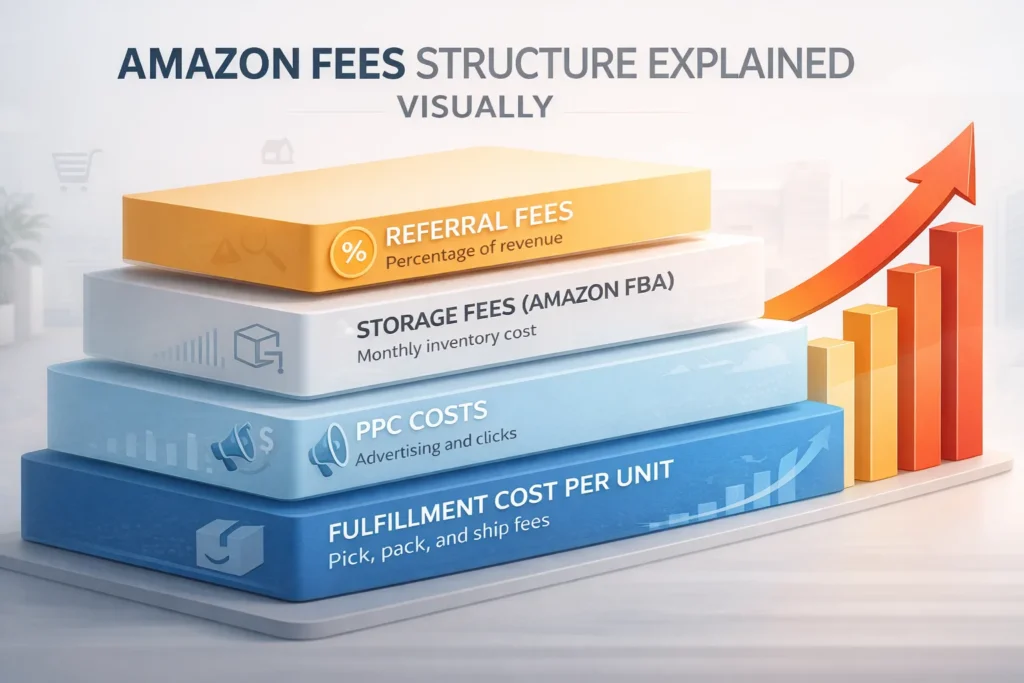
Why amazon fees Are Rising
Firstly, Amazon invests heavily in logistics and delivery systems. As a result, sellers absorb part of that cost.
Secondly, competition grows every year across categories. Therefore, advertising costs rise and margins shrink.
Thirdly, Amazon pushes efficiency across its marketplace. That means poor listings pay more for the same traffic.
- Higher logistics costs increase fulfillment cost per unit
- More sellers increase PPC competition
- Storage rules push faster inventory turnover
- Algorithm rewards better Conversion Rates
However, most sellers blame only ads or traffic. In contrast, the real issue lies in total cost structure.
Pro Tip: Track every cost weekly. Small increases destroy profit over time.
amazon seller fees breakdown Explained
To begin with, you must understand each cost clearly. Otherwise, you cannot control your profit.
Main Types of amazon fees
- Referral fees amazon on each sale
- Fulfillment cost per unit for FBA orders
- Storage fees amazon fba for inventory space
- Advertising spend through PPC campaigns
For example, referral fees amazon can reach fifteen percent. As a result, your margin drops instantly.
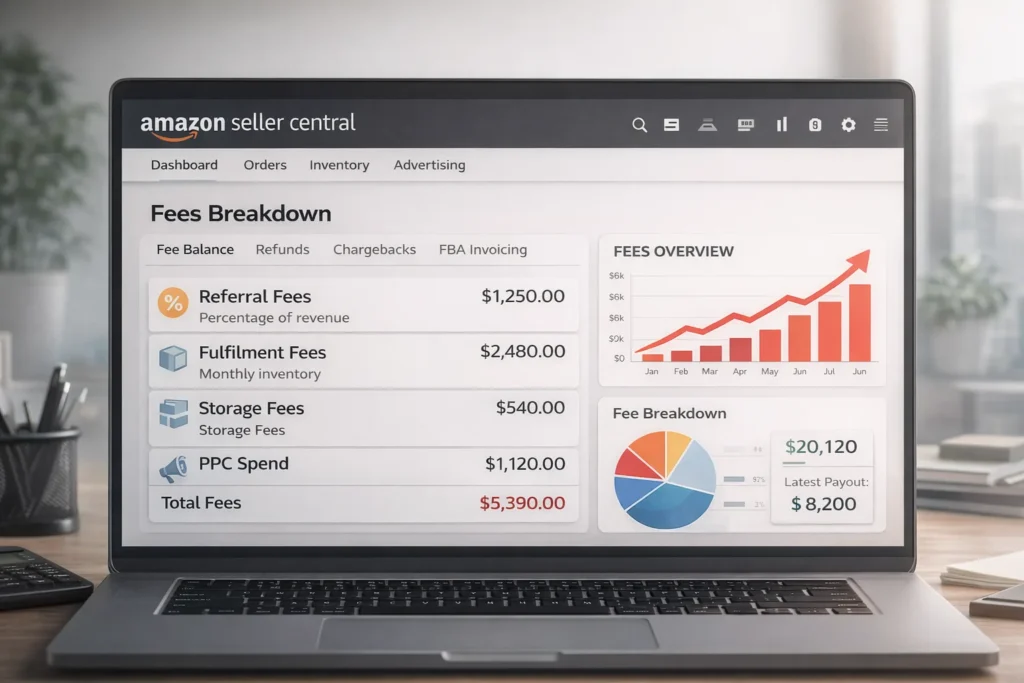
| Fee Type | What It Covers | Impact Level |
|---|---|---|
| Referral Fee | Percentage of each sale | High |
| FBA Fulfillment | Picking packing and delivery | High |
| Storage Fee | Inventory holding cost | Medium |
| PPC Spend | Traffic acquisition cost | Very High |
Table: Key components of amazon seller fees breakdown
In addition, sellers ignore indirect costs. That includes returns, refunds, and damaged inventory.
amazon hidden fees sellers Miss
Most importantly, many sellers miss hidden charges completely. That leads to profit shock later.
Specifically, inbound placement fees increased recently. Therefore, shipping strategy now affects profit.
- Low inventory level fees
- Long term storage penalties
- Removal and disposal fees
- Return processing charges
In fact, these amazon hidden fees sellers often ignore. As a consequence, margins drop without warning.
Warning: Ignoring hidden costs will destroy your profit silently.
Next, check your reports inside Seller Central regularly. Also review official updates from Amazon fee structure guide.
amazon revenue vs profit Problem
Many sellers confuse revenue with profit. However, amazon revenue vs profit shows a big gap.
For instance, you may sell ten thousand dollars monthly. Yet your profit might stay under two thousand.
Why This Happens
- High TACOS amazon eats total revenue
- Increasing fulfillment cost per unit
- Unoptimized listings reduce conversion rate
- High returns reduce net profit
Meanwhile, sellers focus only on sales growth. In contrast, profit depends on cost control.
That is why strong Amazon SEO improves conversion and reduces ad waste.
amazon fba fees 2026 What Changed
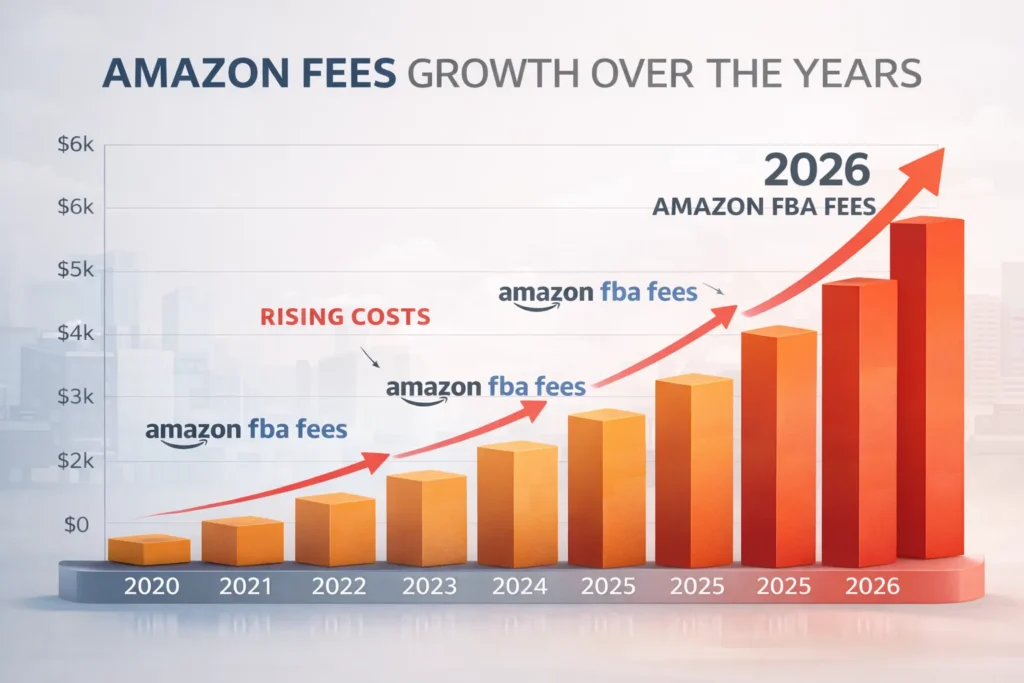
Recently, amazon fba fees 2026 updates created new pressure. Therefore, Sellers Must adapt quickly.
Firstly, placement fees changed how inventory ships. Secondly, storage rules became stricter.
- Higher inbound placement costs
- More penalties for slow inventory
- Increased cost for oversized items
- Regional distribution requirements
For example, sending inventory to one warehouse now costs more. As a result, sellers must split shipments.
Additionally, you can review insights from Jungle Scout fee analysis.
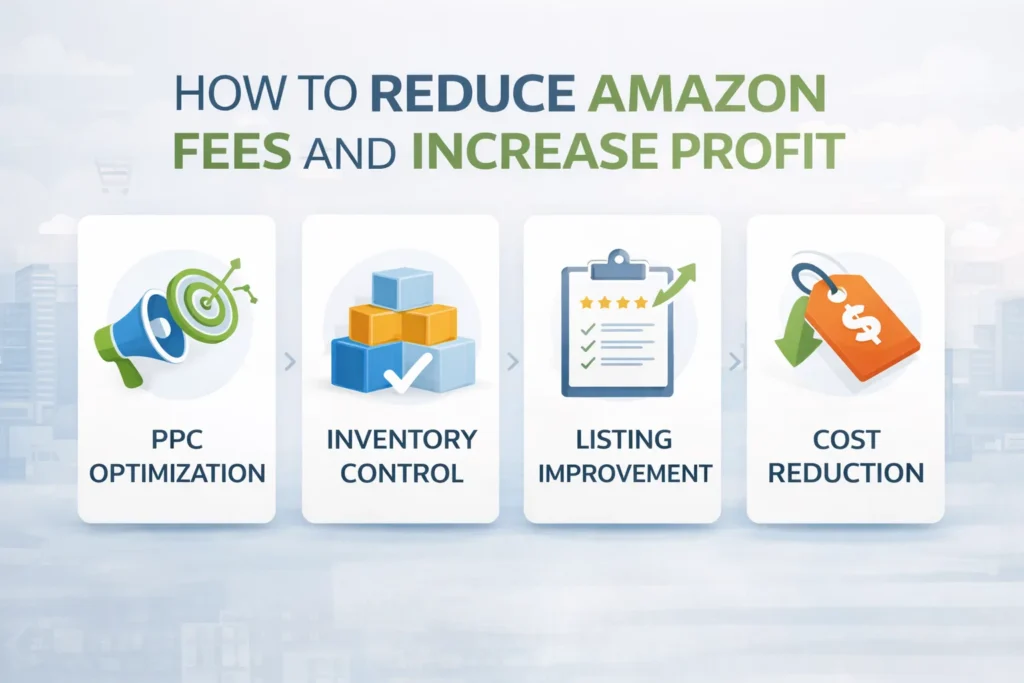
How to Reduce amazon fees and Improve Profit
Firstly, Improve Your listing conversion rate. As a result, you reduce wasted ad spend.
Secondly, optimize your PPC campaigns carefully. That means lowering TACOS amazon over time.
Action Steps
- Audit listing images and copy
- Remove non converting keywords
- Focus on high intent search terms
- Improve pricing and perceived value
In addition, manage inventory better. That prevents storage fees amazon fba from increasing.
Similarly, monitor your fulfillment cost per unit weekly. Small changes add up quickly.
- Use smaller packaging to reduce fees
- Avoid overstocking slow products
- Bundle products to increase order value
- Improve supplier cost negotiation
Finally, track profit not revenue. That keeps your business healthy long term.
Frequently Asked Questions
Why are amazon fees increasing?
Amazon increases costs due to logistics expansion and marketplace competition. What is the biggest cost for sellers?
PPC spend and fulfillment fees usually take the largest share. How do I reduce amazon fees?
Improve conversion rate and optimize PPC campaigns to reduce wasted spend. Are amazon fba fees 2026 higher than before?
Yes, updates added new placement fees and stricter inventory rules. What is TACOS amazon?
TACOS measures ad spend compared to total revenue across your account.
Ready to grow your Amazon business?
Get a free strategy call with Advertpreneur.Book Your Free Consultation
Conclusion
Amazon fees continue to rise and affect every seller. Therefore, you must track every cost closely.
Most importantly, focus on profit not revenue. As a result, your business stays strong and scalable.
Finally, control amazon fees through strategy and optimization. That is how you win in 2026.
Fix amazon ppc mistakes and stop wasting your ad budget

amazon ppc mistakes cost sellers money every single day. Yet most sellers repeat the same errors without knowing.
Firstly, many sellers trust ads without strategy. Therefore, budgets burn fast with little return.
Secondly, poor setup leads to bad data. As a result, decisions become guesswork instead of growth.
Table of Contents
- What are amazon ppc mistakes
- The biggest amazon ppc mistakes
- Why ACOS problems happen
- How to fix amazon ppc mistakes
- Mistake vs solution comparison
- Frequently Asked Questions
- Conclusion
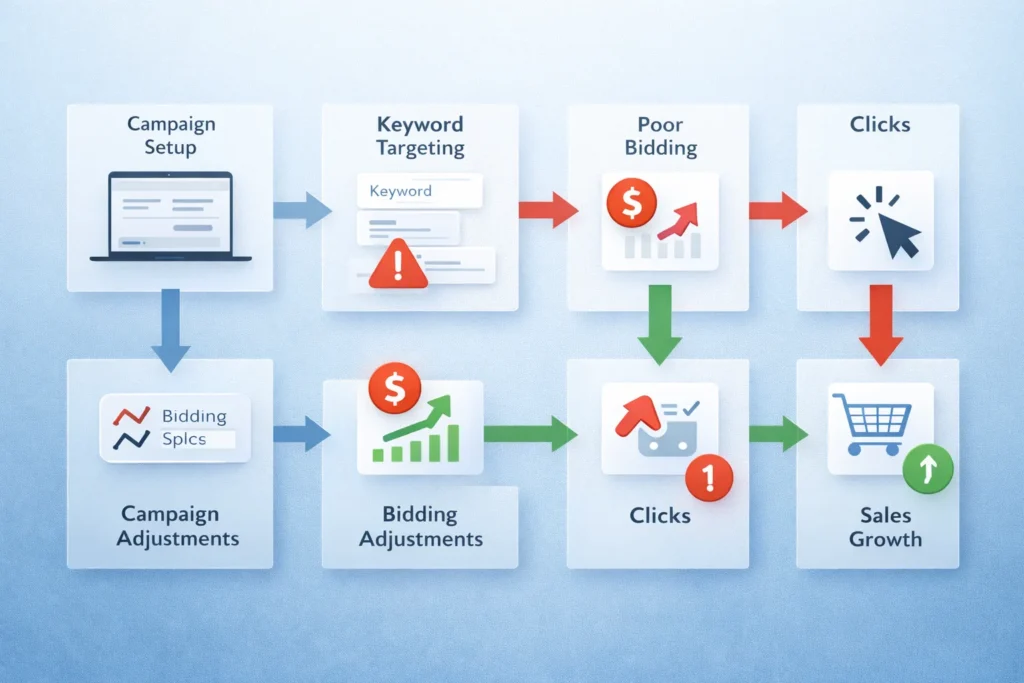
What are amazon ppc mistakes
Firstly, amazon ppc mistakes refer to poor ad decisions. These mistakes waste budget and reduce profit.
Secondly, they include wrong targeting and poor bids. In other words, you pay for clicks that never convert.
Additionally, many sellers ignore data signals. As a result, campaigns run without improvement.
- Wrong keyword targeting amazon strategy
- Ignoring negative keywords amazon filters
- Poor campaign structure
- Overbidding on low intent keywords
For example, a broad keyword can attract wrong buyers. Therefore, clicks increase but sales stay low.
Warning: Running ads without tracking leads to fast budget loss.
The biggest amazon ppc mistakes
Firstly, ignoring keyword intent is a major issue. Therefore, ads show to the wrong audience.
Secondly, sellers forget to add negative keywords amazon filters. As a result, wasted clicks increase daily.
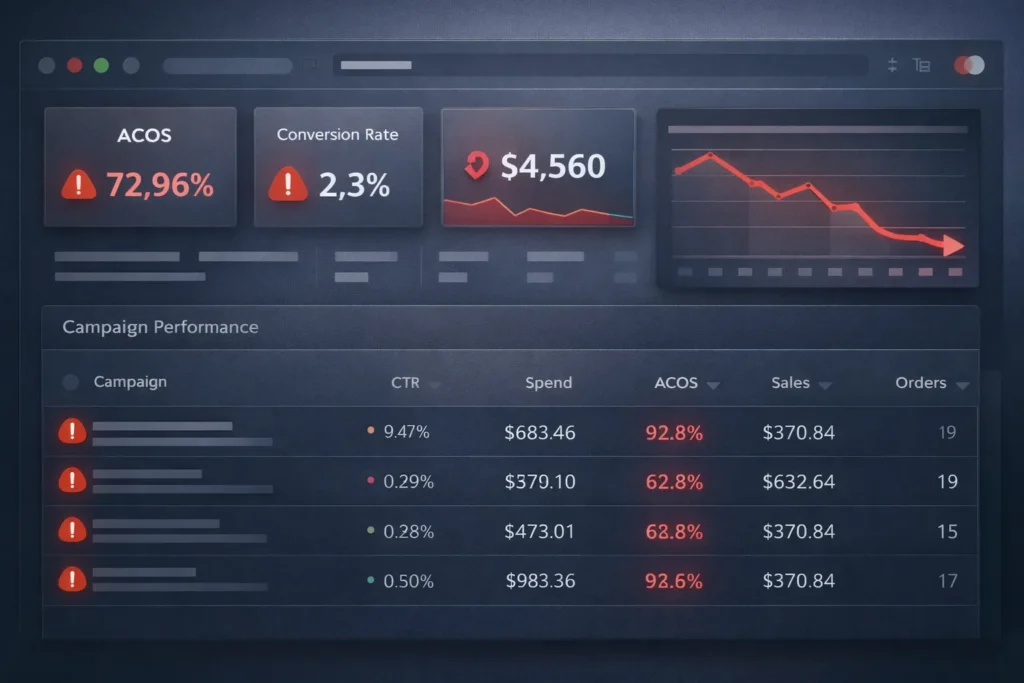
Thirdly, poor bidding strategy leads to high spend. In contrast, smart bidding protects profit.
Meanwhile, many sellers run only auto campaigns. However, they never scale into manual targeting.
- No clear campaign structure
- Overlapping keywords
- Ignoring search term reports
- No ACOS optimization plan
In addition, many sellers stop testing early. That means they never find winning keywords.
Also, relying only on ads is risky. Instead, combine ads with strong Listing Optimization.
To Improve Your PPC performance, you must fix these errors first.
Why ACOS problems happen
Firstly, ACOS rises when targeting is poor. Therefore, irrelevant clicks reduce return.
Secondly, weak listings hurt conversion. As a result, even good traffic fails.
Additionally, amazon advertising mistakes often come from poor research. In fact, most sellers skip deep keyword analysis.
- High bids without conversion data
- Low quality listing images
- Poor pricing strategy
- Weak product positioning
For instance, a bad image reduces trust fast. Consequently, buyers click but do not purchase.
Learn more from Amazon sponsored ads guide.
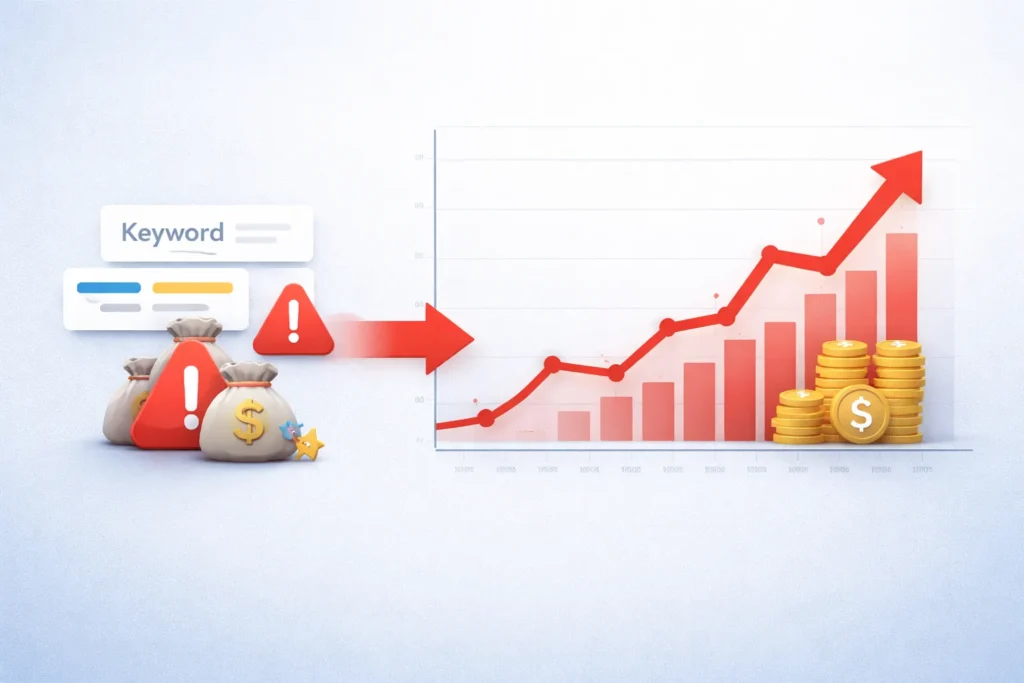
Similarly, lack of testing slows growth. That means campaigns stay stuck without improvement.
How to fix amazon ppc mistakes
Firstly, audit your campaigns weekly. Therefore, you spot issues early.
Secondly, focus on keyword targeting amazon strategy. In other words, match keywords with buyer intent.
Next, add strong negative keywords amazon filters. As a result, you reduce wasted clicks.
- Download search term report
- Find low converting keywords
- Add them as negative keywords
- Adjust bids based on data
Additionally, build structured campaigns. That means separate auto and manual campaigns.
Then, test different match types. For example, use exact for high intent terms.
Pro Tip: Always scale winning keywords into exact match campaigns.
Also, improve your listing conversion. In fact, better images increase sales fast.
Learn more from this PPC guide.
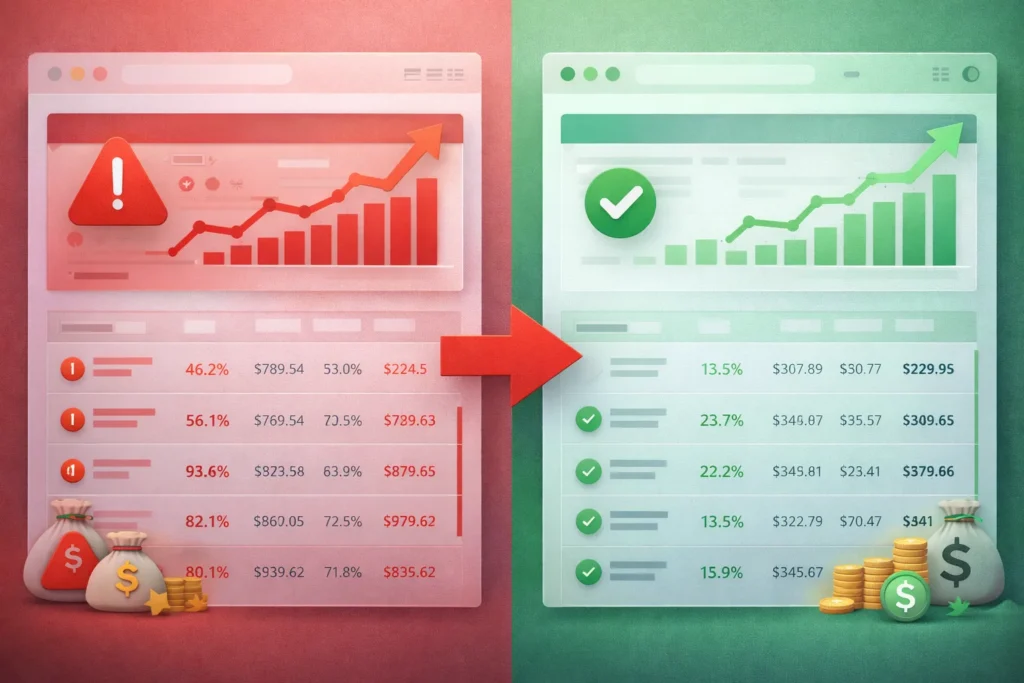
Mistake vs solution comparison
| Mistake | Impact | Solution |
|---|---|---|
| No negative keywords | High wasted spend | Add negative keywords amazon filters |
| Wrong targeting | Low conversions | Improve keyword targeting amazon |
| High bids | High ACOS | Adjust bids with data |
| Poor structure | Confusing data | Organise campaigns clearly |
Table: Common amazon ppc errors and solutions
Frequently Asked Questions
What are common amazon ppc mistakes?
Most sellers target wrong keywords and ignore negative keywords. They also overbid without data. Why is my ACOS high?
High ACOS comes from poor targeting and low Conversion Rates. Fix both to reduce spend. How often should I optimise campaigns?
You should review campaigns weekly. Frequent checks improve results faster. Do negative keywords really help?
Yes, they remove unwanted traffic. As a result, your budget goes to better clicks. Can beginners run profitable ads?
Yes, but they must avoid common amazon ppc errors. Learning basics improves results quickly.
Ready to grow Your Amazon business?
Get a free strategy call with Advertpreneur.Book Your Free Consultation
Conclusion
amazon ppc mistakes cost time and money. However, fixing them brings fast results.
Therefore, focus on data, testing, and structure. In short, smart changes lead to better profit.
To summarise, avoid common amazon ppc mistakes and refine your strategy. As a result, your ads will drive real growth.
How amazon A10 Algorithm Optimization Drives Rankings and Sales

Amazon A10 Algorithm Optimization helps sellers rank higher and sell more. Firstly, it focuses on user intent and real engagement signals.
Secondly, it rewards listings that convert and satisfy buyers. Therefore, sellers must focus on both traffic and conversion.
Table of Contents
- What is Amazon A10 Algorithm
- How Amazon A10 Algorithm Optimization Works
- Key Ranking Factors
- Amazon A10 Algorithm Optimization Strategy
- A9 vs A10 Comparison
- Frequently Asked Questions
- Conclusion
 Amazon Listing Optimization Service workflow showing ranking and conversion process” class=”wp-image-7092″/>
What is Amazon A10 Algorithm
Firstly, Amazon A10 decides which products appear in search results. It ranks listings based on performance and relevance.
Secondly, it focuses more on organic signals than ads. Therefore, sellers must build strong listings.
Why A10 matters for sellers
Most importantly, A10 rewards listings that convert well. As a result, better listings get more visibility.
- Higher conversion improves ranking
- Better reviews increase trust
- Relevant keywords improve discoverability
In addition, using an Amazon SEO approach helps improve results.
How Amazon A10 Algorithm Optimization Works
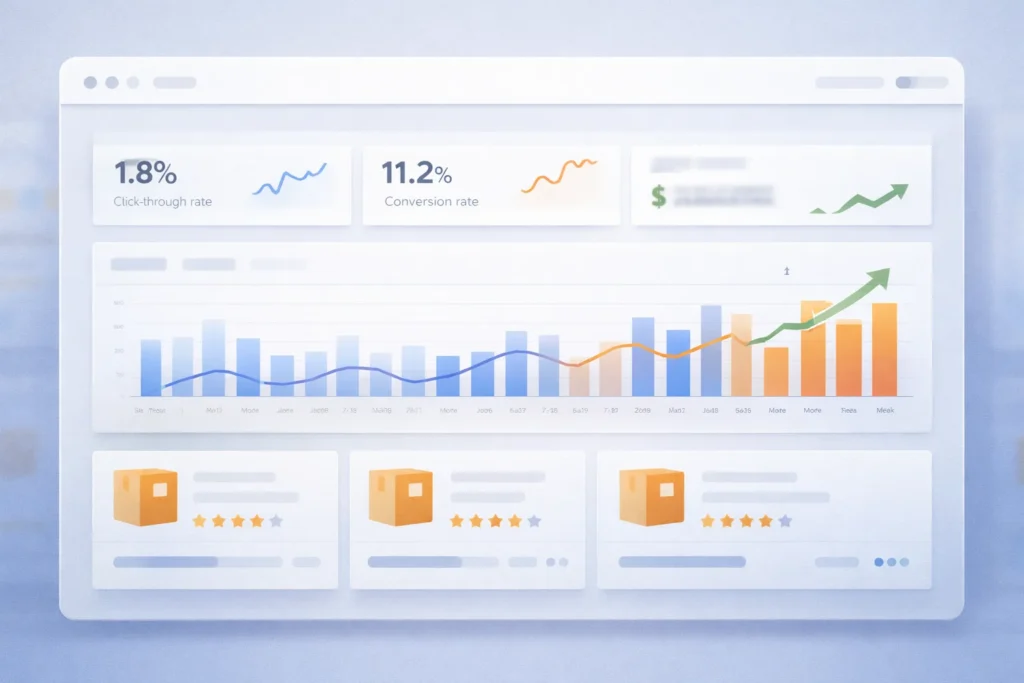
Firstly, A10 looks at shopper behaviour and purchase intent. Then, it ranks products based on performance.
Secondly, it values organic sales more than paid traffic. That means strong listings win long term.
Main working logic
- Customer searches for a keyword
- Amazon matches relevant listings
- System ranks based on performance
- Top listings get more clicks and sales
For example, products with better click rates rank higher. As a result, visibility grows faster.
Pro Tip: Focus on improving click rate and conversion first
Key Ranking Factors
Firstly, A10 uses several signals to rank listings. Secondly, each factor impacts visibility and sales.
Important ranking signals
- Keyword relevance
- Sales velocity
- Customer reviews
- Click through rate
- Conversion rate
In contrast, weak listings struggle to rank. Therefore, you must improve every factor.
Role of keywords
Specifically, keywords help Amazon understand your product. In fact, better keyword use improves ranking.
That means you should use Amazon Product Listing Optimization techniques. Additionally, include keywords naturally.
Role of conversion
Above all, conversion matters the most. Consequently, listings with higher sales rank higher.
For instance, better images increase buyer trust. As a result, sales improve quickly.
Warning: Do not stuff keywords as it hurts readability
Amazon A10 Algorithm Optimization Strategy
Firstly, you need a clear strategy to rank. Secondly, you must optimise both SEO and conversion.
Step by step strategy
- Research high intent keywords
- Optimise title and bullets
- Improve images and A Plus Content
- Drive initial traffic
- Collect reviews and feedback
Additionally, using an Amazon SEO Optimization Service helps speed up results. In other words, experts handle complex tasks.
Meanwhile, a strong Amazon Listing Optimization Service improves conversion rates. As a result, ranking improves faster.
Also, you can book a Free Amazon Consultation to plan growth.
A9 vs A10 Comparison
| Factor | A9 Algorithm | A10 Algorithm |
|---|---|---|
| Focus | Sales driven | User behaviour driven |
| Ads impact | High | Lower |
| Organic ranking | Less priority | More priority |
| External traffic | Limited value | Higher value |
Table: Key differences between Amazon A9 and A10 ranking systems

However, A10 focuses more on user experience. Therefore, better listings always win.
Similarly, external traffic boosts ranking. As a consequence, brands should drive traffic outside Amazon.
Frequently Asked Questions
What is Amazon A10 Algorithm Optimization?
It is the process of improving listings to rank higher in Amazon search results. Does A10 prefer organic sales?
Yes, it values organic sales more than paid ads. How do keywords affect ranking?
Keywords help Amazon understand relevance and match search queries. Do reviews impact ranking?
Yes, positive reviews improve trust and increase conversions. Should I use external traffic?
Yes, external traffic helps improve ranking signals and visibility.

Ready to grow Your Amazon business?
Get a free strategy call with Advertpreneur.Book Your Free Consultation
Conclusion
Amazon A10 Algorithm Optimization plays a key role in ranking. Firstly, it rewards strong listings and real engagement.
Secondly, it focuses on conversion and user behaviour. Therefore, sellers must optimise every part of the listing.
Finally, consistent optimisation leads to long term growth. In short, better listings always win on Amazon.
amazon Suppressed Listing Fix: How to Restore Your Sales Fast
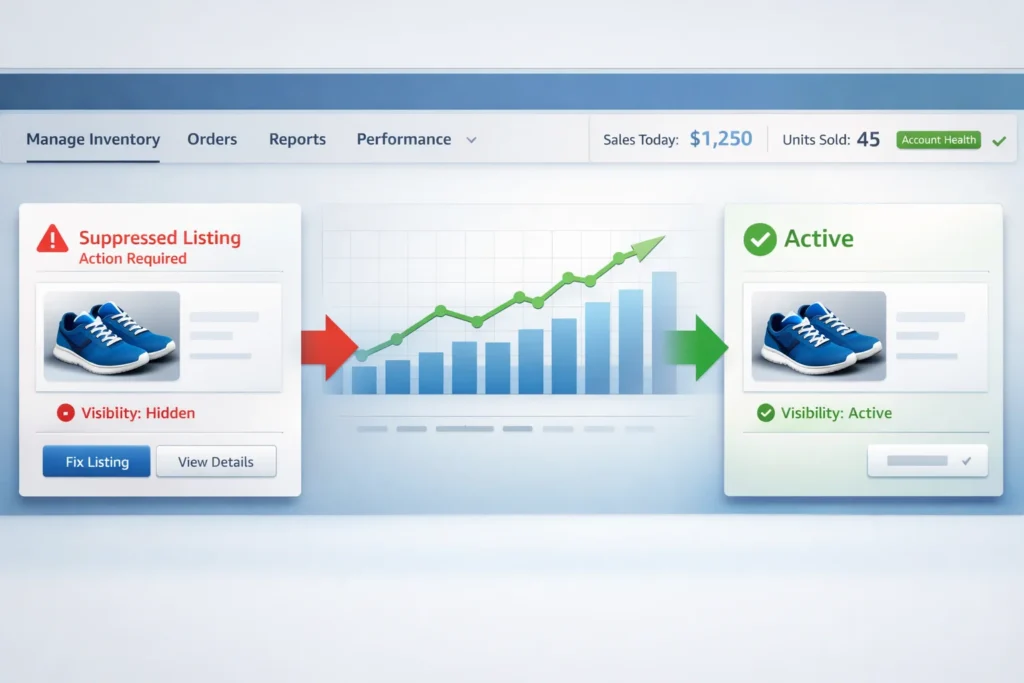
An Amazon Suppressed Listing Fix can save your business from lost sales. Therefore, you need to understand why Amazon hides Your Products. Then, you can take fast action to restore visibility.
Table of Contents
- What Is a Suppressed Amazon Listing
- Why Is My Amazon Listing Suppressed
- How to Fix a Suppressed Amazon Listing
- Using Flat Files for Bulk Fixes
- Fixing Stranded Inventory Issues
- How to Prevent Future Suppressions
- When to Use an Amazon Listing Fix Service
- Frequently Asked Questions
- Conclusion
What Is a Suppressed Amazon Listing
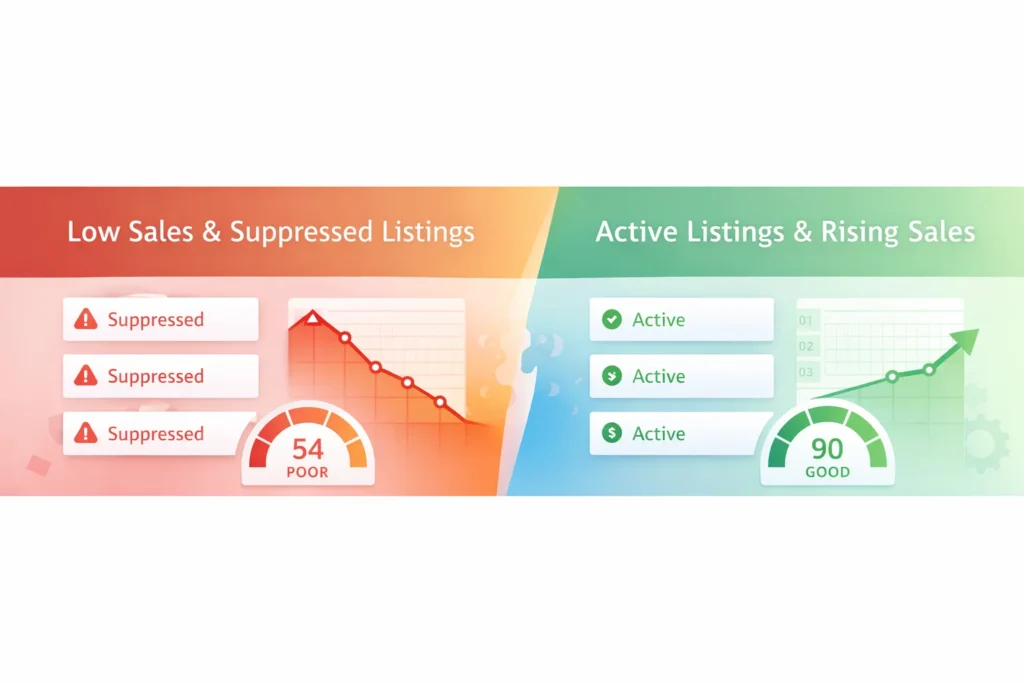
A suppressed listing is a product that Amazon hides from buyers. As a result, shoppers cannot find or buy your item.
Amazon suppresses listings that break their rules. In other words, your product becomes invisible in search results.
Most importantly, suppressed listings cost you money every day. Consequently, you lose sales while competitors win.
An Amazon Suppressed Listing Fix restores your product to active status. Therefore, buyers can see and purchase your items again.
Warning: Suppressed listings do not show up in Amazon search at all. This means zero visibility until you fix the problem.
Why Is My Amazon Listing Suppressed
Amazon suppresses listings for many different reasons. However, most issues fall into three main categories.
Missing Required Information
Amazon needs complete data for every product. For example, you must include images, titles, and descriptions.
Additionally, you need valid category codes and proper brand names. Without these details, Amazon will suppress your listing.
Policy Violations
Your listing might break Amazon’s selling rules. In fact, restricted words or false claims trigger suppression quickly.
Similarly, incorrect product details cause problems. So always check your content against Amazon’s guidelines.
Image Issues
Amazon requires specific image standards. Specifically, your main photo needs a pure white background.
Moreover, images must show the actual product clearly. Therefore, blurry or text heavy images get rejected.
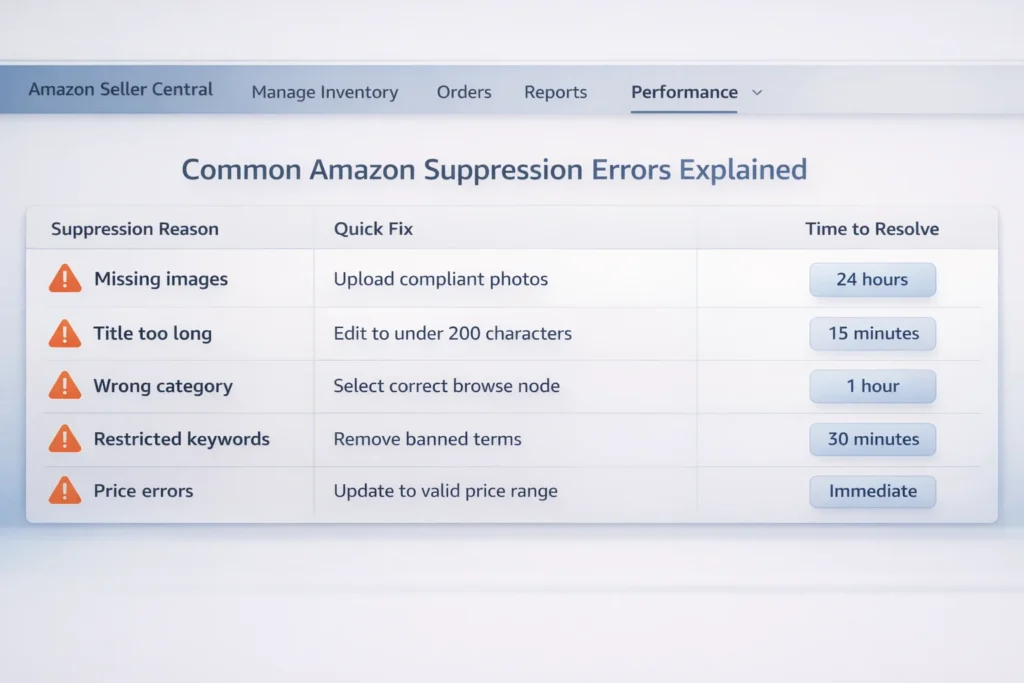
| Suppression Reason | Quick Fix | Time to Resolve |
|---|---|---|
| Missing images | Upload compliant photos | 24 hours |
| Title too long | Edit to under 200 characters | 15 minutes |
| Wrong category | Select correct browse node | 1 hour |
| Restricted keywords | Remove banned terms | 30 minutes |
| Price errors | Update to valid price range | Immediate |
Table: Common suppression causes and their typical resolution times
How to Fix a Suppressed Amazon Listing
You can perform an Amazon Suppressed Listing Fix yourself. However, you need to follow specific steps carefully.
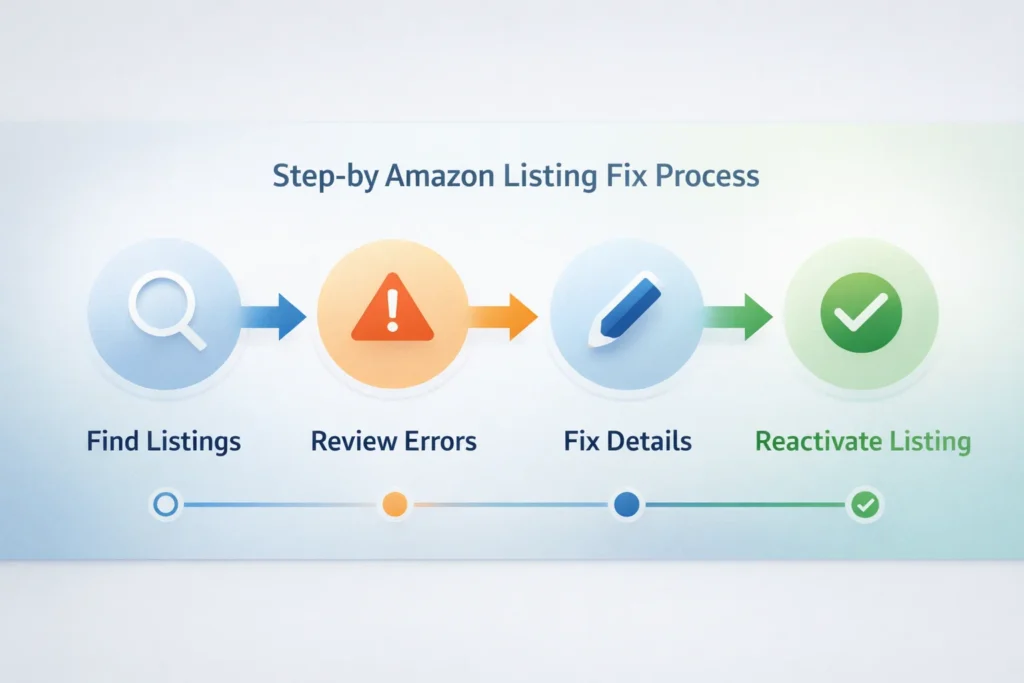
Step 1: Find Your Suppressed Listings
Firstly, log into Amazon Seller Central. Then, click the Inventory menu tab.
Next, select Manage Inventory from the dropdown. After that, click Fix Suppressed Listings at the top.
Step 2: Review the Error Details
Amazon shows exactly what is wrong. For instance, you might see Missing Bullet Points or Image Required.
Therefore, read each error message completely. This tells you exactly what to fix.
Step 3: Update Your Listing
Edit the missing or incorrect information. Additionally, upload new images if needed.
Then, save your changes and wait. In most cases, Amazon reactivates listings within 24 hours.
Pro Tip: Save your listing as a draft before submitting. This prevents new errors from going live.
Meanwhile, you can check other listings for similar issues. Consequently, you fix problems before they cause suppression.
Using Flat Files for Bulk Fixes
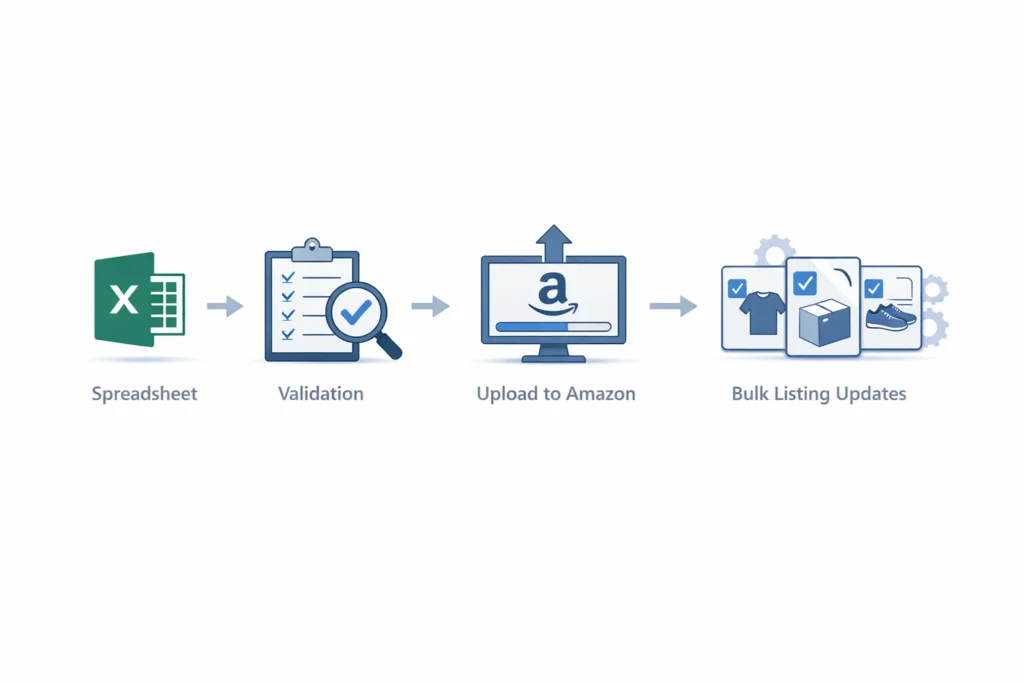
An Amazon Flat File Fix Service helps with many listings at once. Specifically, this works well for sellers with large catalogs.
What Is a Flat File
A flat file is a spreadsheet template from Amazon. In fact, you can update hundreds of listings simultaneously.
However, flat files contain many columns. Therefore, one small error can cause big problems.
How to Use Flat Files Safely
Firstly, download the correct template for your category. Then, fill in all required fields completely.
Next, validate your file before uploading. As a result, you catch errors before Amazon sees them.
Finally, upload small batches first. This way, you test the process with less risk.
Fixing Stranded Inventory Issues
An Amazon Listing Stranded Inventory Fix addresses a special problem. Specifically, this happens when inventory exists but has no active listing.
What Causes Stranded Inventory
Inventory becomes stranded for several reasons. For example, listing errors or policy violations can strand your stock.
Additionally, deleting listings while inventory remains in FBA causes stranding. Therefore, always check stock levels before making changes.
How to Fix Stranded Inventory
Go to Inventory then Manage Inventory in Seller Central. Then, click Fix Stranded Inventory.
Amazon will show why each item is stranded. After that, follow their specific instructions to relist.
In some cases, you need to create a new listing. Meanwhile, in other cases, you simply edit existing details.
How to Prevent Future Suppressions
Stopping problems before they start saves time. Therefore, follow these simple prevention tips.
- Check your listings weekly for alerts or warnings
- Keep images updated with Amazon’s latest requirements
- Never use restricted words in titles or bullets
- Maintain accurate inventory counts at all times
- Update prices regularly to avoid pricing errors
Additionally, use Amazon’s Listing Quality Dashboard. This tool shows potential problems before suppression happens.
Most importantly, stay current with Amazon’s policy changes. Consequently, you avoid new restriction triggers.
When to Use an Amazon Listing Fix Service
Sometimes you need expert help. Therefore, consider an Amazon Listing Fix when you face complex issues.
You Have Hundreds of Suppressed Listings
DIY fixes work for a few listings. However, bulk problems need professional Amazon Flat File Fix Service expertise.
Experts can process thousands of listings quickly. As a result, you restore revenue faster.
The Problem Keeps Returning
Some suppressions happen again and again. In fact, this usually means a deeper issue exists.
An Amazon Listing Fix Service finds root causes. Therefore, they stop the cycle permanently.
You Need an Amazon Listing Stranded Inventory Fix
Stranded inventory costs storage fees without generating sales. Moreover, long term stranding can hurt your account health.
Professionals understand Amazon’s complex inventory systems. Consequently, they fix stranding issues that stump sellers.
If you want personalised help, book a Free Amazon Consultation with Advertpreneur today.
Frequently Asked Questions
What is the fastest way to fix a suppressed Amazon listing?
The fastest Amazon Suppressed Listing Fix is updating the specific missing information. Firstly, check the error message in Seller Central. Then, add the required data and save. Most listings reactivate within 15 minutes to 24 hours. Can I fix multiple suppressed listings at once?
Yes, you can fix many listings simultaneously. Specifically, use Amazon’s flat file upload feature. However, this requires careful attention to detail. Alternatively, hire an Amazon Flat File Fix Service for bulk updates without errors. Why does my listing keep getting suppressed after I fix it?
Recurring suppression usually means an underlying problem exists. For example, you might have category mismatches or policy violations. Therefore, review Amazon’s complete requirements. Additionally, consider professional help from an Amazon Listing Fix Service to find the root cause. What is stranded inventory and how is it different?
Stranded inventory is stock in Amazon warehouses without an active listing. In contrast, suppressed listings still exist but are hidden. An Amazon Listing Stranded Inventory Fix requires relinking your stock to a valid product page. Consequently, your items become buyable again. How much does an Amazon Listing Fix Service cost?
Costs vary based on how many listings need fixing. For instance, a single listing might cost less than a bulk catalog fix. However, Advertpreneur offers a Free Amazon Consultation to assess your needs. Therefore, you get exact pricing before committing. Will fixing suppressed listings improve my sales?
Absolutely. When you perform an Amazon Suppressed Listing Fix, your products become visible again. As a result, buyers can find and purchase them. Additionally, active listings improve your overall account health. Consequently, this helps all your products rank better.
Ready to grow Your Amazon business?
Get a free strategy call with Advertpreneur.Book Your Free Consultation
Conclusion
An Amazon Suppressed Listing Fix is essential for every seller. Without it, you lose sales daily while competitors thrive.
Therefore, check your listings regularly for suppression warnings. Then, fix issues quickly using the steps above.
However, complex problems need expert help. Consequently, consider Advertpreneur’s professional Amazon Listing Fix services. In fact, we also offer Amazon Flat File Fix Service and Amazon Listing Stranded Inventory Fix solutions.
Most importantly, act fast when you spot suppression. The sooner you fix the problem, the sooner sales return.
Finally, prevention beats cure every time. So maintain high listing quality standards and stay updated on Amazon’s policies.
Why Your amazon Listing Isn’t Ranking Even with Good Keywords in Amazon SEO
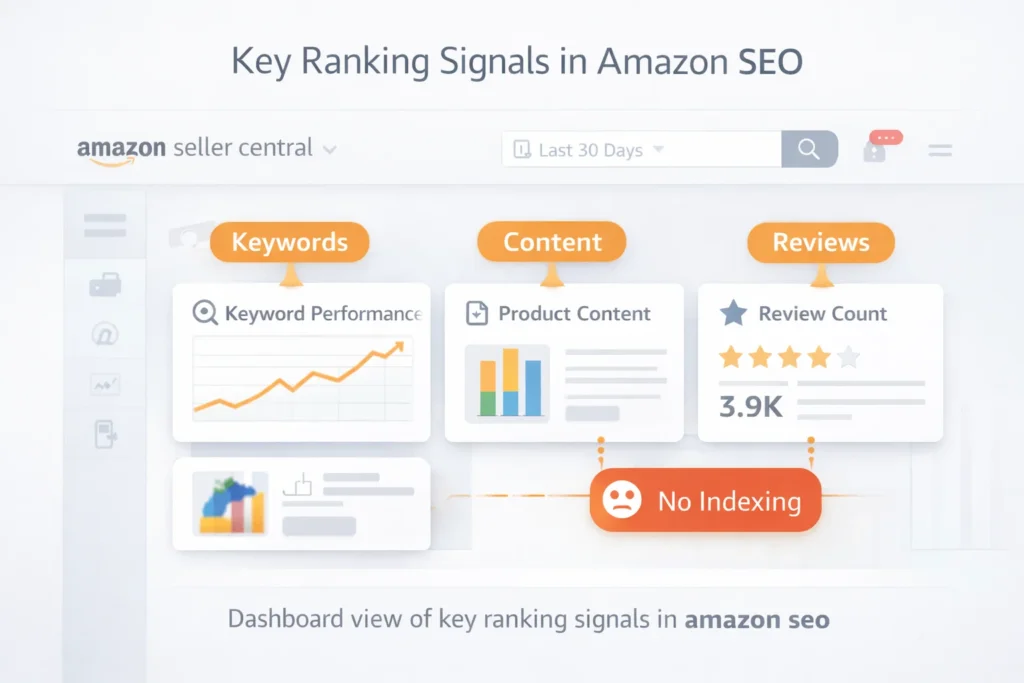
Many sellers struggle with amazon seo even after finding good keywords. You may rank nowhere despite strong research and effort. Therefore, you must understand what really blocks your listing from visibility.
Table of Contents
- Why Amazon SEO Fails Even with Good Keywords
- Understanding Amazon Indexing Issues
- Core Amazon Ranking Factors You Must Know
- Common Amazon SEO Mistakes Sellers Make
- Complete Listing Optimization Amazon Guide
- How to Track and Fix Performance Issues
- Frequently Asked Questions
- Conclusion
Why Amazon SEO Fails Even with Good Keywords
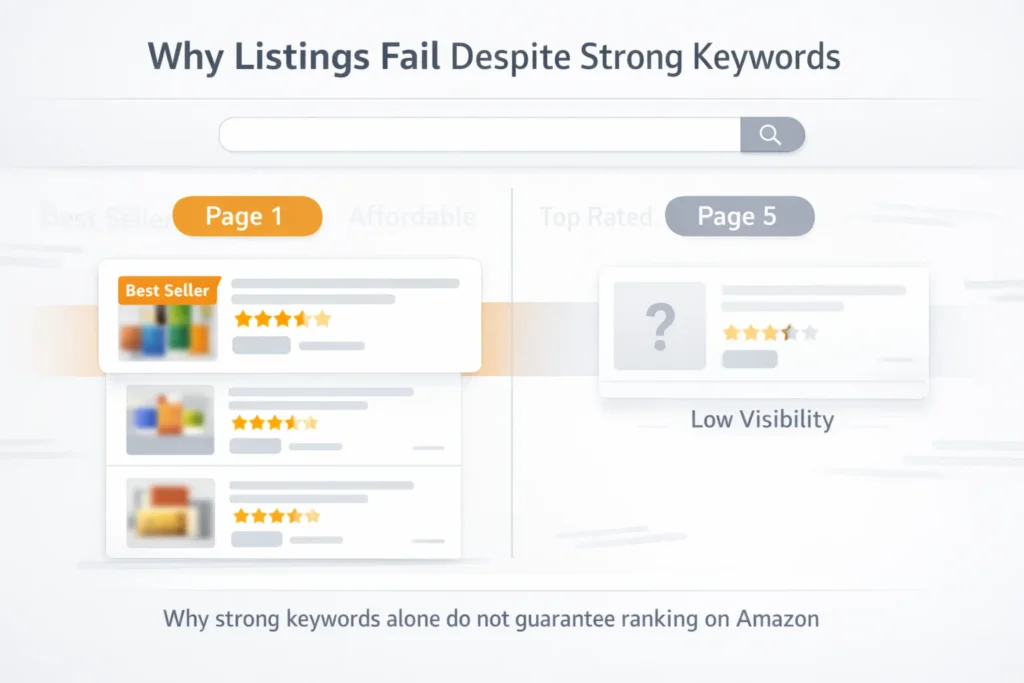
Firstly, keywords alone do not guarantee ranking. Amazon uses behavior data to decide visibility. Therefore, listings without sales rarely move up.
Secondly, poor listing structure weakens your relevance. Even strong keywords fail without proper placement. As a result, your product stays hidden.
Most importantly, conversion rate plays a huge role. If shoppers do not buy, rankings drop quickly. In contrast, high conversions boost visibility.
- Low click through rate reduces exposure
- Poor images lower buyer trust
- Weak copy reduces conversions
- Incorrect keyword placement hurts relevance
Warning: Good keywords without sales signals will not rank your listing.
Understanding Amazon Indexing Issues
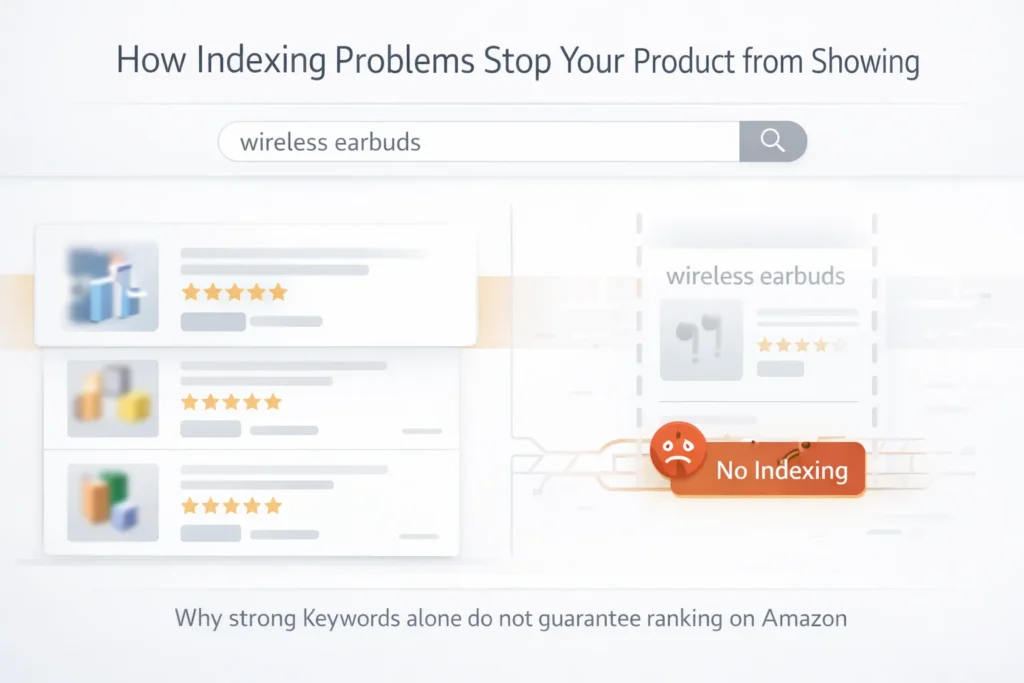
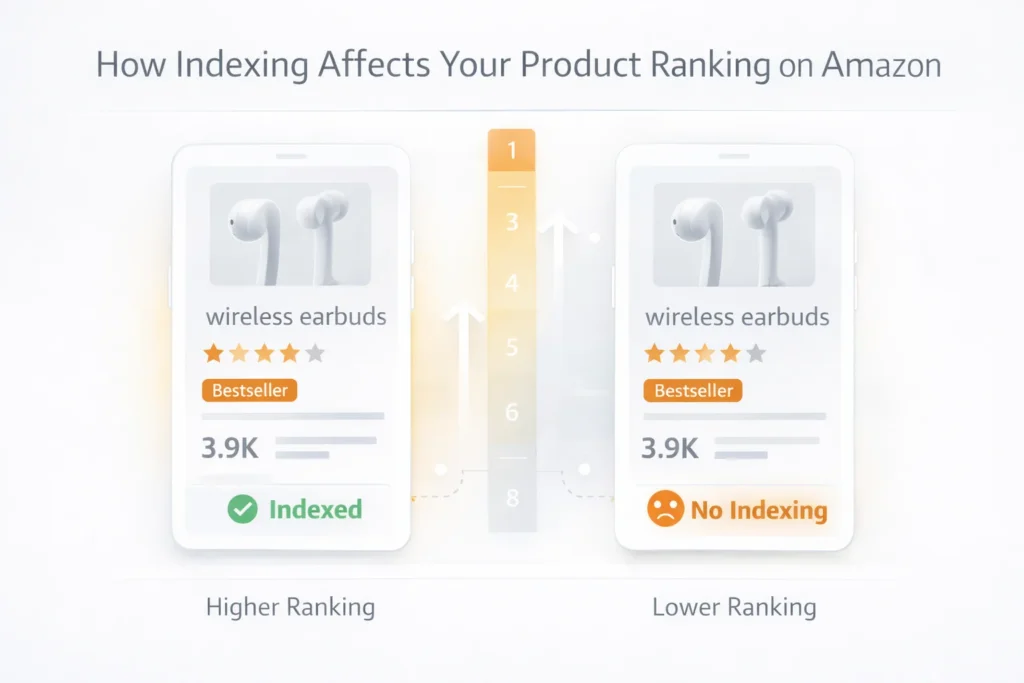
Amazon indexing issues happen when your product does not appear for search terms. This often confuses new sellers. However, indexing and ranking are different.
Indexing means Amazon recognizes your keyword. Ranking means your position in results. Therefore, you must check both regularly.
For example, use tools or search manually on Amazon search results. This helps confirm if your product shows.
Signs of Amazon Keyword Indexing Problems
- Your product does not appear for exact keyword search
- Backend keywords do not trigger visibility
- Long tail keywords fail to index
Additionally, avoid keyword stuffing. Amazon may ignore excessive repetition. Consequently, indexing fails silently.
Pro Tip: Use short and clear keywords across title, bullets, and backend fields.
Core Amazon Ranking Factors You Must Know
Amazon ranking factors go beyond keywords. The algorithm focuses on performance data. Therefore, you must optimize for sales.
Main Ranking Signals
- Sales velocity over time
- Click through rate from search
- Conversion rate on listing
- Customer reviews and ratings
In addition, pricing impacts conversions. Competitive pricing improves performance. As a result, your ranking improves.
You can learn more about listing strategy through our Services page.
Relevance vs Performance
Relevance comes from keywords and content. Performance comes from sales and engagement. Therefore, both must align.
| Factor | Impact on Ranking | Control Level |
|---|---|---|
| Keywords | Medium | High |
| Sales | Very High | Medium |
| Conversion Rate | High | High |
| Reviews | High | Low |
Table: Key amazon ranking factors explained
Common Amazon SEO Mistakes Sellers Make
Many sellers repeat the same amazon seo mistakes. These errors block growth even with good keywords. Therefore, fixing them improves results fast.
- Ignoring backend search terms
- Using irrelevant keywords
- Poor product images
- Weak Product Titles
In addition, duplicate keywords waste space. Amazon reads variations automatically. Consequently, you lose indexing opportunities.
For example, review competitor listings on Amazon best sellers. This helps identify gaps.
Complete Listing Optimization Amazon Guide
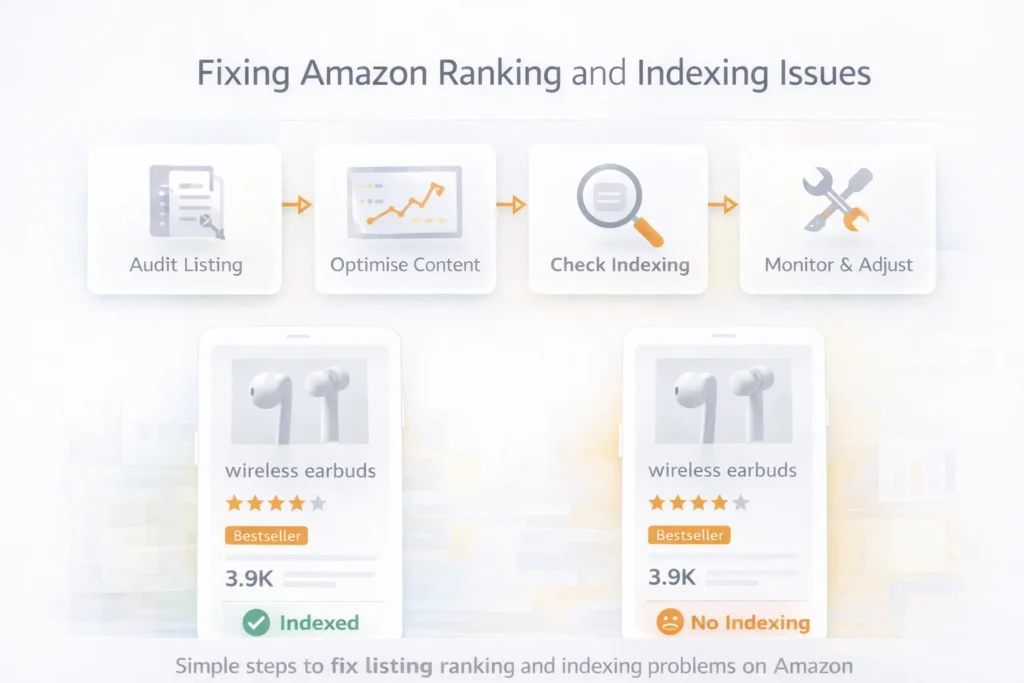
Listing optimization amazon requires structure and clarity. Every section must support conversions. Therefore, optimize each element carefully.
Key Areas to Optimize
- Title with primary keywords
- Bullet points focused on benefits
- High quality images
- Backend keyword field
Additionally, keep sentences simple and clear. Buyers scan quickly. As a result, clarity increases conversions.
Step by Step Optimization
- Research keywords and search intent
- Place main keywords in title
- Add secondary keywords in bullets
- Use backend for extra terms
- Improve images and A Plus Content
You can also explore our Services for full optimization support.
Pro Tip: Focus on conversion rate first, ranking follows naturally.
How to Track and Fix Performance Issues
Tracking helps you improve amazon seo results. Without data, you cannot fix problems. Therefore, monitor metrics daily.
- Track keyword ranking positions
- Monitor click through rate
- Check conversion rate changes
- Analyze competitor performance
Finally, test changes regularly. Small updates can improve results fast. Consequently, consistent optimization wins.
Frequently Asked Questions
Why is my Amazon Listing not ranking?
Your listing may lack sales or conversions. Amazon prioritizes performance data over keywords. What are amazon indexing issues?
These occur when your product does not appear for keywords. It means Amazon does not recognize your terms. How do I improve amazon keyword indexing?
Use keywords in title, bullets, and backend fields. Keep them relevant and avoid repetition. Does listing optimization amazon improve ranking?
Yes, better structure improves conversion rate. This leads to higher rankings over time. What are common amazon seo mistakes?
Sellers often ignore conversions, overuse keywords, and use weak images.
Ready to grow your Amazon business?
Get a free strategy call with Advertpreneur.Book Your Free Consultation
Conclusion
Amazon seo requires more than keywords. You must focus on conversions, indexing, and performance signals. Therefore, build listings that sell, not just rank.
In addition, avoid common amazon seo mistakes. Fix indexing issues and improve content structure. As a result, your rankings will improve steadily.
Finally, stay consistent with testing and optimization. Amazon rewards sellers who improve performance over time. Focus on results and growth will follow.
What is Amazon SEO?
Amazon SEO (Search Engine Optimization) is the process of optimizing product listings to rank higher in Amazon’s internal search results. When a shopper types a query into the Amazon search bar, Amazon’s A10 algorithm scans millions of listings and ranks them based on relevance, conversion history, and seller performance. Amazon SEO is the practice of aligning your listing with what the A10 algorithm rewards.
Amazon SEO is different from Google SEO. While Google optimizes for information, Amazon’s search engine optimizes for purchases. Every ranking signal Amazon weighs is tied to the likelihood that a listing will convert.
Why Amazon SEO Matters for US Sellers
More than 70% of Amazon shoppers never scroll past the first page of search results. For US sellers competing in crowded categories, appearing on page 1 is the difference between generating sales daily and going unnoticed. Amazon SEO is the organic, sustainable path to page 1 — without paying for every click.
How the Amazon A10 Algorithm Works
Amazon’s A10 algorithm (the successor to A9) ranks products based on several weighted signals:
- Click-Through Rate (CTR) — How often shoppers click your listing when it appears in search results. Your main image and title drive CTR.
- Conversion Rate (CVR) — The percentage of visitors who purchase. This is the most heavily weighted signal in A10.
- Sales Velocity — How many units you sell per day. Higher velocity signals demand and pushes rankings higher.
- Relevance — How closely your title, bullets, description, and backend keywords match the shopper’s query.
- Seller Authority — Your account health, review count, and feedback score.
- External Traffic — Traffic from outside Amazon (Google, social media) that converts on your listing now carries positive ranking weight in A10.
The 5 Core Elements of Amazon SEO
1. Keyword Research Keyword research is the foundation. Use tools like Helium 10’s Magnet or Jungle Scout’s Keyword Scout to identify high-volume, relevant search terms. Focus on: primary keywords (highest volume), secondary keywords (supporting terms), and long-tail keywords (lower competition, higher buyer intent).
2. Title Optimization Your Amazon product title is the most important SEO field. It should include your primary keyword within the first 80 characters, your brand name, key product attributes (size, color, material), and a conversion hook. Amazon allows up to 200 characters for most categories.
3. Bullet Points The five bullet points serve a dual purpose: keyword indexing for the algorithm and conversion copy for the shopper. Each bullet should start with a benefit keyword, not a feature. For example: “WATERPROOF PROTECTION: Sealed lining keeps contents dry in heavy rain” outperforms “Made from waterproof materials.”
4. Backend Search Terms The backend search term field (up to 250 bytes) is invisible to shoppers but indexed by Amazon. Include synonyms, alternate spellings, Spanish-language terms for US Hispanic buyers, and related search terms that didn’t fit in the visible copy.
5. A+ Content A+ Content (formerly Enhanced Brand Content) replaces the standard product description for Brand Registry members. It adds rich images, comparison charts, and brand storytelling. Amazon reports that A+ Content increases conversion rates by an average of 3-10%, and higher conversions directly improve organic rankings.
Amazon SEO vs Google SEO: Key Differences
| Factor | Amazon SEO | Google SEO |
|---|---|---|
| Primary goal | Purchase conversion | Information retrieval |
| Main ranking signal | Conversion rate + sales velocity | Backlinks + content authority |
| Timeframe for results | 2-6 weeks | 3-12 months |
| Keyword research tools | Helium 10, Jungle Scout, Brand Analytics | Ahrefs, Semrush, Google Keyword Planner |
| Content format | Titles, bullets, backend terms | Blog posts, pages, schema |
| External traffic impact | Positive (A10 rewards it) | Core requirement |
Common Amazon SEO Mistakes
- Keyword stuffing titles with commas and symbols (Amazon penalizes this)
- Ignoring the backend search terms entirely
- Writing bullets as feature lists instead of benefit-driven copy
- Using competitor brand names in backend terms (against Amazon TOS)
- Not updating listings when seasonal keywords shift
- Neglecting images — low CTR from poor images tanks SEO regardless of keyword quality
How Long Does Amazon SEO Take?
Most sellers see movement in rankings within 2-6 weeks of a full listing optimization. Sales velocity and conversion rate improvements are the fastest path to accelerated ranking. Pairing Amazon SEO with a PPC campaign during the initial launch period drives the sales velocity needed to push the algorithm faster.
FAQ: Amazon SEO
What is the difference between Amazon SEO and Amazon PPC? Amazon SEO improves your organic (unpaid) ranking through listing optimization. Amazon PPC (Pay-Per-Click) pays for ad placement in search results. They work best together: PPC drives immediate visibility and sales velocity while SEO builds sustainable long-term ranking.
Do I need Brand Registry for Amazon SEO? No — any seller can optimize titles, bullets, and backend keywords. However, Brand Registry unlocks A+ Content, which significantly improves conversion rates and supports SEO indirectly.
How many keywords should I target? Focus on 3-5 primary keywords for your title and bullets. Use your remaining keyword variations in the backend search terms. Quality and relevance matter more than quantity.
Can I hire an agency for Amazon SEO? Yes. A specialized Amazon SEO agency like advertpreneur conducts keyword research, writes optimized listings, and monitors ranking changes on your behalf. Get a free consultation here.
Introduction
Amazon listing optimization is the foundation of Amazon success. A well-optimized listing can increase conversion rates by 30-50% and improve organic rankings, driving more sales without additional ad spend.
But most Amazon sellers make critical optimization mistakes that hurt their rankings and conversions. They focus on the wrong elements, ignore important factors, or optimize once and never update.
In this comprehensive guide, we’ll share 15 proven Amazon listing optimization strategies. These are the same techniques we use to help sellers achieve page 1 rankings and double their sales.
Why Amazon Listing Optimization Matters
The Impact:
Ranking Impact:
- Better rankings – Optimized listings rank higher
- More visibility – Appear in more searches
- Organic traffic – Free traffic from search
- Long-term growth – Sustainable rankings
Conversion Impact:
- Higher conversion rates – Better listings convert better
- More sales – Optimized = more purchases
- Lower returns – Clear expectations = fewer returns
- Better reviews – Happy customers = better ratings
Business Impact:
- Increased revenue – More sales = more profit
- Lower ACoS – Better listings = better PPC performance
- Competitive advantage – Stand out from competitors
- Brand building – Professional listings build trust
15 Amazon Listing Optimization Strategies
1. Optimize Your Product Title
Why it matters:
- Most important SEO element – Heavily weighted by algorithm
- First impression – What customers see first
- Primary ranking factor – Determines search visibility
How to optimize:
- Place primary keyword in first 50 characters
- Use all 200 characters available
- Include brand name, key features, use cases
- Add size/color/variations if applicable
- Keep it natural and readable (no keyword stuffing)
Example: ❌ Bad: “Headphones” ✅ Good: “Wireless Bluetooth Headphones, Noise Cancelling Over-Ear Headphones with 30H Battery, Hi-Fi Sound, Quick Charge, for Travel Work Home Office – Black”
2. Write Compelling Bullet Points
Why it matters:
- Second most important SEO element
- Conversion driver – Converts browsers to buyers
- Keyword placement – Secondary keyword opportunities
How to optimize:
- Lead with benefits – What’s in it for customers
- Include keywords naturally – Don’t force them
- Address pain points – Solve customer problems
- Use formatting – Bold text, line breaks
- Stay under 500 characters per bullet
- Use 5-7 bullet points – Cover all key benefits
Example: ❌ Bad: “Bluetooth connectivity” ✅ Good: “Wireless Freedom: Advanced Bluetooth 5.0 technology provides seamless connectivity up to 33 feet, perfect for workouts, commuting, or working from home. No more tangled wires or connection drops.”
3. Optimize Backend Keywords
Why it matters:
- Hidden SEO goldmine – 250 bytes for keywords
- No customer clutter – Keep listing clean
- More discoverability – Target additional terms
How to optimize:
- Use all 250 bytes – Every character counts
- No repetition – Don’t repeat title/bullet keywords
- Include synonyms – “headphones”, “earphones”, “earbuds”
- Add misspellings – Common typos
- Use long-tail keywords – Specific phrases
- Separate with commas – Clean formatting
4. Create High-Quality Product Images
Why it matters:
- 75% of shoppers influenced by images
- 30% better conversion with good images
- Reduces returns – Sets proper expectations
How to optimize:
- Use all 9 image slots – Maximum visibility
- Main image: White background, product fills 85%
- Lifestyle images – Product in use
- Infographics – Key features and benefits
- Comparison charts – Your product vs competitors
- Size guides – Help with sizing decisions
- Meet Amazon requirements – 1000px minimum, JPEG/PNG
5. Write Detailed Product Descriptions
Why it matters:
- SEO value – Additional keyword opportunities
- Conversion driver – Detailed info converts better
- Reduces questions – Answers customer queries
How to optimize:
- Natural keyword integration – Don’t stuff keywords
- Tell your brand story – Build emotional connection
- Include specifications – Technical details
- Use formatting – Paragraphs, bold, lists
- Address FAQs – Answer common questions
- Focus on benefits – What customers get
6. Add A+ Content (Enhanced Brand Content)
Why it matters:
- 5-10% conversion boost – Proven impact
- Reduces returns – Better expectations
- Brand building – Stand out from competitors
How to optimize:
- Visual storytelling – Compelling images
- Feature highlights – Key benefits showcased
- Comparison charts – Competitive advantages
- Brand story – Connect emotionally
- Mobile-optimized – 70%+ traffic is mobile
- Professional design – High-quality visuals
7. Optimize for Mobile
Why it matters:
- 70%+ of Amazon traffic is mobile
- Mobile conversion often lower
- Mobile-first indexing – Amazon prioritizes mobile
How to optimize:
- Short, scannable titles – Mobile shows fewer characters
- Clear bullet points – Easy to read on small screens
- Fast-loading images – Optimize file sizes
- Mobile-friendly A+ Content – Test on devices
- Simple navigation – Easy to use on mobile
8. Get More Customer Reviews
Why it matters:
- Social proof – Builds trust
- Ranking factor – More reviews = better ranking
- Conversion driver – Reviews increase sales
How to optimize:
- Use Amazon’s Request a Review – Automated follow-up
- Provide excellent service – Happy customers review
- Follow up with buyers – Polite request for feedback
- Respond to reviews – Show you care
- Consider Amazon Vine – Early reviews for new products
9. Optimize Pricing Strategy
Why it matters:
- Buy Box eligibility – Competitive pricing wins Buy Box
- Conversion impact – Right price = more sales
- Profitability – Balance price and margin
How to optimize:
- Research competitors – Know market prices
- Price competitively – Not always lowest
- Consider value – Quality justifies price
- Test pricing – Find sweet spot
- Monitor Buy Box – Win rate matters
10. Improve Inventory Management
Why it matters:
- Out of stock = no ranking – Can’t rank if unavailable
- Buy Box eligibility – Stock affects Buy Box
- Customer satisfaction – Fast shipping builds trust
How to optimize:
- Maintain stock levels – Never go out of stock
- FBA for Prime – Faster shipping, better ranking
- Forecast demand – Plan inventory ahead
- Monitor stock levels – Daily checks
- Quick restocking – Minimize downtime
11. Use Enhanced Brand Content Strategically
Why it matters:
- Conversion boost – 5-10% increase common
- Brand differentiation – Stand out
- Trust building – Professional appearance
How to optimize:
- Tell your story – Brand narrative
- Showcase benefits – Visual feature highlights
- Include comparisons – Competitive advantages
- Use high-quality visuals – Professional images
- Mobile-optimized – Test on devices
- Update regularly – Keep content fresh
12. Optimize for Search Intent
Why it matters:
- Better matching – Amazon shows you to right customers
- Higher conversion – Relevant traffic converts
- Better rankings – Relevance = ranking boost
How to optimize:
- Match keywords to intent – Buying vs browsing
- Use commercial keywords – “buy”, “best”, “review”
- Address search queries – Answer what customers search
- Optimize for questions – “how to”, “what is”
- Seasonal optimization – Match seasonal searches
13. Monitor and Respond to Customer Questions
Why it matters:
- Keyword opportunities – Questions reveal searches
- Conversion impact – Answered questions = more sales
- Trust building – Shows you care
How to optimize:
- Answer quickly – Within 24 hours
- Be helpful – Provide detailed answers
- Use keywords – Naturally in answers
- Address concerns – Build confidence
- Update listing – Add common Q&As to description
14. Optimize Product Variations
Why it matters:
- More visibility – Each variation can rank
- Better conversion – Customers find exact product
- Cross-selling – Show related options
How to optimize:
- Set up parent-child – Proper variation structure
- Optimize each variation – Unique titles/bullets
- Clear differentiation – Size, color, style
- Proper images – Show each variation
- Accurate attributes – Match Amazon requirements
15. Continuously Test and Optimize
Why it matters:
- Amazon changes – Algorithm updates
- Competition changes – Stay ahead
- Performance data – Learn what works
How to optimize:
- A/B test titles – Test different keywords
- Test bullet points – Different benefit focuses
- Monitor rankings – Track keyword positions
- Analyze conversion – What converts best
- Update quarterly – Regular optimization
- Test new strategies – Stay innovative
Amazon Listing Optimization Checklist
Title Optimization
Bullet Points
Backend Keywords
Images
Description & A+ Content
Reviews & Social Proof
Ongoing Optimization
Measuring Listing Optimization Success
Key Metrics:
- Keyword Rankings
- Track positions for target keywords
- Monitor weekly
- Identify improvements
- Organic Traffic
- Sessions from organic search
- Compare before/after
- Track growth
- Conversion Rate
- Sales ÷ Page Views
- Target: 10-15%+
- Higher = better optimization
- Sales Velocity
- Units sold per day/week
- Increasing = better ranking
- Monitor consistency
- Return Rate
- Returns ÷ Total Sales
- Lower = better expectations set
- Target: Under 5%
Common Listing Optimization Mistakes
1. Keyword Stuffing
❌ Mistake: “Wireless Wireless Bluetooth Bluetooth Headphones Wireless” ✅ Solution: Natural integration, readable copy
2. Ignoring Backend Keywords
❌ Mistake: Only optimizing visible content ✅ Solution: Use all 250 bytes strategically
3. Poor Images
❌ Mistake: Low-quality, few images ✅ Solution: Professional photos, use all 9 slots
4. Weak Bullet Points
❌ Mistake: Features without benefits ✅ Solution: Lead with benefits, address pain points
5. Not Updating
❌ Mistake: Set it and forget it ✅ Solution: Regular optimization based on data
6. Ignoring Mobile
❌ Mistake: Desktop-only optimization ✅ Solution: Mobile-first approach
7. No A+ Content
❌ Mistake: Missing conversion opportunity ✅ Solution: Create Enhanced Brand Content
Conclusion: Optimize for Rankings and Conversions
Amazon listing optimization is an ongoing process that requires strategic thinking, data analysis, and continuous improvement. The 15 strategies above will help you create listings that rank well AND convert browsers into buyers.
Key Principles:
- Balance SEO and conversion – Rank AND convert
- Optimize all elements – Title, bullets, images, backend
- Mobile-first – 70%+ traffic is mobile
- Test and optimize – Data-driven improvements
- Update regularly – SEO is ongoing
Remember: Optimization is never done. Amazon’s algorithm changes, competition evolves, and customer behavior shifts. Continuous optimization keeps you ahead.
Need Professional Amazon Listing Optimization?
Our Amazon listing optimization service includes comprehensive keyword research, competitor analysis, and strategic optimization of all listing elements. We’ll help you rank higher, convert better, and drive more organic sales.
Related Resources
- → Amazon PPC Basics: Simple Guide for Beginners
- → 7 Amazon Sponsored Products Strategies That Lower ACoS by 40%
- → Complete Guide to Amazon SEO: How to Rank Your Products on Page 1 in 2025
- → Amazon A+ Content: How to Create Conversion-Optimized Enhanced Brand Content
- → Amazon Keyword Research: The Ultimate Guide to Finding Profitable Keywords
- → Amazon Product Title Optimization: How to Write Titles That Rank and Convert
Introduction
Amazon A+ Content (Enhanced Brand Content) is one of the most powerful tools for increasing product conversions. Studies show that A+ Content can boost conversion rates by 5-10% and significantly reduce returns by setting proper customer expectations.
But creating effective A+ Content isn’t just about adding pretty images—it’s about strategic storytelling, conversion optimization, and understanding what makes customers click “Add to Cart.”
In this comprehensive guide, we’ll teach you everything you need to know about creating Amazon A+ Content that converts browsers into buyers and drives real sales growth.
What is Amazon A+ Content?
Amazon A+ Content (also called Enhanced Brand Content or EBC) is premium content that allows brand-registered sellers to add rich media, detailed product information, and brand storytelling to their product listings.
Key Features:
- Rich visual content – Images, infographics, comparison charts
- Extended product information – Beyond standard listing fields
- Brand storytelling – Connect with customers emotionally
- Mobile-optimized – Automatically responsive
- Free for Brand Registry sellers – No additional cost
Who Can Use A+ Content?
- Brand Registry sellers – Must be enrolled in Amazon Brand Registry
- Vendor Central sellers – Automatic access
- Some third-party sellers – Limited access in certain categories
Why Amazon A+ Content Matters
The Impact of A+ Content:
Conversion Rate Increase:
- Average 5-10% conversion rate boost
- Some sellers see 15-20% increases
- Higher conversions = better organic rankings
Return Rate Reduction:
- Better set expectations = fewer returns
- Detailed product info = informed purchases
- Visual storytelling = reduced buyer’s remorse
Brand Building:
- Tell your brand story – Build emotional connection
- Showcase brand values – Stand out from competitors
- Professional appearance – Builds trust and credibility
SEO Benefits:
- Indirect SEO boost – Higher conversions improve rankings
- More time on page – Signals quality to Amazon
- Lower bounce rate – Engaged customers stay longer
Types of Amazon A+ Content Modules
Amazon offers various A+ Content modules. Here are the most effective:
1. Standard Image with Text
- Best for: Feature highlights, benefits
- Layout: Image on left/right, text on opposite side
- Use case: Explain key features with visuals
2. Standard Single Image and Sidebar
- Best for: Hero product shots
- Layout: Large image with sidebar text
- Use case: Main product showcase
3. Standard Four Image and Text
- Best for: Multiple features
- Layout: 4 images with text blocks
- Use case: Comprehensive feature overview
4. Standard Single Image and Specifications
- Best for: Technical products
- Layout: Image with detailed specs table
- Use case: Electronics, appliances, technical items
5. Comparison Chart
- Best for: Competitive advantage
- Layout: Side-by-side comparison
- Use case: Show why your product is better
6. Standard Image and Dark Text Overlay
- Best for: Lifestyle images
- Layout: Text overlaid on image
- Use case: Emotional storytelling
7. Standard Three Images and Text
- Best for: Product variations
- Layout: 3 images with descriptions
- Use case: Show different models/colors
Amazon A+ Content Best Practices
1. Lead with Benefits, Not Features
❌ Bad: “Our headphones have Bluetooth 5.0 technology” ✅ Good: “Wireless Freedom: Advanced Bluetooth 5.0 keeps you connected up to 33 feet away, perfect for workouts, commuting, or working from home.”
2. Use High-Quality Images
Image Requirements:
- Minimum 970px width for standard modules
- High resolution – Crisp, professional photos
- Consistent style – Match your brand aesthetic
- Optimized file size – Fast loading times
Image Types to Include:
- Lifestyle photos – Product in real use
- Infographics – Key features and benefits
- Comparison charts – Your product vs competitors
- Detail shots – Close-ups of important features
- Size guides – Help customers visualize
3. Tell Your Brand Story
Effective Brand Story Elements:
- Origin story – How your brand started
- Mission and values – What you stand for
- Quality commitment – Why customers should trust you
- Customer focus – How you serve buyers
Example Structure:
- Who We Are – Brand introduction
- Our Mission – What drives you
- Quality Promise – Why you’re different
- Customer Commitment – How you serve buyers
4. Address Customer Pain Points
Identify Pain Points:
- Read customer reviews – What problems do they mention?
- Check competitor reviews – What do customers complain about?
- Analyze Q&A sections – What questions come up?
- Use keyword research – What problems do searches reveal?
Address in A+ Content:
- Show how your product solves specific problems
- Use before/after comparisons
- Highlight problem-solving features
- Include testimonials or social proof
5. Use Social Proof Strategically
Types of Social Proof:
- Customer testimonials – Real quotes (with permission)
- Usage statistics – “Trusted by 50,000+ customers”
- Awards and certifications – Build credibility
- Press mentions – Media recognition
Placement:
- Near the top for immediate trust
- Throughout content for reinforcement
- At the bottom to close the sale
6. Optimize for Mobile
Mobile Considerations:
- 70%+ of Amazon traffic is mobile – Must look great on phones
- Test on devices – View your A+ Content on mobile
- Large, readable text – Easy to read on small screens
- Touch-friendly layouts – Consider thumb navigation
- Fast loading – Optimize image sizes
7. Include Clear CTAs
Effective CTAs in A+ Content:
- “Add to Cart” reminders (subtle, not pushy)
- “Learn More” for additional information
- “See All Features” to drive engagement
- “Check Reviews” to build trust
Amazon A+ Content Design Strategy
Design Principles:
1. Visual Hierarchy
- Most important info first – Lead with key benefits
- Use headings – Break up content for scannability
- White space – Don’t overcrowd modules
- Consistent styling – Match your brand
2. Color Psychology
- Brand colors – Reinforce brand identity
- Contrast – Ensure readability
- Emotional triggers – Use colors that match product type
- Accessibility – High contrast for readability
3. Typography
- Readable fonts – Clear, professional typefaces
- Size hierarchy – Headings > subheadings > body
- Line spacing – Comfortable reading experience
- Bold for emphasis – Highlight key points
4. Image Selection
- Professional photography – High-quality images
- Consistent style – Cohesive visual identity
- Relevant images – Support the content
- Optimized sizes – Fast loading, high quality
Step-by-Step: Creating Your A+ Content
Step 1: Research and Planning
Before You Start:
Step 2: Content Outline
Structure Your Content:
- Hero Section – Main product showcase
- Key Features – Top 3-5 benefits
- Problem/Solution – Address pain points
- Comparison – Why choose you?
- Brand Story – Connect emotionally
- Social Proof – Build trust
- Final CTA – Encourage purchase
Step 3: Create Visual Assets
Assets Needed:
- Product lifestyle photos
- Feature infographics
- Comparison charts
- Brand elements (logos, colors)
- Size/usage guides
Tools for Creating A+ Content:
- Canva – Easy graphic design
- Adobe Photoshop/Illustrator – Professional design
- Figma – Collaborative design
- Amazon’s A+ Content Manager – Built-in tools
Step 4: Write Compelling Copy
Copywriting Tips:
- Lead with benefits – What’s in it for them?
- Use power words – “Transform”, “Revolutionary”, “Ultimate”
- Be specific – “30-hour battery” not “long battery”
- Create urgency – “Limited time”, “Exclusive”
- Address objections – “Worried about fit? See our size guide”
Step 5: Build in A+ Content Manager
In Amazon Seller Central:
- Go to Advertising → A+ Content Manager
- Click “Create A+ Content”
- Choose template or custom layout
- Add modules and content
- Preview on desktop and mobile
- Submit for approval
Step 6: Submit and Wait for Approval
Approval Process:
- Usually 7 days for review
- Common rejections: Copyright issues, poor quality images, prohibited content
- Fix and resubmit if rejected
- Once approved – Assign to products
Amazon A+ Content Examples and Templates
Example 1: Electronics Product
Structure:
- Hero image with key benefit headline
- Feature grid (4 key features with icons)
- Technical specifications table
- Comparison chart vs competitors
- Brand story section
- Customer testimonials
Example 2: Fashion/Apparel
Structure:
- Lifestyle hero image
- Material and quality highlights
- Size and fit guide
- Styling suggestions
- Care instructions
- Brand values and sustainability
Example 3: Home & Kitchen
Structure:
- Product in use (lifestyle)
- Key features with benefits
- How it works (step-by-step)
- Comparison with alternatives
- Customer reviews highlights
- Warranty and support info
Common A+ Content Mistakes to Avoid
1. Too Much Text, Not Enough Visuals
❌ Mistake: Walls of text that overwhelm ✅ Solution: Balance text with compelling visuals
2. Generic Content
❌ Mistake: Same content for all products ✅ Solution: Customize for each product’s unique value
3. Poor Image Quality
❌ Mistake: Low-res, unprofessional images ✅ Solution: Invest in professional photography
4. Ignoring Mobile
❌ Mistake: Only designing for desktop ✅ Solution: Test and optimize for mobile first
5. No Clear Value Proposition
❌ Mistake: Features without benefits ✅ Solution: Always explain “what’s in it for me”
6. Missing Brand Story
❌ Mistake: Only product features ✅ Solution: Include brand narrative and values
7. Not Testing
❌ Mistake: Set it and forget it ✅ Solution: A/B test different versions
Measuring A+ Content Success
Key Metrics:
- Conversion Rate
- Before vs after A+ Content
- Target: 5-10% increase
- Track in Seller Central
- Time on Page
- Longer engagement = better signal
- Use Amazon Brand Analytics
- Compare to category average
- Return Rate
- Lower returns = better expectations set
- Track in Seller Central
- Compare pre/post A+ Content
- Sales Velocity
- Units sold per day/week
- Higher velocity = better rankings
- Monitor for consistency
A+ Content Optimization Tips
1. A/B Testing
- Test different headlines
- Try different image styles
- Compare module layouts
- Measure what converts best
2. Seasonal Updates
- Update for holidays
- Seasonal imagery
- Holiday-specific messaging
- Plan 2-3 months ahead
3. Competitor Analysis
- See what competitors do
- Identify gaps in their content
- Find opportunities to differentiate
- Learn from their successes
4. Customer Feedback Integration
- Use review insights
- Address common questions
- Highlight praised features
- Fix mentioned issues
A+ Content for Different Product Categories
Electronics:
- Technical specifications
- Compatibility information
- Setup guides
- Warranty details
Fashion/Apparel:
- Size guides
- Material information
- Care instructions
- Styling tips
Home & Kitchen:
- Usage instructions
- Cleaning guides
- Safety information
- Recipe ideas (if applicable)
Beauty/Personal Care:
- Ingredient lists
- Usage instructions
- Results expectations
- Safety warnings
Conclusion: Create A+ Content That Converts
Amazon A+ Content is a powerful tool for increasing conversions, reducing returns, and building your brand. But success requires strategic planning, high-quality assets, and customer-focused messaging.
Key Takeaways:
- Lead with benefits – Always explain what’s in it for customers
- Use quality visuals – Professional images make a difference
- Tell your story – Build emotional connection with your brand
- Address pain points – Show how you solve problems
- Test and optimize – Continuously improve based on data
Remember: A+ Content should convert browsers into buyers, not just look pretty. Every element should serve the goal of driving sales.
Need Professional A+ Content Design?
Our A+ Content Design service creates conversion-optimized Enhanced Brand Content that boosts sales and reduces returns. We handle everything from strategy to design to Amazon submission.
Related Resources
- → Amazon PPC Basics: Simple Guide for Beginners
- → 7 Amazon Sponsored Products Strategies That Lower ACoS by 40%
- → Amazon Listing Optimization: 15 Ways to Improve Your Product Listings
- → Complete Guide to Amazon SEO: How to Rank Your Products on Page 1 in 2025
- → Amazon Keyword Research: The Ultimate Guide to Finding Profitable Keywords
- → Amazon Product Title Optimization: How to Write Titles That Rank and Convert
Introduction
Your Amazon product title is the most important SEO element on your listing. It’s the first thing customers see, the primary ranking factor, and your biggest opportunity to capture attention and drive clicks.
The stakes are high: Get your title wrong, and you’ll struggle to rank. Get it right, and you’ll dominate search results and drive organic sales.
In this comprehensive guide, we’ll teach you everything you need to know about Amazon product title optimization. You’ll learn proven formulas, best practices, and real examples that rank and convert.
Why Amazon Product Titles Matter
The Impact of Title Optimization:
SEO Impact:
- Primary ranking factor – Amazon’s algorithm heavily weights titles
- First 50 characters get most weight in search
- Keyword placement determines search visibility
- Relevance matching – How well you match customer searches
Conversion Impact:
- First impression – Title is what customers see first
- Click-through rate – Better titles = more clicks
- Trust building – Professional titles build credibility
- Expectation setting – Clear titles reduce returns
The Numbers:
- 70% of shoppers never click past page 1
- Top 3 results get 64% of all clicks
- Title optimization can improve rankings by 20-40%
- Better titles can increase CTR by 15-25%
Amazon Title Requirements and Limits
Character Limits:
- Maximum: 200 characters
- Recommended: Use all 200 characters
- Minimum: At least 50-80 characters for basic info
Format Requirements:
- No HTML – Plain text only
- No special characters – Avoid symbols, emojis
- No promotional text – “Free shipping”, “On sale” (against policy)
- No ALL CAPS – Use proper capitalization
- No misleading claims – Must be accurate
Category-Specific Rules:
- Books: Author, title, edition
- Electronics: Brand, model, key specs
- Apparel: Brand, style, size, color
- Home & Kitchen: Brand, type, key features
The Amazon Title Optimization Formula
Standard Title Structure:
[Brand] + [Primary Keyword] + [Key Feature 1] + [Key Feature 2] + [Target Audience/Use Case] + [Size/Color/Variation]
Breaking Down Each Element:
1. Brand Name
- Placement: Usually first or second
- Purpose: Brand recognition and trust
- Example: “Sony”, “Apple”, “YourBrand”
2. Primary Keyword
- Placement: Within first 50 characters (critical!)
- Purpose: Main search term you want to rank for
- Example: “Wireless Bluetooth Headphones”
3. Key Features
- Placement: After primary keyword
- Purpose: Differentiation and additional keywords
- Example: “Noise Cancelling”, “30-Hour Battery”
4. Target Audience/Use Case
- Placement: Middle to end
- Purpose: Attract specific customer segments
- Example: “for Travel”, “for Gym”, “for Office”
5. Size/Color/Variation
- Placement: End of title
- Purpose: Help customers find exact product
- Example: “Black”, “15-inch”, “10-Pack”
Amazon Title Best Practices
1. Place Primary Keyword in First 50 Characters
Why it matters:
- Amazon gives most weight to early keywords
- First 50 characters appear in search results
- Mobile shows even fewer characters
- Early placement = better ranking
Example: ❌ Bad: “Premium Quality Wireless Bluetooth Headphones with Advanced Noise Cancelling Technology” ✅ Good: “Wireless Bluetooth Headphones, Noise Cancelling Over-Ear Headphones with 30H Battery”
2. Use All 200 Characters
Maximize opportunities:
- More keywords = more ranking chances
- More information = better matching
- More features = higher conversion potential
How to fill 200 characters:
- Include multiple keywords
- Add key features and benefits
- Specify use cases
- Include size/color/variations
3. Include Numbers and Specifics
Specificity converts:
- “30-hour battery” > “long battery”
- “10-pack” > “pack”
- “15-inch” > “large”
- “5.0 Bluetooth” > “Bluetooth”
Why it works:
- Sets clear expectations
- Helps customers find exact product
- Reduces returns
- Improves conversion rate
4. Lead with Benefits When Possible
Benefit-focused titles:
- “Noise Cancelling” (benefit) > “Active Noise Reduction” (feature)
- “Waterproof” (benefit) > “IPX7 Rated” (technical)
- “Lightweight” (benefit) > “0.5 lbs” (spec, but also benefit)
Balance:
- Include both benefits and features
- Use customer language
- Avoid technical jargon (unless necessary)
5. Use Natural Language
Readability matters:
- Titles should read naturally
- Avoid keyword stuffing
- Maintain grammar and flow
- Sound like human writing
Example: ❌ Bad: “Headphones Wireless Bluetooth Noise Cancelling Over Ear” ✅ Good: “Wireless Bluetooth Headphones, Noise Cancelling Over-Ear Headphones with 30H Battery”
6. Include Brand Name Strategically
Brand placement:
- First: If brand is well-known (Sony, Apple)
- Second: If keyword is more important
- Last: If brand is less known
When to include:
- Always include your brand
- Builds brand recognition
- Helps with brand searches
- Required for Brand Registry
7. Avoid Keyword Stuffing
Natural integration:
- Don’t repeat keywords unnecessarily
- Use variations and synonyms
- Maintain readability
- Focus on conversion, not just SEO
Example: ❌ Bad: “Wireless Wireless Bluetooth Bluetooth Headphones Wireless” ✅ Good: “Wireless Bluetooth Headphones, Noise Cancelling Over-Ear with Long Battery Life”
Amazon Title Optimization by Category
Electronics:
Structure: Brand + Product Type + Key Specs + Features + Use Case
Example: “Sony WH-1000XM4 Wireless Bluetooth Headphones, Noise Cancelling Over-Ear Headphones with 30H Battery, Hi-Fi Sound, Quick Charge, for Travel Work Home Office – Black”
Key Elements:
- Brand: Sony
- Product: Wireless Bluetooth Headphones
- Specs: 30H Battery, Quick Charge
- Features: Noise Cancelling, Hi-Fi Sound
- Use: Travel, Work, Home, Office
- Color: Black
Apparel:
Structure: Brand + Product Type + Style + Material + Size/Color
Example: “adidas Men’s Ultraboost 22 Running Shoes, Lightweight Athletic Sneakers with Boost Cushioning, Primeknit Upper, Size 10, Black/White”
Key Elements:
- Brand: adidas
- Product: Running Shoes
- Style: Athletic Sneakers
- Features: Lightweight, Boost Cushioning, Primeknit
- Size: 10
- Color: Black/White
Home & Kitchen:
Structure: Brand + Product Type + Key Features + Capacity/Size + Use Case
Example: “Instant Pot Duo 7-in-1 Electric Pressure Cooker, Slow Cooker, Rice Cooker, Steamer, Sauté, Yogurt Maker, Warmer & Sterilizer, 6 Quart, Stainless Steel”
Key Elements:
- Brand: Instant Pot
- Product: Pressure Cooker
- Features: 7-in-1 functions listed
- Size: 6 Quart
- Material: Stainless Steel
Step-by-Step: Optimizing Your Amazon Title
Step 1: Research Primary Keywords
Find your main keyword:
- Use Helium 10 or Jungle Scout
- Check Amazon autocomplete
- Analyze competitor titles
- Review customer search terms
Choose:
- High search volume
- Relevant to your product
- Commercial intent
- Achievable to rank for
Step 2: Analyze Top Competitors
Study top 10 listings:
- What keywords do they use?
- How do they structure titles?
- What features do they highlight?
- What’s their title length?
Learn from:
- Successful title patterns
- Keyword placement
- Feature prioritization
- Use case mentions
Step 3: List Key Features and Benefits
Brainstorm:
- Top 5-7 product features
- Main benefits to customers
- Unique selling points
- Use cases and applications
Prioritize:
- Most important features first
- Benefits over features when possible
- Customer language over technical terms
Step 4: Identify Target Audience
Define:
- Who buys this product?
- What are their use cases?
- Where do they use it?
- What problems does it solve?
Include in title:
- “for Travel”, “for Gym”, “for Office”
- “Professional”, “Home Use”, “Commercial”
- “Beginner”, “Advanced”, “Expert”
Step 5: Build Your Title
Follow the formula:
- Start with primary keyword (first 50 chars)
- Add brand name (if not first)
- Include key features
- Add use cases
- End with size/color/variation
Check:
- Primary keyword in first 50 characters ✓
- All 200 characters used ✓
- Natural and readable ✓
- No keyword stuffing ✓
- Includes brand ✓
Step 6: Test and Refine
After publishing:
- Monitor keyword rankings
- Track click-through rates
- Analyze conversion rates
- A/B test variations
- Update based on data
Common Title Optimization Mistakes
1. Primary Keyword Not in First 50 Characters
❌ Mistake: “Premium Quality [Brand] Wireless Bluetooth Headphones…” ✅ Solution: “Wireless Bluetooth Headphones [Brand] Premium Quality…”
2. Not Using All 200 Characters
❌ Mistake: “Wireless Headphones” (only 20 characters) ✅ Solution: Fill all 200 characters with relevant keywords
3. Keyword Stuffing
❌ Mistake: “Wireless Wireless Bluetooth Bluetooth Headphones Wireless” ✅ Solution: Natural integration: “Wireless Bluetooth Headphones, Noise Cancelling…”
4. Too Generic
❌ Mistake: “Headphones” ✅ Solution: “Wireless Bluetooth Headphones, Noise Cancelling Over-Ear with 30H Battery”
5. Missing Brand
❌ Mistake: No brand name in title ✅ Solution: Always include your brand
6. Using Prohibited Terms
❌ Mistake: “Free Shipping”, “On Sale”, “Best Seller” ✅ Solution: Only product attributes, no promotional text
7. Ignoring Mobile
❌ Mistake: Long, complex title that’s cut off on mobile ✅ Solution: Ensure first 50-80 characters are compelling
Advanced Title Optimization Strategies
1. A/B Testing Titles
Test variations:
- Different keyword placements
- Various feature orders
- Different use case mentions
- Test for 2-4 weeks each
- Measure CTR and conversions
2. Seasonal Optimization
Update for seasons:
- Add “Holiday”, “Gift” in Q4
- Add “Summer”, “Travel” in summer
- Add “Back to School” in August
- Remove after season
3. Competitor Gap Analysis
Find opportunities:
- Keywords competitors use but you don’t
- Features they highlight
- Use cases they mention
- Test in your title
4. Customer Language Matching
Use real customer terms:
- Extract from reviews
- Use Q&A language
- Match search patterns
- Natural over technical
Measuring Title Optimization Success
Key Metrics:
- Keyword Rankings
- Track positions for title keywords
- Monitor weekly
- Identify winning/losing keywords
- Click-Through Rate (CTR)
- Impressions vs clicks
- Higher CTR = better title
- Target: 0.5-1%+ CTR
- Conversion Rate
- Clicks vs sales
- Better titles = more conversions
- Monitor in Seller Central
- Organic Traffic
- Sessions from organic search
- Compare before/after
- Track growth over time
Amazon Title Optimization Checklist
Use this for every product:
Research Phase
Creation Phase
Optimization Phase
Conclusion: Write Titles That Rank and Convert
Amazon product title optimization is both art and science. The right title can catapult your product to page 1, while a poor title can keep you invisible.
Key Principles:
- Primary keyword first – Within first 50 characters
- Use all 200 characters – Maximize opportunities
- Natural and readable – Balance SEO with conversion
- Include specifics – Numbers, features, use cases
- Test and optimize – Data tells you what works
Remember: Your title must rank AND convert. It’s not enough to show up in search—you need to get clicks and sales.
Need Help with Amazon Title Optimization?
Our Amazon SEO optimization service includes strategic title optimization based on keyword research, competitor analysis, and conversion best practices. We’ll help you create titles that rank on page 1 and convert browsers into buyers.
Related Resources
- → Amazon PPC Basics: Simple Guide for Beginners
- → 7 Amazon Sponsored Products Strategies That Lower ACoS by 40%
- → Amazon Listing Optimization: 15 Ways to Improve Your Product Listings
- → Complete Guide to Amazon SEO: How to Rank Your Products on Page 1 in 2025
- → Amazon A+ Content: How to Create Conversion-Optimized Enhanced Brand Content
- → Amazon Keyword Research: The Ultimate Guide to Finding Profitable Keywords