Amazon Ads is making the AI shopping shift harder for sellers and agencies to ignore. In official Amazon Ads guidance published on August 5, 2026, Amazon explained how brands can connect with shoppers who are using AI agents to research, compare, and narrow product choices before a human buyer makes the final decision.
For Amazon sellers, Amazon Ads teams, and ecommerce service providers in the United States, the practical takeaway is clear: product content now has to serve both people and machine-assisted shopping journeys. Weak titles, thin product details, missing comparison context, poor imagery, inconsistent pricing signals, and neglected reviews can all reduce how confidently an AI assistant understands and recommends a product.
What The Official Amazon Ads Guidance Covers
Amazon Ads says AI shopping agents synthesize information across product details, reviews, pricing, inventory, and brand content. The guidance frames structure as a competitive advantage because AI-led shopping experiences depend on clear, organized, and complete product information.
Amazon also connects this trend to Alexa for Shopping, Sponsored Products and Sponsored Brands prompts, Alexa+ Conversational Ads, Prime Video Sponsored Tiles, and wider AI-powered Amazon Ads tools. A related official Amazon Ads newsroom article from June 11, 2026, explains that existing sponsored ads campaigns can become part of Alexa for Shopping conversational experiences without a separate setup path.
Why This Matters For Amazon Sellers
The old listing optimization model focused mainly on human search behavior: keyword relevance, image clarity, conversion copy, ratings, and price. Those fundamentals still matter, but AI shopping adds another layer. Sellers now need product pages that are easy for an assistant to interpret with confidence.
That means Amazon Seller Central operators should treat every major ASIN as a structured information asset. Product titles need to be specific without becoming cluttered. Bullet points should answer real shopper questions. A+ Content should clarify use cases, materials, sizing, compatibility, differentiation, and trust signals. Images should help shoppers and AI-assisted journeys understand the product quickly.
For Amazon FBA and FBM sellers, this is not only an Amazon Ads issue. If inventory availability, reviews, pricing, and content quality are inconsistent, the product may look weaker in a comparison-driven path even when the ad campaign is technically active.
Action Checklist For Amazon Seller Central Teams
- Audit top ASINs for information gaps. Check titles, bullets, A+ Content, images, variation structure, review themes, pricing, and inventory health.
- Rewrite bullets around decision criteria. Cover who the product is for, what problem it solves, what makes it different, and what buyers should verify before purchase.
- Improve comparison readiness. Add clear details on size, material, compatibility, bundle contents, care instructions, and use cases where relevant.
- Strengthen visual merchandising. Use lifestyle, scale, feature-callout, and comparison images that reduce uncertainty before checkout.
- Review Sponsored Products and Sponsored Brands structure. Make sure campaigns are aligned with the ASINs most likely to perform in high-intent conversational discovery.
- Monitor review language. Repeated customer questions or complaints should feed directly into listing copy, imagery, and product content updates.
What Agencies And Service Providers Should Do
Amazon service providers should update their audit frameworks. A listing review that only checks keyword placement is too narrow for agentic shopping. The stronger approach is to evaluate whether the product page can support search ranking, ad performance, human persuasion, and AI-assisted product comparison at the same time.
This is where creative, marketplace SEO, and Amazon Ads management need to work together. Advertpreneur’s A+ Content Design service and Amazon Listing Images service are directly relevant because richer visual and structured content can make the buying decision easier to understand across both traditional and AI-assisted shopping paths.
Source References
This analysis is based on official Amazon Ads sources: How brands can connect with customers who are shopping alongside AI agents and Agentic shopping is here. What does that mean for advertisers?.
Conclusion
Amazon’s AI shopping direction does not replace the fundamentals of Amazon marketplace growth. It raises the standard for them. Sellers that maintain clean product data, strong creative, persuasive A+ Content, stable inventory, and disciplined Amazon Ads structure are better positioned for discovery paths where shoppers ask questions, compare options, and expect useful recommendations quickly.
The strategic move is to stop treating content, advertising, and operations as separate lanes. For US Amazon sellers, AI shopping readiness is becoming part of the same performance system that already drives ranking, conversion, and paid media efficiency.
Amazon’s latest seller story is a useful playbook for brands trying to improve creative output without adding a full production team. In an official Amazon Selling Partners profile, Amazon highlighted how Funky Junque used Amazon’s seller ecosystem, including FBA, A+ Content, and Creative Studio, to support growth in the Amazon store.
This is not a new compliance rule or Seller Central deadline. It is a practical operator signal. Amazon is pushing more creative and content work into AI-assisted workflows, and sellers that treat creative production as an operating system will have an advantage over teams still waiting on slow one-off asset cycles.
What The Official Amazon Source Says
Amazon’s profile says Funky Junque is a Northbrook, Illinois headwear brand with thousands of active Amazon listings and a growth story built around product pivots, marketplace demand signals, FBA, A+ Content, and AI-supported creative workflows.
The story specifically points to Amazon Creative Studio as part of the brand’s content stack. Amazon describes Creative Studio as a toolset for independent sellers that can help create lifestyle images, video ads from static product images, and ready-to-run audio ads for sellers advertising in Amazon’s store.
Sources: Amazon Selling Partners profile of Funky Junque and Amazon Selling Partners Creative Studio page.
Why This Matters for Amazon Sellers
For US Amazon sellers, creative velocity is becoming part of marketplace competitiveness. Product listings, A+ Content, Sponsored Brands video, seasonal campaigns, and Amazon Ads assets all need stronger visuals than they did a few years ago. The old model of waiting weeks for every lifestyle shot, video edit, or campaign variant is too slow for sellers that need to test frequently.
Creative Studio matters because Amazon is making professional-grade asset production more accessible inside the seller ecosystem. That does not remove the need for brand strategy, product positioning, or quality control. It changes where the bottleneck sits. Sellers still need to decide what message to test, which product angle matters, and how creative connects to Amazon SEO, conversion rate, and campaign performance.
The Funky Junque story also shows a broader lesson: Amazon seller growth usually comes from connected operating decisions, not one isolated tool. Product development, catalog expansion, fulfillment, content quality, and advertising all support each other.
Operator Checklist for Creative Studio Readiness
- Audit your content gaps: Identify listings that lack strong lifestyle images, A+ Content, product-use visuals, video assets, or seasonal creative.
- Prioritize proven ASINs first: Start with products that already have demand, reviews, and traffic. Better creative has more impact when the product foundation is working.
- Build test themes: Plan creative variants around use case, audience, season, problem solved, giftability, material quality, or comparison angle.
- Connect creative to Amazon Ads: Use new visuals to support Sponsored Brands, Sponsored Brands video, Store pages, and upper-funnel campaigns where relevant.
- Keep brand control: AI-generated assets still need human review for accuracy, compliance, product truth, and brand consistency.
- Measure after launch: Track click-through rate, conversion rate, ACoS, TACoS, sessions, unit session percentage, and ranking movement after creative updates.
What Agencies and Service Providers Should Do
Amazon agencies should treat Creative Studio as a way to increase testing discipline, not as a shortcut for generic creative. The value is not simply producing more assets. The value is producing better-informed variations faster and connecting them to listing strategy, paid media, and marketplace reporting.
For service providers, this creates a clear client workflow: identify content gaps, generate controlled variants, approve brand-safe assets, deploy to the right surface, and measure the performance change. That turns creative into a repeatable growth process instead of an occasional design task.
Advertpreneur’s A+ Content Design service and Amazon Listing Images service sit in the same strategic lane: better visuals should help shoppers understand the product faster, trust the brand more, and move through the buying decision with less friction.
SEO and Marketplace Strategy Angle
Creative assets indirectly affect Amazon SEO because they influence conversion behavior. Stronger product images, A+ Content, video assets, and Store experiences can improve shopper confidence, which can support paid and organic performance when the rest of the listing is built correctly.
But creative cannot carry a weak offer by itself. Sellers should pair Creative Studio experiments with listing optimization, keyword strategy, pricing checks, review analysis, inventory readiness, and fulfillment quality. The goal is a stronger commercial system, not isolated image production.
Conclusion
The Funky Junque story gives Amazon sellers a useful reminder: growth comes from repeated operating improvements. Amazon Creative Studio can help sellers create and test visual assets faster, but the winning edge comes from using those assets with strategic discipline.
The next move is straightforward. Review your top ASINs, identify where visual content is limiting conversion, create controlled creative variants, and measure what changes. For serious Amazon operators, creative is not decoration. It is part of the marketplace growth engine.
Most Sellers treat their product listings as digital brochures. At Advertpreneur, we treat them as high-performance sales funnels. If your conversion rate is below 15%, you aren’t just losing sales; you are telling the Amazon A10 algorithm that your product is irrelevant, which actively kills your organic ranking.
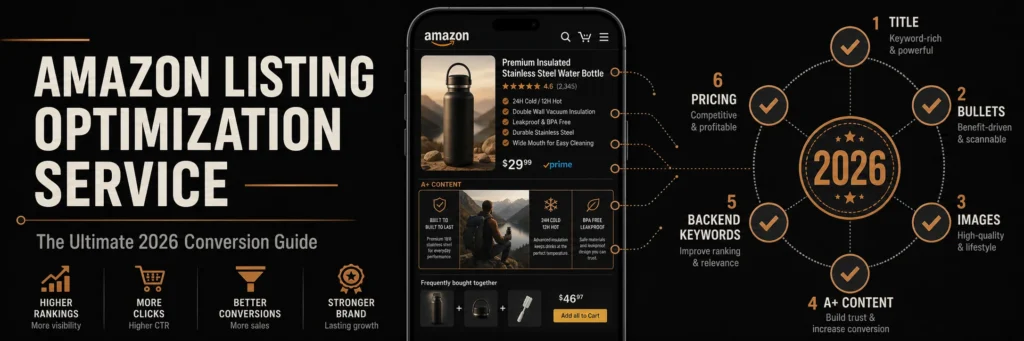
Table of Contents
- The Psychology of the Amazon Shopper
- Bullet Points: Solving Pain Points
- Visual Storytelling & A+ Content
- Backend SEO: The Hidden Rank Power
- The Advertpreneur Listing Audit Process
- Conclusion
The Psychology of the Amazon Shopper
Firstly, we must understand how users shop on mobile in 2026. They scroll past your main image and immediately look at your price and star rating. If those pass the test, they spend exactly 5 seconds looking for a reason not to buy.
Human-centric AI marketing means using data to find what customers care about, but using human empathy to write the copy. You must answer their biggest objection in the first two bullet points. For example, if you sell “premium loofahs,” your first bullet shouldn’t be about the size; it should be about how it doesn’t get moldy addressing the #1 fear of loofah buyers.
Title Optimization: The A10 Hook
Secondly, your title has two jobs: it must be readable for humans and indexable for bots. Many Amazon listing SEO optimization experts make the mistake of “keyword stuffing,” which looks like spam and lowers your Click-Through Rate (CTR).
Our winning 2026 formula for a high-ranking title is:
Formula: [Brand Name] + [Main Focus Keyword] + [Key Feature/Benefit] + [Material/Quantity] + [Size/Color].
By placing the focus keyword within the first 50 characters, you ensure it is visible even on mobile devices where titles are often truncated.
Bullet Points: Solving Pain Points
Thirdly, avoid the “Wall of Text.” In 2026, shoppers scan listings. Use CAPITALIZED HEADERS at the start of each bullet point to highlight the benefit.
- DURABILITY THAT LASTS: Made from reinforced fibers so you don’t have to replace it every month.
- GENTLE ON SKIN: Dermatologist-tested materials ensure no irritation for sensitive skin types.
- ECO-FRIENDLY CHOICE: 100% biodegradable packaging to support your sustainable lifestyle.
Note how each point starts with a “Benefit” and follows with a “Feature.” This is the core of building brand trust through listing copy.
Visual Storytelling & A+ Content
Meanwhile, images are the most important part of your listing. An A+ content creation service Amazon provides isn’t just about pretty pictures; it’s about “Visual Information.”
Your image stack should follow this 2026 sequence:
- Main Image: Pure white background, high resolution, taking up 85% of the frame.
- Infographic: Dimensions, what’s in the box, or a “How it Works” chart.
- Lifestyle: The product being used by your target demographic (Human-centric focus).
- Comparison: A “Us vs. Them” chart showing why your product is superior.
Backend SEO: The Hidden Rank Power
Additionally, do not ignore the “Search Terms” field in Seller Central. This is where you put keywords that are relevant but don’t fit naturally in the public-facing copy. This includes Spanish translations, common misspellings, and synonymous terms that help the A10 algorithm categorize your product correctly.
The Advertpreneur Listing Audit Process
To ensure guaranteed results, we follow a strict audit process for every client:
| Phase | Action Item | Goal |
|---|---|---|
| Research | Competitor Review Harvesting | Identify customer pain points and “missing” features. |
| SEO | A10 Keyword Mapping | Index for high-volume and long-tail search terms. |
| Design | Visual Asset Audit | Replace low-quality photos with 3D renders or lifestyle shots. |
| Launch | A/B Title Testing | Use Manage Your Experiments to find the highest CTR title. |
Conclusion
Optimization is not a “one and done” task. It is a continuous cycle of testing and refining. By investing in a professional Amazon Listing Optimization service, you give your brand the best chance to survive and thrive in 2026. Ready to transform your sales? Advertpreneur is ready to help.
Double Your Conversion Rate Today
Get a free listing audit and see exactly why your shoppers are leaving.Analyze My Listing
Frequently Asked Questions
Does A+ Content help with SEO?
A+ Content is not directly indexed for Amazon search. However, it significantly increases Conversion Rates, which signals to the A10 algorithm that your product is high-quality, indirectly boosting your rank. Should I put my brand name in the title?
Yes. Amazon’s current guidelines and A10 logic prefer the Brand Name to be the very first part of the title for authority and brand protection.