
As we look ahead to 2026, the principles of Search Engine Optimization (SEO) on Etsy continue to refine, blending tried-and-true methods with new considerations for buyer behavior and platform algorithm updates. This comprehensive guide will walk you through the most effective strategies to master Etsy SEO in 2026, ensuring your unique creations find their way into the hands of eager buyers. Get ready to elevate your shop’s presence and unlock its full potential.
1. Deciphering Etsy’s Search Algorithm in 2026
Before diving into specific tactics, it’s crucial to understand the underlying mechanism that dictates how your listings appear in search results. Etsy’s search algorithm, often referred to as “Etsy Rank,” is a sophisticated system designed to connect buyers with the most relevant and high-quality items. While the exact formula remains proprietary, Etsy has shared key factors that influence your ranking.
In 2026, these factors continue to prioritize relevance and quality. Relevance is determined by how closely your listing’s title, tags, and attributes match a buyer’s search query. Quality, on the other hand, encompasses a broader range of signals, including listing popularity, customer reviews, shop policies, and the overall health of your shop. Understanding this dual focus is the first step toward effective optimization.
Etsy’s goal is to facilitate sales and provide a positive user experience. Therefore, listings that consistently lead to purchases, receive positive feedback, and offer clear, professional information are generally favored. The algorithm also considers buyer preferences, location, and shopping history, personalizing search results to a degree. Keeping these principles in mind will guide your optimization efforts.
2. Mastering Keyword Research: The Foundation of Etsy SEO in 2026
Keywords are the bridge between a buyer’s intent and your product. Effective keyword research is not just about finding popular terms; it’s about identifying specific phrases that your target audience uses to find items like yours. In 2026, the emphasis remains on long-tail keywords and understanding buyer intent.
Start by brainstorming every possible way a buyer might search for your product. Think about its material, color, style, occasion, recipient, and specific use. For example, instead of just “earrings,” consider “sterling silver drop earrings for bridesmaids” or “dainty gold stud earrings for everyday wear.” These longer, more specific phrases often have less competition and attract buyers with a clearer purchasing intent.
Utilize Etsy’s own search bar for inspiration. As you type, Etsy suggests popular autocomplete phrases – these are valuable insights into what buyers are actively searching for. Additionally, explore competitor listings and their tags to discover keywords you might have overlooked. Third-party tools can also provide data on search volume and competition, helping you refine your list.
Don’t forget to consider seasonal and trending keywords. If you sell holiday-specific items, incorporate those terms well in advance of the season. Stay updated on current trends in your niche to capture emerging search interest. A robust list of relevant, high-performing keywords is the cornerstone of successful Etsy SEO.
3. Optimizing Your Listing Titles and Tags for Maximum Visibility
Once you have your carefully researched keywords, the next crucial step is to strategically incorporate them into your listing titles and tags. These are arguably the most important on-page SEO elements for your Etsy shop.
Crafting Compelling Listing Titles
Your listing title is the first thing buyers see and a primary factor for Etsy’s algorithm. Aim for clarity, keyword density, and readability. Start your title with your most important keywords, as these carry the most weight. For example, instead of “Beautiful Necklace,” opt for “Handmade Silver Pendant Necklace, Dainty Birthstone Jewelry, Personalized Gift for Her.”
Use a natural, descriptive flow. While keyword stuffing was once a tactic, it’s now detrimental to both SEO and buyer experience. Focus on including 2-3 strong keyword phrases that accurately describe your item. Remember, you have 140 characters, so make every character count. Think about what makes your item unique and include those differentiating factors.
Maximizing Your 13 Tags
Etsy allows you 13 tags per listing, and you should use all of them. Each tag can be up to 20 characters long. Think of tags as additional opportunities to tell Etsy what your item is about. Use a mix of broad and specific keywords, including long-tail phrases.
Avoid repeating words within tags (e.g., “silver necklace” and “necklace silver”). Instead, use unique keyword phrases in each tag slot. For instance, if your item is a “handmade ceramic mug,” your tags could include: “ceramic coffee mug,” “pottery tea cup,” “unique gift idea,” “rustic kitchenware,” “artisan mug,” “handmade gift,” “stoneware mug,” “personalized mug,” “housewarming gift,” “birthday gift,” “gift for him,” “gift for her,” and “mug with handle.”
Also, ensure your tags align with your listing title and description. Consistency across these elements reinforces relevance to the algorithm. Regularly review your tags to see which ones are driving traffic and adjust as needed.
4. Crafting Compelling Product Descriptions and Attributes
While titles and tags get buyers to your listing, your product description and attributes seal the deal. These elements also play a significant role in Etsy SEO by providing more context to the algorithm and answering potential buyer questions.
Writing Engaging Product Descriptions
Your description should be informative, engaging, and keyword-rich, but always readable. Start with a compelling hook that highlights the main features and benefits of your item. Use your primary keywords naturally within the first few sentences, as these are often weighted more heavily.
Break up your description into short, digestible paragraphs using bullet points for key details like dimensions, materials, care instructions, and customization options. This improves readability and helps buyers quickly find the information they need. Think about the story behind your product – its inspiration, how it’s made, and what makes it special. This emotional connection can be a
Learn more in our related guide.
Reference: authoritative source.
Most Sellers treat their product listings as digital brochures. At Advertpreneur, we treat them as high-performance sales funnels. If your conversion rate is below 15%, you aren’t just losing sales; you are telling the Amazon A10 algorithm that your product is irrelevant, which actively kills your organic ranking.
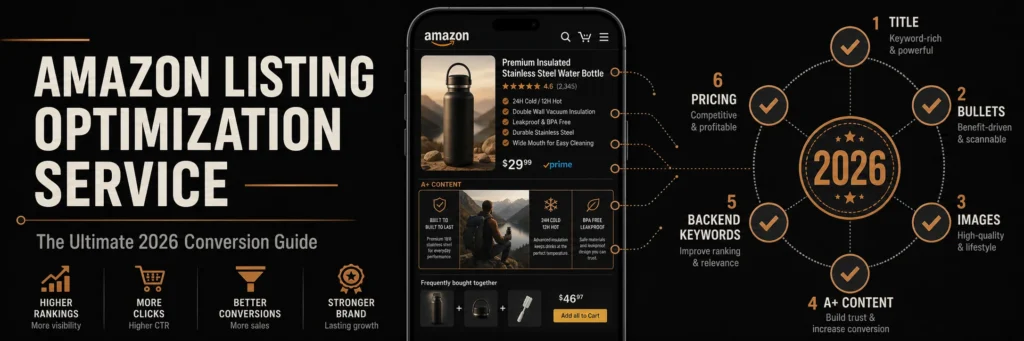
Table of Contents
- The Psychology of the Amazon Shopper
- Bullet Points: Solving Pain Points
- Visual Storytelling & A+ Content
- Backend SEO: The Hidden Rank Power
- The Advertpreneur Listing Audit Process
- Conclusion
The Psychology of the Amazon Shopper
Firstly, we must understand how users shop on mobile in 2026. They scroll past your main image and immediately look at your price and star rating. If those pass the test, they spend exactly 5 seconds looking for a reason not to buy.
Human-centric AI marketing means using data to find what customers care about, but using human empathy to write the copy. You must answer their biggest objection in the first two bullet points. For example, if you sell “premium loofahs,” your first bullet shouldn’t be about the size; it should be about how it doesn’t get moldy addressing the #1 fear of loofah buyers.
Title Optimization: The A10 Hook
Secondly, your title has two jobs: it must be readable for humans and indexable for bots. Many Amazon listing SEO optimization experts make the mistake of “keyword stuffing,” which looks like spam and lowers your Click-Through Rate (CTR).
Our winning 2026 formula for a high-ranking title is:
Formula: [Brand Name] + [Main Focus Keyword] + [Key Feature/Benefit] + [Material/Quantity] + [Size/Color].
By placing the focus keyword within the first 50 characters, you ensure it is visible even on mobile devices where titles are often truncated.
Bullet Points: Solving Pain Points
Thirdly, avoid the “Wall of Text.” In 2026, shoppers scan listings. Use CAPITALIZED HEADERS at the start of each bullet point to highlight the benefit.
- DURABILITY THAT LASTS: Made from reinforced fibers so you don’t have to replace it every month.
- GENTLE ON SKIN: Dermatologist-tested materials ensure no irritation for sensitive skin types.
- ECO-FRIENDLY CHOICE: 100% biodegradable packaging to support your sustainable lifestyle.
Note how each point starts with a “Benefit” and follows with a “Feature.” This is the core of building brand trust through listing copy.
Visual Storytelling & A+ Content
Meanwhile, images are the most important part of your listing. An A+ content creation service Amazon provides isn’t just about pretty pictures; it’s about “Visual Information.”
Your image stack should follow this 2026 sequence:
- Main Image: Pure white background, high resolution, taking up 85% of the frame.
- Infographic: Dimensions, what’s in the box, or a “How it Works” chart.
- Lifestyle: The product being used by your target demographic (Human-centric focus).
- Comparison: A “Us vs. Them” chart showing why your product is superior.
Backend SEO: The Hidden Rank Power
Additionally, do not ignore the “Search Terms” field in Seller Central. This is where you put keywords that are relevant but don’t fit naturally in the public-facing copy. This includes Spanish translations, common misspellings, and synonymous terms that help the A10 algorithm categorize your product correctly.
The Advertpreneur Listing Audit Process
To ensure guaranteed results, we follow a strict audit process for every client:
| Phase | Action Item | Goal |
|---|---|---|
| Research | Competitor Review Harvesting | Identify customer pain points and “missing” features. |
| SEO | A10 Keyword Mapping | Index for high-volume and long-tail search terms. |
| Design | Visual Asset Audit | Replace low-quality photos with 3D renders or lifestyle shots. |
| Launch | A/B Title Testing | Use Manage Your Experiments to find the highest CTR title. |
Conclusion
Optimization is not a “one and done” task. It is a continuous cycle of testing and refining. By investing in a professional Amazon Listing Optimization service, you give your brand the best chance to survive and thrive in 2026. Ready to transform your sales? Advertpreneur is ready to help.
Double Your Conversion Rate Today
Get a free listing audit and see exactly why your shoppers are leaving.Analyze My Listing
Frequently Asked Questions
Does A+ Content help with SEO?
A+ Content is not directly indexed for Amazon search. However, it significantly increases Conversion Rates, which signals to the A10 algorithm that your product is high-quality, indirectly boosting your rank. Should I put my brand name in the title?
Yes. Amazon’s current guidelines and A10 logic prefer the Brand Name to be the very first part of the title for authority and brand protection.
Many sellers struggle with amazon seo even after finding good keywords. You may rank nowhere despite strong research and effort. Therefore, you must understand what really blocks your listing from visibility.
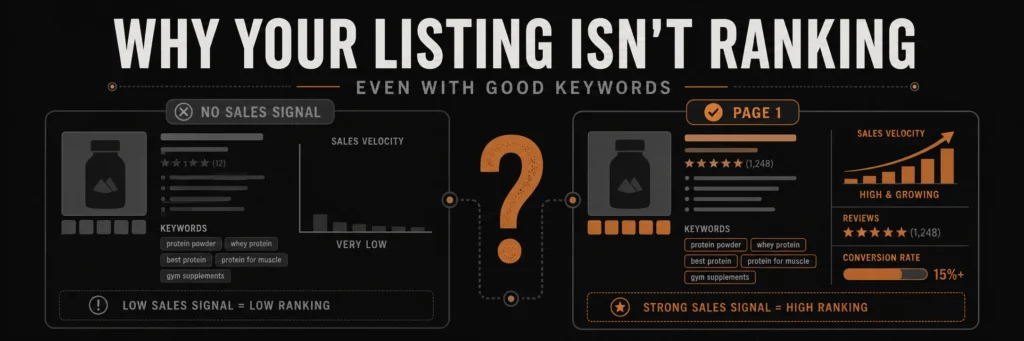
Table of Contents
- Why Amazon SEO Fails Even with Good Keywords
- Understanding Amazon Indexing Issues
- Common Amazon SEO Mistakes Sellers Make
- How to Track and Fix Performance Issues
- Frequently Asked Questions
- Conclusion
Why Amazon SEO Fails Even with Good Keywords
Firstly, keywords alone do not guarantee ranking. Amazon uses behavior data to decide visibility. Therefore, listings without sales rarely move up.
Secondly, poor listing structure weakens your relevance. Even strong keywords fail without proper placement. As a result, your product stays hidden.
Most importantly, conversion rate plays a huge role. If shoppers do not buy, rankings drop quickly. In contrast, high conversions boost visibility.
- Low click through rate reduces exposure
- Poor images lower buyer trust
- Weak copy reduces conversions
- Incorrect keyword placement hurts relevance
Warning: Good keywords without sales signals will not rank your listing.
Understanding Amazon Indexing Issues
Amazon indexing issues happen when your product does not appear for search terms. This often confuses new sellers. However, indexing and ranking are different.
Indexing means Amazon recognizes your keyword. Ranking means your position in results. Therefore, you must check both regularly.
For example, use tools or search manually on Amazon search results. This helps confirm if your product shows.
Signs of Amazon Keyword Indexing Problems
- Your product does not appear for exact keyword search
- Backend keywords do not trigger visibility
- Long tail keywords fail to index
Additionally, avoid keyword stuffing. Amazon may ignore excessive repetition. Consequently, indexing fails silently.
Pro Tip: Use short and clear keywords across title, bullets, and backend fields.
Core Amazon Ranking Factors You Must Know
Amazon ranking factors go beyond keywords. The algorithm focuses on performance data. Therefore, you must optimize for sales.
Main Ranking Signals
- Sales velocity over time
- Click through rate from search
- Conversion rate on listing
- Customer reviews and ratings
In addition, pricing impacts conversions. Competitive pricing improves performance. As a result, your ranking improves.
You can learn more about listing strategy through our Services page.
Relevance vs Performance
Relevance comes from keywords and content. Performance comes from sales and engagement. Therefore, both must align.
| Factor | Impact on Ranking | Control Level |
|---|---|---|
| Keywords | Medium | High |
| Sales | Very High | Medium |
| Conversion Rate | High | High |
| Reviews | High | Low |
Table: Key amazon ranking factors explained
Common Amazon SEO Mistakes Sellers Make
Many sellers repeat the same amazon seo mistakes. These errors block growth even with good keywords. Therefore, fixing them improves results fast.
- Ignoring backend search terms
- Using irrelevant keywords
- Poor product images
- Weak Product Titles
In addition, duplicate keywords waste space. Amazon reads variations automatically. Consequently, you lose indexing opportunities.
For example, review competitor listings on Amazon best sellers. This helps identify gaps.
Complete Listing Optimization Amazon Guide
Listing optimization amazon requires structure and clarity. Every section must support conversions. Therefore, optimize each element carefully.
Key Areas to Optimize
- Title with primary keywords
- Bullet points focused on benefits
- High quality images
- Backend keyword field
Additionally, keep sentences simple and clear. Buyers scan quickly. As a result, clarity increases conversions.
Step by Step Optimization
- Research keywords and search intent
- Place main keywords in title
- Add secondary keywords in bullets
- Use backend for extra terms
- Improve images and A Plus Content
You can also explore our Services for full optimization support.
Pro Tip: Focus on conversion rate first, ranking follows naturally.
How to Track and Fix Performance Issues
Tracking helps you improve amazon seo results. Without data, you cannot fix problems. Therefore, monitor metrics daily.
- Track keyword ranking positions
- Monitor click through rate
- Check conversion rate changes
- Analyze competitor performance
Finally, test changes regularly. Small updates can improve results fast. Consequently, consistent optimization wins.
Frequently Asked Questions
Why is my Amazon Listing not ranking?
Your listing may lack sales or conversions. Amazon prioritizes performance data over keywords. What are amazon indexing issues?
These occur when your product does not appear for keywords. It means Amazon does not recognize your terms. How do I improve amazon keyword indexing?
Use keywords in title, bullets, and backend fields. Keep them relevant and avoid repetition. Does listing optimization amazon improve ranking?
Yes, better structure improves conversion rate. This leads to higher rankings over time. What are common amazon seo mistakes?
Sellers often ignore conversions, overuse keywords, and use weak images.
Ready to grow your Amazon business?
Get a free strategy call with Advertpreneur.Book Your Free Consultation
Conclusion
Amazon seo requires more than keywords. You must focus on conversions, indexing, and performance signals. Therefore, build listings that sell, not just rank.
In addition, avoid common amazon seo mistakes. Fix indexing issues and improve content structure. As a result, your rankings will improve steadily.
Finally, stay consistent with testing and optimization. Amazon rewards sellers who improve performance over time. Focus on results and growth will follow.
Amazon listing optimization is the foundation of Amazon success. A well-optimized listing can increase conversion rates by 30-50% and improve organic rankings, driving more sales without additional ad spend.
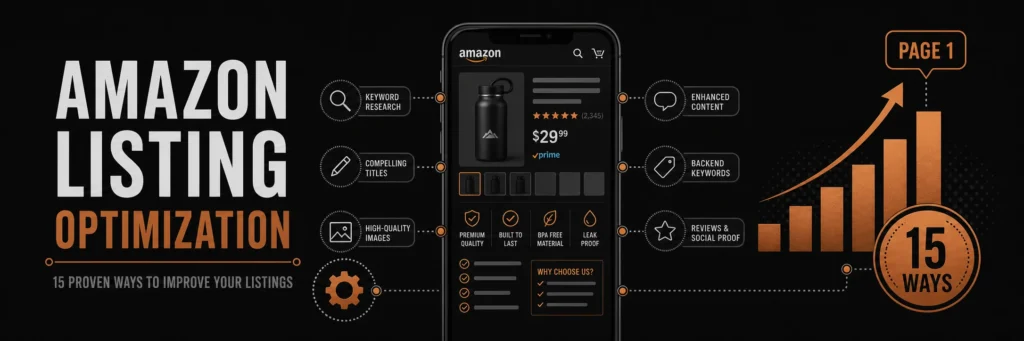
Listing optimization is not a one-time task. These 15 methods cover every section of your listing and directly impact both ranking and conversion.
But most Amazon sellers make critical optimization mistakes that hurt their rankings and conversions. They focus on the wrong elements, ignore important factors, or optimize once and never update.
In this comprehensive guide, we’ll share 15 proven Amazon listing optimization strategies. These are the same techniques we use to help sellers achieve page 1 rankings and double their sales.
Why Amazon Listing Optimization Matters
The Impact:
Ranking Impact:
- Better rankings – Optimized listings rank higher
- More visibility – Appear in more searches
- Organic traffic – Free traffic from search
- Long-term growth – Sustainable rankings
Conversion Impact:
- Higher conversion rates – Better listings convert better
- More sales – Optimized = more purchases
- Lower returns – Clear expectations = fewer returns
- Better reviews – Happy customers = better ratings
Business Impact:
- Increased revenue – More sales = more profit
- Lower ACoS – Better listings = better PPC performance
- Competitive advantage – Stand out from competitors
- Brand building – Professional listings build trust
15 Amazon Listing Optimization Strategies
1. Optimize Your Product Title
Why it matters:
- Most important SEO element – Heavily weighted by algorithm
- First impression – What customers see first
- Primary ranking factor – Determines search visibility
How to optimize:
- Place primary keyword in first 50 characters
- Use all 200 characters available
- Include brand name, key features, use cases
- Add size/color/variations if applicable
- Keep it natural and readable (no keyword stuffing)
Example: ❌ Bad: “Headphones” ✅ Good: “Wireless Bluetooth Headphones, Noise Cancelling Over-Ear Headphones with 30H Battery, Hi-Fi Sound, Quick Charge, for Travel Work Home Office – Black”
2. Write Compelling Bullet Points
Why it matters:
- Second most important SEO element
- Conversion driver – Converts browsers to buyers
- Keyword placement – Secondary keyword opportunities
How to optimize:
- Lead with benefits – What’s in it for customers
- Include keywords naturally – Don’t force them
- Address pain points – Solve customer problems
- Use formatting – Bold text, line breaks
- Stay under 500 characters per bullet
- Use 5-7 bullet points – Cover all key benefits
Example: ❌ Bad: “Bluetooth connectivity” ✅ Good: “Wireless Freedom: Advanced Bluetooth 5.0 technology provides seamless connectivity up to 33 feet, perfect for workouts, commuting, or working from home. No more tangled wires or connection drops.”
3. Optimize Backend Keywords
Why it matters:
- Hidden SEO goldmine – 250 bytes for keywords
- No customer clutter – Keep listing clean
- More discoverability – Target additional terms
How to optimize:
- Use all 250 bytes – Every character counts
- No repetition – Don’t repeat title/bullet keywords
- Include synonyms – “headphones”, “earphones”, “earbuds”
- Add misspellings – Common typos
- Use long-tail keywords – Specific phrases
- Separate with commas – Clean formatting
4. Create High-Quality Product Images
Why it matters:
- 75% of shoppers influenced by images
- 30% better conversion with good images
- Reduces returns – Sets proper expectations
How to optimize:
- Use all 9 image slots – Maximum visibility
- Main image: White background, product fills 85%
- Lifestyle images – Product in use
- Infographics – Key features and benefits
- Comparison charts – Your product vs competitors
- Size guides – Help with sizing decisions
- Meet Amazon requirements – 1000px minimum, JPEG/PNG
5. Write Detailed Product Descriptions
Why it matters:
- SEO value – Additional keyword opportunities
- Conversion driver – Detailed info converts better
- Reduces questions – Answers customer queries
How to optimize:
- Natural keyword integration – Don’t stuff keywords
- Tell your brand story – Build emotional connection
- Include specifications – Technical details
- Use formatting – Paragraphs, bold, lists
- Address FAQs – Answer common questions
- Focus on benefits – What customers get
6. Add A+ Content (Enhanced Brand Content)
Why it matters:
- 5-10% conversion boost – Proven impact
- Reduces returns – Better expectations
- Brand building – Stand out from competitors
How to optimize:
- Visual storytelling – Compelling images
- Feature highlights – Key benefits showcased
- Comparison charts – Competitive advantages
- Brand story – Connect emotionally
- Mobile-optimized – 70%+ traffic is mobile
- Professional design – High-quality visuals
7. Optimize for Mobile
Why it matters:
- 70%+ of Amazon traffic is mobile
- Mobile conversion often lower
- Mobile-first indexing – Amazon prioritizes mobile
How to optimize:
- Short, scannable titles – Mobile shows fewer characters
- Clear bullet points – Easy to read on small screens
- Fast-loading images – Optimize file sizes
- Mobile-friendly A+ Content – Test on devices
- Simple navigation – Easy to use on mobile
8. Get More Customer Reviews
Why it matters:
- Social proof – Builds trust
- Ranking factor – More reviews = better ranking
- Conversion driver – Reviews increase sales
How to optimize:
- Use Amazon’s Request a Review – Automated follow-up
- Provide excellent service – Happy customers review
- Follow up with buyers – Polite request for feedback
- Respond to reviews – Show you care
- Consider Amazon Vine – Early reviews for new products
9. Optimize Pricing Strategy
Why it matters:
- Buy Box eligibility – Competitive pricing wins Buy Box
- Conversion impact – Right price = more sales
- Profitability – Balance price and margin
How to optimize:
- Research competitors – Know market prices
- Price competitively – Not always lowest
- Consider value – Quality justifies price
- Test pricing – Find sweet spot
- Monitor Buy Box – Win rate matters
10. Improve Inventory Management
Why it matters:
- Out of stock = no ranking – Can’t rank if unavailable
- Buy Box eligibility – Stock affects Buy Box
- Customer satisfaction – Fast shipping builds trust
How to optimize:
- Maintain stock levels – Never go out of stock
- FBA for Prime – Faster shipping, better ranking
- Forecast demand – Plan inventory ahead
- Monitor stock levels – Daily checks
- Quick restocking – Minimize downtime
11. Use Enhanced Brand Content Strategically
Why it matters:
- Conversion boost – 5-10% increase common
- Brand differentiation – Stand out
- Trust building – Professional appearance
How to optimize:
- Tell your story – Brand narrative
- Showcase benefits – Visual feature highlights
- Include comparisons – Competitive advantages
- Use high-quality visuals – Professional images
- Mobile-optimized – Test on devices
- Update regularly – Keep content fresh
12. Optimize for Search Intent
Why it matters:
- Better matching – Amazon shows you to right customers
- Higher conversion – Relevant traffic converts
- Better rankings – Relevance = ranking boost
How to optimize:
- Match keywords to intent – Buying vs browsing
- Use commercial keywords – “buy”, “best”, “review”
- Address search queries – Answer what customers search
- Optimize for questions – “how to”, “what is”
- Seasonal optimization – Match seasonal searches
13. Monitor and Respond to Customer Questions
Why it matters:
- Keyword opportunities – Questions reveal searches
- Conversion impact – Answered questions = more sales
- Trust building – Shows you care
How to optimize:
- Answer quickly – Within 24 hours
- Be helpful – Provide detailed answers
- Use keywords – Naturally in answers
- Address concerns – Build confidence
- Update listing – Add common Q&As to description
14. Optimize Product Variations
Why it matters:
- More visibility – Each variation can rank
- Better conversion – Customers find exact product
- Cross-selling – Show related options
How to optimize:
- Set up parent-child – Proper variation structure
- Optimize each variation – Unique titles/bullets
- Clear differentiation – Size, color, style
- Proper images – Show each variation
- Accurate attributes – Match Amazon requirements
15. Continuously Test and Optimize
Why it matters:
- Amazon changes – Algorithm updates
- Competition changes – Stay ahead
- Performance data – Learn what works
How to optimize:
- A/B test titles – Test different keywords
- Test bullet points – Different benefit focuses
- Monitor rankings – Track keyword positions
- Analyze conversion – What converts best
- Update quarterly – Regular optimization
- Test new strategies – Stay innovative
Amazon Listing Optimization Checklist
Title Optimization
Bullet Points
Backend Keywords
Images
Description & A+ Content
Reviews & Social Proof
Ongoing Optimization
Measuring Listing Optimization Success
Key Metrics:
- Keyword Rankings
- Track positions for target keywords
- Monitor weekly
- Identify improvements
- Organic Traffic
- Sessions from organic search
- Compare before/after
- Track growth
- Conversion Rate
- Sales ÷ Page Views
- Target: 10-15%+
- Higher = better optimization
- Sales Velocity
- Units sold per day/week
- Increasing = better ranking
- Monitor consistency
- Return Rate
- Returns ÷ Total Sales
- Lower = better expectations set
- Target: Under 5%
Common Listing Optimization Mistakes
1. Keyword Stuffing
❌ Mistake: “Wireless Wireless Bluetooth Bluetooth Headphones Wireless” ✅ Solution: Natural integration, readable copy
2. Ignoring Backend Keywords
❌ Mistake: Only optimizing visible content ✅ Solution: Use all 250 bytes strategically
3. Poor Images
❌ Mistake: Low-quality, few images ✅ Solution: Professional photos, use all 9 slots
4. Weak Bullet Points
❌ Mistake: Features without benefits ✅ Solution: Lead with benefits, address pain points
5. Not Updating
❌ Mistake: Set it and forget it ✅ Solution: Regular optimization based on data
6. Ignoring Mobile
❌ Mistake: Desktop-only optimization ✅ Solution: Mobile-first approach
7. No A+ Content
❌ Mistake: Missing conversion opportunity ✅ Solution: Create Enhanced Brand Content
Conclusion: Optimize for Rankings and Conversions
Amazon listing optimization is an ongoing process that requires strategic thinking, data analysis, and continuous improvement. The 15 strategies above will help you create listings that rank well AND convert browsers into buyers.
Key Principles:
- Balance SEO and conversion – Rank AND convert
- Optimize all elements – Title, bullets, images, backend
- Mobile-first – 70%+ traffic is mobile
- Test and optimize – Data-driven improvements
- Update regularly – SEO is ongoing
Remember: Optimization is never done. Amazon’s algorithm changes, competition evolves, and customer behavior shifts. Continuous optimization keeps you ahead.
Need Professional Amazon Listing Optimization?
Our Amazon listing optimization service includes comprehensive keyword research, competitor analysis, and strategic optimization of all listing elements. We’ll help you rank higher, convert better, and drive more organic sales.
Your Amazon product title is the most important SEO element on your listing. It’s the first thing customers see, the primary ranking factor, and your biggest opportunity to capture attention and drive clicks.
The stakes are high: Get your title wrong, and you’ll struggle to rank. Get it right, and you’ll dominate search results and drive organic sales.
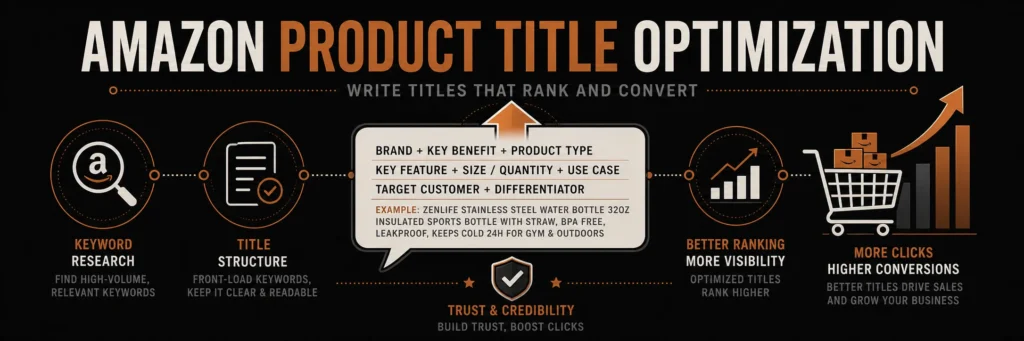
Your product title is the single most important text field on your listing for both ranking and click-through rate. This guide shows you how to write it right.
In this comprehensive guide, we’ll teach you everything you need to know about Amazon product title optimization. You’ll learn proven formulas, best practices, and real examples that rank and convert.
Why Amazon Product Titles Matter
The Impact of Title Optimization:
SEO Impact:
- Primary ranking factor – Amazon’s algorithm heavily weights titles
- First 50 characters get most weight in search
- Keyword placement determines search visibility
- Relevance matching – How well you match customer searches
Conversion Impact:
- First impression – Title is what customers see first
- Click-through rate – Better titles = more clicks
- Trust building – Professional titles build credibility
- Expectation setting – Clear titles reduce returns
The Numbers:
- 70% of shoppers never click past page 1
- Top 3 results get 64% of all clicks
- Title optimization can improve rankings by 20-40%
- Better titles can increase CTR by 15-25%
Amazon Title Requirements and Limits
Character Limits:
- Maximum: 200 characters
- Recommended: Use all 200 characters
- Minimum: At least 50-80 characters for basic info
Format Requirements:
- No HTML – Plain text only
- No special characters – Avoid symbols, emojis
- No promotional text – “Free shipping”, “On sale” (against policy)
- No ALL CAPS – Use proper capitalization
- No misleading claims – Must be accurate
Category-Specific Rules:
- Books: Author, title, edition
- Electronics: Brand, model, key specs
- Apparel: Brand, style, size, color
- Home & Kitchen: Brand, type, key features
The Amazon Title Optimization Formula
Standard Title Structure:
[Brand] + [Primary Keyword] + [Key Feature 1] + [Key Feature 2] + [Target Audience/Use Case] + [Size/Color/Variation]
Breaking Down Each Element:
1. Brand Name
- Placement: Usually first or second
- Purpose: Brand recognition and trust
- Example: “Sony”, “Apple”, “YourBrand”
2. Primary Keyword
- Placement: Within first 50 characters (critical!)
- Purpose: Main search term you want to rank for
- Example: “Wireless Bluetooth Headphones”
3. Key Features
- Placement: After primary keyword
- Purpose: Differentiation and additional keywords
- Example: “Noise Cancelling”, “30-Hour Battery”
4. Target Audience/Use Case
- Placement: Middle to end
- Purpose: Attract specific customer segments
- Example: “for Travel”, “for Gym”, “for Office”
5. Size/Color/Variation
- Placement: End of title
- Purpose: Help customers find exact product
- Example: “Black”, “15-inch”, “10-Pack”
Amazon Title Best Practices
1. Place Primary Keyword in First 50 Characters
Why it matters:
- Amazon gives most weight to early keywords
- First 50 characters appear in search results
- Mobile shows even fewer characters
- Early placement = better ranking
Example: ❌ Bad: “Premium Quality Wireless Bluetooth Headphones with Advanced Noise Cancelling Technology” ✅ Good: “Wireless Bluetooth Headphones, Noise Cancelling Over-Ear Headphones with 30H Battery”
2. Use All 200 Characters
Maximize opportunities:
- More keywords = more ranking chances
- More information = better matching
- More features = higher conversion potential
How to fill 200 characters:
- Include multiple keywords
- Add key features and benefits
- Specify use cases
- Include size/color/variations
3. Include Numbers and Specifics
Specificity converts:
- “30-hour battery” > “long battery”
- “10-pack” > “pack”
- “15-inch” > “large”
- “5.0 Bluetooth” > “Bluetooth”
Why it works:
- Sets clear expectations
- Helps customers find exact product
- Reduces returns
- Improves conversion rate
4. Lead with Benefits When Possible
Benefit-focused titles:
- “Noise Cancelling” (benefit) > “Active Noise Reduction” (feature)
- “Waterproof” (benefit) > “IPX7 Rated” (technical)
- “Lightweight” (benefit) > “0.5 lbs” (spec, but also benefit)
Balance:
- Include both benefits and features
- Use customer language
- Avoid technical jargon (unless necessary)
5. Use Natural Language
Readability matters:
- Titles should read naturally
- Avoid keyword stuffing
- Maintain grammar and flow
- Sound like human writing
Example: ❌ Bad: “Headphones Wireless Bluetooth Noise Cancelling Over Ear” ✅ Good: “Wireless Bluetooth Headphones, Noise Cancelling Over-Ear Headphones with 30H Battery”
6. Include Brand Name Strategically
Brand placement:
- First: If brand is well-known (Sony, Apple)
- Second: If keyword is more important
- Last: If brand is less known
When to include:
- Always include your brand
- Builds brand recognition
- Helps with brand searches
- Required for Brand Registry
7. Avoid Keyword Stuffing
Natural integration:
- Don’t repeat keywords unnecessarily
- Use variations and synonyms
- Maintain readability
- Focus on conversion, not just SEO
Example: ❌ Bad: “Wireless Wireless Bluetooth Bluetooth Headphones Wireless” ✅ Good: “Wireless Bluetooth Headphones, Noise Cancelling Over-Ear with Long Battery Life”
Amazon Title Optimization by Category
Electronics:
Structure: Brand + Product Type + Key Specs + Features + Use Case
Example: “Sony WH-1000XM4 Wireless Bluetooth Headphones, Noise Cancelling Over-Ear Headphones with 30H Battery, Hi-Fi Sound, Quick Charge, for Travel Work Home Office – Black”
Key Elements:
- Brand: Sony
- Product: Wireless Bluetooth Headphones
- Specs: 30H Battery, Quick Charge
- Features: Noise Cancelling, Hi-Fi Sound
- Use: Travel, Work, Home, Office
- Color: Black
Apparel:
Structure: Brand + Product Type + Style + Material + Size/Color
Example: “adidas Men’s Ultraboost 22 Running Shoes, Lightweight Athletic Sneakers with Boost Cushioning, Primeknit Upper, Size 10, Black/White”
Key Elements:
- Brand: adidas
- Product: Running Shoes
- Style: Athletic Sneakers
- Features: Lightweight, Boost Cushioning, Primeknit
- Size: 10
- Color: Black/White
Home & Kitchen:
Structure: Brand + Product Type + Key Features + Capacity/Size + Use Case
Example: “Instant Pot Duo 7-in-1 Electric Pressure Cooker, Slow Cooker, Rice Cooker, Steamer, Sauté, Yogurt Maker, Warmer & Sterilizer, 6 Quart, Stainless Steel”
Key Elements:
- Brand: Instant Pot
- Product: Pressure Cooker
- Features: 7-in-1 functions listed
- Size: 6 Quart
- Material: Stainless Steel
Step-by-Step: Optimizing Your Amazon Title
Step 1: Research Primary Keywords
Find your main keyword:
- Use Helium 10 or Jungle Scout
- Check Amazon autocomplete
- Analyze competitor titles
- Review customer search terms
Choose:
- High search volume
- Relevant to your product
- Commercial intent
- Achievable to rank for
Step 2: Analyze Top Competitors
Study top 10 listings:
- What keywords do they use?
- How do they structure titles?
- What features do they highlight?
- What’s their title length?
Learn from:
- Successful title patterns
- Keyword placement
- Feature prioritization
- Use case mentions
Step 3: List Key Features and Benefits
Brainstorm:
- Top 5-7 product features
- Main benefits to customers
- Unique selling points
- Use cases and applications
Prioritize:
- Most important features first
- Benefits over features when possible
- Customer language over technical terms
Step 4: Identify Target Audience
Define:
- Who buys this product?
- What are their use cases?
- Where do they use it?
- What problems does it solve?
Include in title:
- “for Travel”, “for Gym”, “for Office”
- “Professional”, “Home Use”, “Commercial”
- “Beginner”, “Advanced”, “Expert”
Step 5: Build Your Title
Follow the formula:
- Start with primary keyword (first 50 chars)
- Add brand name (if not first)
- Include key features
- Add use cases
- End with size/color/variation
Check:
- Primary keyword in first 50 characters ✓
- All 200 characters used ✓
- Natural and readable ✓
- No keyword stuffing ✓
- Includes brand ✓
Step 6: Test and Refine
After publishing:
- Monitor keyword rankings
- Track click-through rates
- Analyze conversion rates
- A/B test variations
- Update based on data
Common Title Optimization Mistakes
1. Primary Keyword Not in First 50 Characters
❌ Mistake: “Premium Quality [Brand] Wireless Bluetooth Headphones…” ✅ Solution: “Wireless Bluetooth Headphones [Brand] Premium Quality…”
2. Not Using All 200 Characters
❌ Mistake: “Wireless Headphones” (only 20 characters) ✅ Solution: Fill all 200 characters with relevant keywords
3. Keyword Stuffing
❌ Mistake: “Wireless Wireless Bluetooth Bluetooth Headphones Wireless” ✅ Solution: Natural integration: “Wireless Bluetooth Headphones, Noise Cancelling…”
4. Too Generic
❌ Mistake: “Headphones” ✅ Solution: “Wireless Bluetooth Headphones, Noise Cancelling Over-Ear with 30H Battery”
5. Missing Brand
❌ Mistake: No brand name in title ✅ Solution: Always include your brand
6. Using Prohibited Terms
❌ Mistake: “Free Shipping”, “On Sale”, “Best Seller” ✅ Solution: Only product attributes, no promotional text
7. Ignoring Mobile
❌ Mistake: Long, complex title that’s cut off on mobile ✅ Solution: Ensure first 50-80 characters are compelling
Advanced Title Optimization Strategies
1. A/B Testing Titles
Test variations:
- Different keyword placements
- Various feature orders
- Different use case mentions
- Test for 2-4 weeks each
- Measure CTR and conversions
2. Seasonal Optimization
Update for seasons:
- Add “Holiday”, “Gift” in Q4
- Add “Summer”, “Travel” in summer
- Add “Back to School” in August
- Remove after season
3. Competitor Gap Analysis
Find opportunities:
- Keywords competitors use but you don’t
- Features they highlight
- Use cases they mention
- Test in your title
4. Customer Language Matching
Use real customer terms:
- Extract from reviews
- Use Q&A language
- Match search patterns
- Natural over technical
Measuring Title Optimization Success
Key Metrics:
- Keyword Rankings
- Track positions for title keywords
- Monitor weekly
- Identify winning/losing keywords
- Click-Through Rate (CTR)
- Impressions vs clicks
- Higher CTR = better title
- Target: 0.5-1%+ CTR
- Conversion Rate
- Clicks vs sales
- Better titles = more conversions
- Monitor in Seller Central
- Organic Traffic
- Sessions from organic search
- Compare before/after
- Track growth over time
Amazon Title Optimization Checklist
Use this for every product:
Research Phase
Creation Phase
Optimization Phase
Conclusion: Write Titles That Rank and Convert
Amazon product title optimization is both art and science. The right title can catapult your product to page 1, while a poor title can keep you invisible.
Key Principles:
- Primary keyword first – Within first 50 characters
- Use all 200 characters – Maximize opportunities
- Natural and readable – Balance SEO with conversion
- Include specifics – Numbers, features, use cases
- Test and optimize – Data tells you what works
Remember: Your title must rank AND convert. It’s not enough to show up in search—you need to get clicks and sales.
Need Help with Amazon Title Optimization?
Our Amazon SEO optimization service includes strategic title optimization based on keyword research, competitor analysis, and conversion best practices. We’ll help you create titles that rank on page 1 and convert browsers into buyers.
Amazon bullet points are your product’s sales pitch in 200 characters or less. They’re the first thing customers read after your title, and they can make or break a sale. This guide will teach you how to write compelling bullet points that convert browsers into buyers.
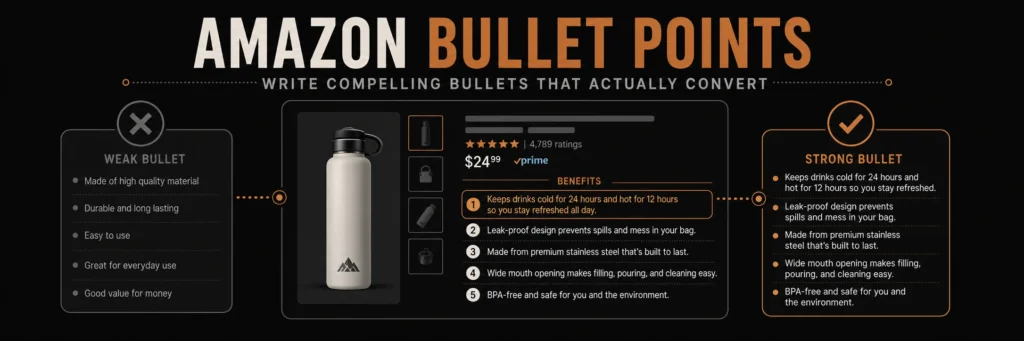
Amazon bullet points are read by both the algorithm and the shopper. Writing them well means satisfying both at the same time. This guide shows you exactly how.
Why Amazon Bullet Points Matter
Impact on Sales
- Bullet points are read by 80% of shoppers before making a purchase decision
- Well-written bullets can increase conversion rates by 20-30%
- Bullets help customers quickly understand product benefits
- They’re crucial for mobile shoppers who scan content quickly
SEO Benefits
- Bullet points are indexed by Amazon’s A9 algorithm
- Keywords in bullets improve search visibility
- Help products rank for long-tail keywords
- Support overall listing optimization
Amazon Bullet Point Requirements
Character Limits
- Maximum: 200 characters per bullet point
- Recommended: 150-180 characters for optimal readability
- Minimum: Use at least 100 characters to maximize SEO value
Number of Bullets
- Maximum: 5 bullet points per listing
- Minimum: Use all 5 bullets for maximum impact
- Best Practice: Fill all 5 bullets with valuable information
Formatting Rules
- No HTML formatting allowed
- No special characters (bullets, arrows, etc.) in first character
- Plain text only
- Can use capital letters for emphasis
- Line breaks are automatically added
Structure of High-Converting Bullet Points
The Formula
Feature + Benefit + Proof/Detail = Conversion
Each bullet should:
- Lead with the feature (what it is)
- Explain the benefit (why it matters)
- Add proof or detail (credibility or specifics)
Example Structure
Bad: “Wireless headphones” Good: “WIRELESS FREEDOM: Bluetooth 5.0 technology provides stable connection up to 33 feet, perfect for workouts and daily commutes without tangled cords”
What to Include in Each Bullet Point
Bullet 1: Primary Benefit or Unique Selling Proposition
- Your product’s main differentiator
- The #1 reason to buy
- What makes you stand out from competitors
- Most important feature/benefit
Bullet 2: Key Features and Specifications
- Important technical details
- Size, dimensions, capacity
- Material quality
- Technical specifications
Bullet 3: Use Cases and Applications
- Who it’s for
- When to use it
- Problem it solves
- Ideal customer scenarios
Bullet 4: Quality and Durability
- Build quality
- Material quality
- Longevity and durability
- Premium features
Bullet 5: Additional Value or Guarantee
- Bonus features
- Included accessories
- Warranty information
- Customer support
- Money-back guarantee
Writing Techniques for Compelling Bullets
1. Lead with Keywords
Start each bullet with your most important keyword:
- “WIRELESS BLUETOOTH HEADPHONES: Advanced 5.0 technology…”
- “PREMIUM LEATHER WALLET: Genuine Italian leather construction…”
2. Use Power Words
Incorporate words that create emotion and urgency:
- Premium, Professional, Advanced, Ultimate, Exclusive
- Guaranteed, Proven, Tested, Certified, Award-Winning
- Instant, Fast, Quick, Easy, Simple
3. Be Specific
Avoid vague claims. Use numbers and specifics:
- Bad: “Long battery life”
- Good: “40-HOUR BATTERY LIFE: Rechargeable lithium battery provides up to 40 hours of continuous playback on a single charge”
4. Focus on Benefits, Not Just Features
Always explain why the feature matters:
- Feature: “Waterproof IPX7 rating”
- Benefit: “WATERPROOF DESIGN: IPX7 rating means you can use these headphones in the rain, at the pool, or during intense workouts without worry”
5. Address Objections
Anticipate and answer common concerns:
- Quality concerns → Emphasize materials and construction
- Size concerns → Provide dimensions and comparisons
- Use concerns → Explain use cases and applications
- Value concerns → Highlight included accessories and value
Amazon Bullet Point Templates
Template 1: Feature-Focused
[KEYWORD]: [Feature description] provides [benefit] for [use case], making it perfect for [target customer]
Example: “NOISE CANCELLATION: Advanced active noise cancellation technology blocks up to 95% of ambient noise, creating an immersive listening experience perfect for travelers and office workers”
Template 2: Problem-Solution
[PROBLEM SOLVED]: [Product feature] eliminates [problem] by [how it works], ensuring [benefit] for [target customer]
Example: “TANGLED CORD SOLUTION: Tangle-free cable design with reinforced connectors eliminates frustrating cord tangles, ensuring reliable performance during workouts and daily use”
Template 3: Comparison
[COMPETITIVE ADVANTAGE]: Unlike [competitor feature], our [product feature] delivers [benefit] through [unique method], providing [result]
Example: “SUPERIOR COMFORT: Unlike standard memory foam, our gel-infused memory foam adapts to your body temperature, providing personalized support that reduces pressure points by 40%”
Keyword Optimization in Bullet Points
Primary Keywords
Include your main keyword in at least 2-3 bullet points:
- Natural integration (not keyword stuffing)
- Vary placement (beginning, middle, end)
- Use variations and synonyms
Long-Tail Keywords
Incorporate long-tail keywords naturally:
- “wireless bluetooth headphones for running”
- “waterproof phone case for swimming”
- “ergonomic office chair for back pain”
Related Keywords
Include semantically related terms:
- For “headphones”: audio, sound, music, listening, earbuds
- For “laptop”: computer, notebook, portable, productivity
Common Bullet Point Mistakes
Mistake 1: Being Too Vague
Bad: “High quality product” Good: “PREMIUM CONSTRUCTION: Aircraft-grade aluminum body with reinforced corners withstands drops up to 6 feet, ensuring durability for years of daily use”
Mistake 2: Focusing Only on Features
Bad: “Bluetooth 5.0 technology” Good: “LATEST BLUETOOTH 5.0: Advanced wireless technology provides stable connection up to 33 feet with zero audio lag, perfect for workouts without phone in pocket”
Mistake 3: Ignoring Character Limits
- Going over 200 characters gets cut off
- Too short (under 100) wastes valuable space
- Aim for 150-180 characters for optimal impact
Mistake 4: Not Using All 5 Bullets
- Missing opportunities to convert
- Wasting SEO value
- Appearing less professional
- Always use all 5 bullets
Mistake 5: Copying Competitors
- Your product is unique
- Copying doesn’t highlight your advantages
- Create original, benefit-focused content
- Stand out from the competition
Mobile Optimization for Bullet Points
Mobile Considerations
- Shorter sentences: Easier to read on small screens
- Clear structure: Each bullet should stand alone
- Scannable format: Use capital letters for keywords
- Quick benefits: Mobile users scan quickly
Mobile Best Practices
- Lead with the most important benefit
- Keep sentences concise
- Use numbers and specifics
- Make each bullet independently valuable
A/B Testing Bullet Points
What to Test
- Different keyword placements
- Benefit-focused vs. feature-focused
- Emotional vs. rational appeals
- Length variations
- Power word usage
How to Test
- Create two versions of bullet points
- Run both versions for 2-4 weeks
- Measure conversion rates
- Implement winning version
- Continue testing and optimizing
Bullet Points for Different Product Categories
Electronics
- Focus on technical specifications
- Highlight compatibility
- Emphasize performance metrics
- Include connectivity features
Home & Kitchen
- Emphasize ease of use
- Highlight durability
- Focus on convenience
- Include safety features
Clothing & Accessories
- Focus on materials and quality
- Highlight fit and comfort
- Emphasize style and versatility
- Include care instructions
Health & Personal Care
- Focus on benefits and results
- Highlight safety and ingredients
- Emphasize ease of use
- Include usage instructions
Bullet Points and Amazon A9 Algorithm
How Bullets Affect Ranking
- Keywords in bullets are indexed
- Better bullets = higher conversion = better ranking
- Bullets support overall listing optimization
- Help rank for long-tail keywords
SEO Best Practices
- Include primary keyword in 2-3 bullets
- Use related keywords naturally
- Incorporate long-tail keywords
- Maintain keyword density (2-3% natural)
Writing Process for Bullet Points
Step 1: Research
- Analyze competitor bullet points
- Identify unique selling propositions
- List all features and benefits
- Research target keywords
Step 2: Prioritize
- Rank features by importance
- Identify top 5 benefits
- Determine unique differentiators
- Select most valuable keywords
Step 3: Write
- Use templates for structure
- Focus on benefits over features
- Include specifics and numbers
- Address customer objections
Step 4: Optimize
- Check character count
- Verify keyword inclusion
- Ensure mobile readability
- Test for clarity and impact
Step 5: Refine
- Remove unnecessary words
- Strengthen power words
- Improve flow and readability
- Final keyword check
Checklist: Amazon Bullet Point Optimization
Common Questions About Amazon Bullet Points
Can I use emojis in bullet points?
No, Amazon doesn’t allow emojis or special characters in bullet points. Use plain text only.
How often should I update bullet points?
Review quarterly or when you notice conversion issues. Update immediately if you receive customer feedback about clarity.
Should I use all caps for keywords?
Using all caps for the first few words can help with scanning and emphasis, but don’t overdo it. Use strategically.
Do bullet points affect Amazon ranking?
Yes, indirectly. Better bullets improve conversion rates, which positively impacts ranking. Keywords in bullets are also indexed.
Conclusion
Amazon bullet points are a critical conversion tool that can significantly impact your sales. By focusing on benefits, using specific details, optimizing for keywords, and addressing customer needs, you can create bullet points that not only inform but also persuade.
Take time to craft compelling bullet points. The investment in well-written bullets will pay off through improved conversion rates, better search visibility, and increased sales.
Need help optimizing your Amazon listings? Contact advertpreneur for expert Amazon listing optimization services. We create conversion-focused bullet points and product descriptions that boost sales.