 Advertpreneur
Amazon ACoS: What is a Good ACoS and How to Achieve It
Introduction ACoS (Advertising Cost of Sale) is the most important metric in Amazon PPC advertising. Understanding what ACoS means and how to achieve profitable ACoS is the difference between profitable…
 WordPressCMS
 WooCommerceCommerce
 ShopifyCommerce
 Custom ThemesDesign
 ExtensionsFunctionality
 PortalsSystems
Introduction ACoS (Advertising Cost of Sale) is the most important metric in Amazon PPC advertising. Understanding what ACoS means and how to achieve profitable ACoS is the difference between profitable…
ACoS (Advertising Cost of Sale) is the most important metric in Amazon PPC advertising. Understanding what ACoS means and how to achieve profitable ACoS is the difference between profitable advertising and wasted ad spend.
Many Amazon sellers struggle with ACoS because they don’t understand:
- What ACoS actually means
- What a “good” ACoS is for their product
- How to calculate target ACoS
- How to optimize campaigns to achieve it
In this comprehensive guide, we’ll demystify Amazon ACoS. You’ll learn how to calculate it, determine your target, and implement strategies to achieve profitable ACoS that drives sustainable growth.
What is Amazon ACoS?
ACoS Definition:
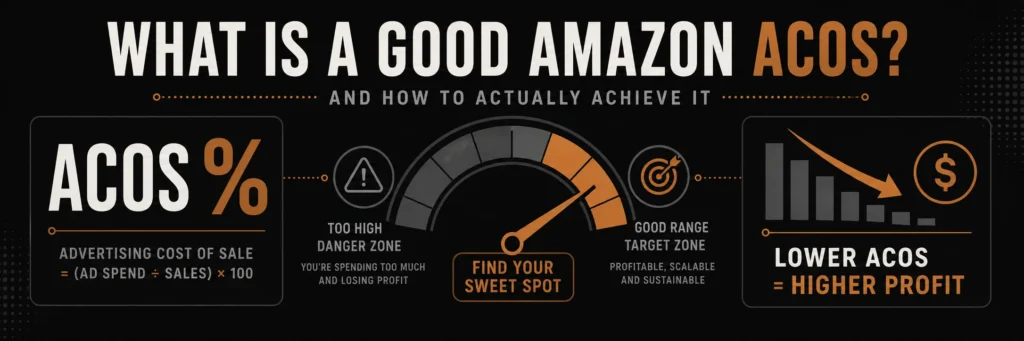
ACoS = (Advertising Spend ÷ Advertising Revenue) × 100
In simple terms: ACoS is the percentage of your ad sales that goes to advertising costs.
ACoS Example:
Scenario:
- You spend $100 on Amazon ads
- Those ads generate $500 in sales
- ACoS = ($100 ÷ $500) × 100 = 20%
This means: For every $1 in ad sales, you spent $0.20 on advertising.
ACoS vs ROAS:
ACoS (Advertising Cost of Sale):
- Lower is better
- Shows cost as percentage of sales
- Example: 20% ACoS = $0.20 cost per $1 sale
ROAS (Return on Ad Spend):
- Higher is better
- Shows revenue per $1 spent
- Example: 5x ROAS = $5 revenue per $1 spent
- Conversion: ROAS = 1 ÷ (ACoS ÷ 100)
Example:
- 20% ACoS = 5x ROAS
- 25% ACoS = 4x ROAS
- 33% ACoS = 3x ROAS
What is a Good ACoS on Amazon?
The Answer: It Depends on Your Profit Margin
There’s no universal “good” ACoS because it depends on your product’s profit margin. Here’s how to determine your target:
Calculate break-even ACoS from your own product economics
There is no universal healthy ACoS percentage for all Amazon sellers. Break-even ACoS depends on the product’s pre-ad contribution margin: the amount remaining after cost of goods, Amazon fees, fulfillment, returns allowance and other relevant costs, but before ad spend. Amazon Ads explains why the target should be set from profitability goals rather than a single industry number in its official ACoS guide.
Break-even ACoS (%) = (revenue per unit – non-ad unit costs) / revenue per unit × 100. For example, a $50 item with $30.50 of relevant non-ad costs has $19.50 of pre-ad contribution (39%). Its break-even ACoS is approximately 39% before any additional fixed costs not included in that calculation. A business seeking profit from advertised orders would set its target below this level, with the gap based on its actual required profit, not a mandatory 10-15-point deduction.
How to Calculate Your Target ACoS
Step 1: Calculate Your Profit Margin
Profit Margin Formula: Profit Margin = ((Selling Price – Total Costs) ÷ Selling Price) × 100
Total Costs Include:
- Product cost
- Amazon fees (referral, FBA)
- Shipping costs
- Exclude advertising from this pre-ad calculation; evaluate it separately when assessing after-ad contribution
- Returns and refunds
- Relevant non-ad variable costs; account for fixed overhead separately when assessing net profitability
Example:
- Selling Price: $50
- Product Cost: $15
- Amazon Fees: $7.50 (15%)
- FBA Fees: $5
- Shipping: $2
- Returns (2%): $1
- Total Costs: $30.50
- Pre-ad contribution: $19.50
- Pre-ad contribution margin: ($19.50 ÷ $50) × 100 = 39%
Step 2: Determine your target ACoS
Target ACoS = break-even ACoS minus the after-ad contribution margin you want to retain. For the example above, if break-even ACoS is 39% and you aim to retain 12 percentage points of revenue after ad spend, your illustrative target ACoS would be 27%. This is an example, not an industry benchmark; also account for fixed overhead, taxes, returns and business objectives before judging net profitability.
Step 3: Set Campaign Targets
Use separate targets for branded, generic, competitor and discovery campaigns based on their actual conversion rates, incremental sales value and product margins. A discovery campaign may legitimately run at a higher ACoS while generating useful data, but that does not make it automatically profitable. Review performance at both campaign and business level.
Factors That Affect ACoS
1. Product Profit Margin
Higher pre-ad contribution margin generally allows more room for advertising, but thresholds must account for each product’s costs and the seller’s objectives. Calculate break-even ACoS for each product rather than applying fixed percentages to an entire catalog.
2. Competition Level
High competition = Higher ACoS:
- Competitive niches require higher bids
- Lower competition = lower ACoS possible
- Research your competition
3. Keyword Intent
Commercial intent = Better ACoS:
- Brand keywords: Lower ACoS (high intent)
- Generic keywords: Higher ACoS (broader)
- Long-tail keywords: Lower ACoS (specific)
4. Listing Quality
Better listing = Better ACoS:
- High conversion rate = Lower ACoS
- Poor listing = Wasted clicks = Higher ACoS
- Optimize listing for conversions
5. Seasonality
Peak seasons = Higher ACoS:
- Holiday seasons: More competition
- Off-season: Lower competition
- Adjust targets seasonally
How to Lower Your Amazon ACoS
Strategy 1: Optimize Your Listing
Potential impact: Depends on baseline performance, conversion rate, traffic mix and costs
How:
- Improve conversion rate
- Better images
- Compelling copy
- Social proof (reviews)
- Clear value proposition
Why it works:
- Higher conversion = More sales per click
- Lower cost per sale = Lower ACoS
Strategy 2: Use Negative Keywords
Potential impact: Depends on baseline performance, conversion rate, traffic mix and costs
How:
- Export Search Terms Report weekly
- Identify high-impression, zero-sale terms
- Add as negative keywords
- Prevent wasted clicks
Example:
- Search: “headphones repair” (100 impressions, 0 sales)
- Add “repair” as negative
- Save money on irrelevant clicks
Strategy 3: Optimize Bids
Potential impact: Depends on baseline performance, conversion rate, traffic mix and costs
Bid Strategy:
- High ACoS keywords: Investigate conversion rate, attribution and spend before testing lower bids
- Low ACoS keywords: Test increases where contribution margin and incremental demand justify it
- Break-even keywords: Test adjustments
- New keywords: Start conservative
Bid adjustment approach:
Test bid changes incrementally using conversion rate, cost per click, sales attribution and campaign goals; there is no fixed bid-change percentage that works across all keywords.
Strategy 4: Focus on Converting Keywords
Potential impact: Depends on baseline performance, conversion rate, traffic mix and costs
How:
- Pause high-ACoS, low-converting keywords
- Scale low-ACoS, high-converting keywords
- Focus budget on winners
- Test new keywords regularly
Strategy 5: Improve Match Type Strategy
Impact: Better control = Lower ACoS
Approach:
- Exact Match: Lower ACoS (precise targeting)
- Phrase Match: Moderate ACoS (balanced)
- Broad Match: Higher ACoS (discovery)
Strategy:
- Use Exact for converting keywords
- Use Phrase for testing
- Use Broad for discovery only
Strategy 6: Product Targeting
Potential impact: Depends on baseline performance, conversion rate, traffic mix and costs
How:
- Target competitor ASINs
- Target complementary products
- Lower competition than keywords
- Often higher conversion
Strategy 7: Seasonal Optimization
Impact: Maintain profitability year-round
How:
- Adjust targets for peak seasons
- Increase budgets strategically
- Focus on high-converting keywords
- Plan for seasonality
ACoS by Campaign Type
There is no dependable universal ACoS range by campaign type. Use the same product-level economics and different performance objectives to judge each audience:
- Branded campaigns: Examine incrementality, existing organic demand and attributable sales; a low ACoS alone does not prove incremental profit.
- Generic campaigns: Assess category relevance, conversion rate, new-customer acquisition and contribution margin.
- Competitor campaigns: Compare acquisition costs and sales quality against your break-even threshold.
- Discovery campaigns: Define a testing budget and decision window; their role may be learning, not immediate profitability.
Common ACoS Mistakes
1. Chasing Unrealistic ACoS
❌ Mistake: Trying to achieve 10% ACoS on 20% margin product ✅ Solution: Set realistic targets based on margin
2. Ignoring Profit Margin
❌ Mistake: Using same ACoS target for all products ✅ Solution: Calculate target per product based on margin
3. Focusing Only on ACoS
❌ Mistake: Pausing all high-ACoS keywords ✅ Solution: Consider total profit, not just ACoS
4. Not Accounting for Organic Boost
❌ Mistake: Ignoring organic ranking improvements from PPC ✅ Solution: Factor in long-term organic value
5. Seasonal ACoS Confusion
❌ Mistake: Same ACoS target year-round ✅ Solution: Adjust for seasonality and competition
Advanced ACoS Optimization
1. Total Profit Analysis
Look beyond ACoS:
- Total Profit = Revenue – Costs
- High ACoS keyword might still be profitable
- Low ACoS keyword might have low volume
- Focus on total profit, not just ACoS
Example:
- Keyword A: $1,000 ad-attributed sales at 30% ACoS means $300 ad spend, not $300 profit.
- Keyword B: $200 ad-attributed sales at 20% ACoS means $40 ad spend, not $160 profit.
- Compare actual contribution: Subtract product costs, marketplace fees, fulfillment and ad spend before deciding which keyword generated more profit.
2. Lifetime Value (LTV) Consideration
Factor in repeat customers:
- First purchase might have high ACoS
- Repeat customer orders may involve additional marketing and retention costs
- Calculate LTV, not just first sale
- Accept higher ACoS for new customers
3. Relationship to Organic Visibility
Advertising can create additional product discovery and sales, but a particular organic ranking increase is not guaranteed. Measure paid and organic performance separately and avoid assuming that a higher ad budget will necessarily produce better organic rankings.
4. Break-Even Analysis
When to accept higher ACoS:
- New product launches
- Competitive positioning
- Market share growth
- Long-term strategy
Measuring ACoS Success
Key Metrics to Track:
- Overall ACoS
- Total ad spend ÷ Total ad sales
- Primary profitability metric
- Monitor daily
- ACoS by Campaign
- Track per campaign type
- Identify best/worst performers
- Optimize accordingly
- ACoS by Keyword
- Individual keyword performance
- Pause high-ACoS, low-converting
- Scale low-ACoS, high-converting
- ACoS Trends
- Improving or declining?
- Seasonal patterns?
- Optimization impact?
- Total Profit
- Revenue – Total Costs
- More important than ACoS alone
- Focus on profitability
ACoS Optimization Checklist
Calculation Phase
Optimization Phase
Monitoring Phase
Conclusion: Achieve Profitable ACoS
Amazon ACoS is an important measure of PPC spend efficiency, but profitability also depends on your unit economics, attribution, non-ad costs and wider business goals. Calculate a product-specific target and evaluate campaigns using both advertising and total-business measures.
Key Takeaways:
- ACoS depends on profit margin – No universal “good” ACoS
- Target ACoS depends on unit economics – Set it below the applicable break-even level when the objective is after-ad profit
- Optimize continuously – Daily monitoring, weekly optimization
- Focus on total profit – Not just ACoS percentage
- Factor in long-term value – Organic boost, LTV, market share
Remember: ACoS is a tool, not a goal. The goal is profitability and growth. Use ACoS to guide optimization, but always consider total profit and long-term value.
Need Help Achieving Profitable ACoS?
Our Amazon PPC management service helps sellers review campaign structure, spend allocation, search terms, bids and profitability targets. We cannot promise a particular ACoS without reviewing your actual account and product economics.
Request an Amazon advertising account review, or calculate campaign performance with our Amazon ACoS calculator.