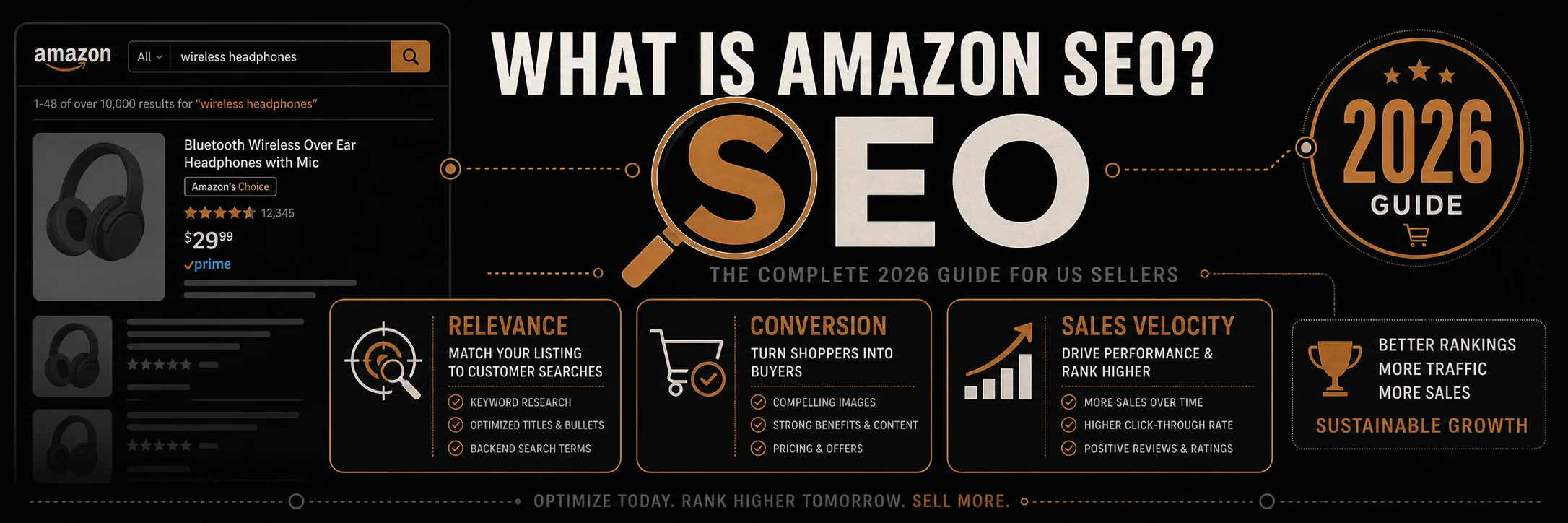
Amazon SEO (Search Engine Optimization) is the process of optimizing product listings to rank higher in Amazon’s internal search results. When a shopper types a query into the Amazon search bar, Amazon’s A10 algorithm scans millions of listings and ranks them based on relevance, conversion history, and seller performance. Amazon SEO is the practice of aligning your listing with what the A10 algorithm rewards.
Amazon SEO is different from Google SEO. While Google optimizes for information, Amazon’s search engine optimizes for purchases. Every ranking signal Amazon weighs is tied to the likelihood that a listing will convert.
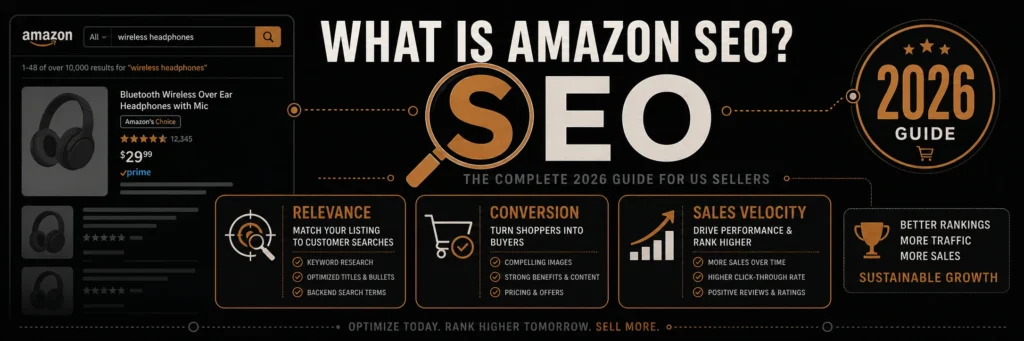
Why Amazon SEO Matters for US Sellers
More than 70% of Amazon shoppers never scroll past the first page of search results. For US sellers competing in crowded categories, appearing on page 1 is the difference between generating sales daily and going unnoticed. Amazon SEO is the organic, sustainable path to page 1 — without paying for every click.
How the Amazon A10 Algorithm Works
Amazon’s A10 algorithm (the successor to A9) ranks products based on several weighted signals:
- Click-Through Rate (CTR) — How often shoppers click your listing when it appears in search results. Your main image and title drive CTR.
- Conversion Rate (CVR) — The percentage of visitors who purchase. This is the most heavily weighted signal in A10.
- Sales Velocity — How many units you sell per day. Higher velocity signals demand and pushes rankings higher.
- Relevance — How closely your title, bullets, description, and backend keywords match the shopper’s query.
- Seller Authority — Your account health, review count, and feedback score.
- External Traffic — Traffic from outside Amazon (Google, social media) that converts on your listing now carries positive ranking weight in A10.
The 5 Core Elements of Amazon SEO
1. Keyword Research Keyword research is the foundation. Use tools like Helium 10’s Magnet or Jungle Scout’s Keyword Scout to identify high-volume, relevant search terms. Focus on: primary keywords (highest volume), secondary keywords (supporting terms), and long-tail keywords (lower competition, higher buyer intent).
2. Title Optimization Your Amazon product title is the most important SEO field. It should include your primary keyword within the first 80 characters, your brand name, key product attributes (size, color, material), and a conversion hook. Amazon allows up to 200 characters for most categories.
3. Bullet Points The five bullet points serve a dual purpose: keyword indexing for the algorithm and conversion copy for the shopper. Each bullet should start with a benefit keyword, not a feature. For example: “WATERPROOF PROTECTION: Sealed lining keeps contents dry in heavy rain” outperforms “Made from waterproof materials.”
4. Backend Search Terms The backend search term field (up to 250 bytes) is invisible to shoppers but indexed by Amazon. Include synonyms, alternate spellings, Spanish-language terms for US Hispanic buyers, and related search terms that didn’t fit in the visible copy.
5. A+ Content A+ Content (formerly Enhanced Brand Content) replaces the standard product description for Brand Registry members. It adds rich images, comparison charts, and brand storytelling. Amazon reports that A+ Content increases conversion rates by an average of 3-10%, and higher conversions directly improve organic rankings.
Amazon SEO vs Google SEO: Key Differences
| Factor | Amazon SEO | Google SEO |
|---|---|---|
| Primary goal | Purchase conversion | Information retrieval |
| Main ranking signal | Conversion rate + sales velocity | Backlinks + content authority |
| Timeframe for results | 2-6 weeks | 3-12 months |
| Keyword research tools | Helium 10, Jungle Scout, Brand Analytics | Ahrefs, Semrush, Google Keyword Planner |
| Content format | Titles, bullets, backend terms | Blog posts, pages, schema |
| External traffic impact | Positive (A10 rewards it) | Core requirement |
Common Amazon SEO Mistakes
- Keyword stuffing titles with commas and symbols (Amazon penalizes this)
- Ignoring the backend search terms entirely
- Writing bullets as feature lists instead of benefit-driven copy
- Using competitor brand names in backend terms (against Amazon TOS)
- Not updating listings when seasonal keywords shift
- Neglecting images — low CTR from poor images tanks SEO regardless of keyword quality
How Long Does Amazon SEO Take?
Most sellers see movement in rankings within 2-6 weeks of a full listing optimization. Sales velocity and conversion rate improvements are the fastest path to accelerated ranking. Pairing Amazon SEO with a PPC campaign during the initial launch period drives the sales velocity needed to push the algorithm faster.
FAQ: Amazon SEO
What is the difference between Amazon SEO and Amazon PPC? Amazon SEO improves your organic (unpaid) ranking through listing optimization. Amazon PPC (Pay-Per-Click) pays for ad placement in search results. They work best together: PPC drives immediate visibility and sales velocity while SEO builds sustainable long-term ranking.
Do I need Brand Registry for Amazon SEO? No — any seller can optimize titles, bullets, and backend keywords. However, Brand Registry unlocks A+ Content, which significantly improves conversion rates and supports SEO indirectly.
How many keywords should I target? Focus on 3-5 primary keywords for your title and bullets. Use your remaining keyword variations in the backend search terms. Quality and relevance matter more than quantity.
Can I hire an agency for Amazon SEO? Yes. A specialized Amazon SEO agency like advertpreneur conducts keyword research, writes optimized listings, and monitors ranking changes on your behalf. Get a free consultation here.
Architect Signature
Hasnain
Runs Amazon SEO and listing optimization for the Advertpreneur portfolio. He researches keywords and rebuilds listing architecture at the intersection of algorithm understanding and conversion copywriting.