
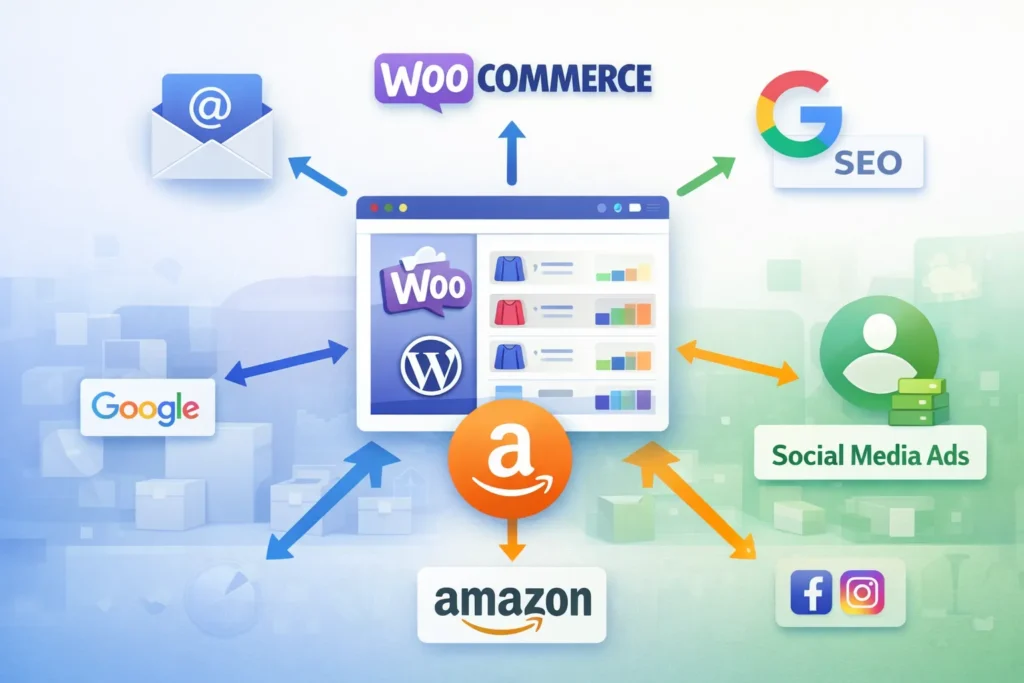
Choosing between WooCommerce Store Development and Shopify is one of the most important decisions an Amazon seller can make when expanding off-platform. Both solutions offer powerful eCommerce tools, yet they serve very different business needs. In this guide, Advertpreneur breaks down every key difference so you can invest your time and money wisely.
- Why Amazon Sellers Need Their Own Store
- WooCommerce Store Development: What It Offers
- Shopify: What It Offers
- Head-to-Head Comparison: WooCommerce vs Shopify
- WooCommerce Pros for Amazon Sellers
- WooCommerce Cons for Amazon Sellers
- Shopify Pros and Cons for Amazon Sellers
- When WooCommerce Store Development Is the Best Choice
- Frequently Asked Questions
- Conclusion
Why Amazon Sellers Need Their Own Store
Amazon is a powerful sales channel, but it limits your brand control significantly. You do not own your customer data, and Amazon can suppress or delist your products at any time. Therefore, building an independent store protects your revenue and strengthens your brand identity.
Furthermore, owning a website lets you capture email subscribers, run retargeting ads, and create loyalty programs. These are all impossible on Amazon alone. As a result, top-performing sellers consistently diversify onto platforms like WooCommerce or Shopify to reduce dependency risk.
Additionally, having your own store boosts your brand’s perceived legitimacy. Customers trust businesses with professional websites. For example, a well-built store increases average order value and repeat purchases over time.
Pro Tip: Amazon sellers who add an independent eCommerce store typically see 20–35% more total revenue within the first year, according to industry data from Shopify’s seller research.
WooCommerce Store Development: What It Offers
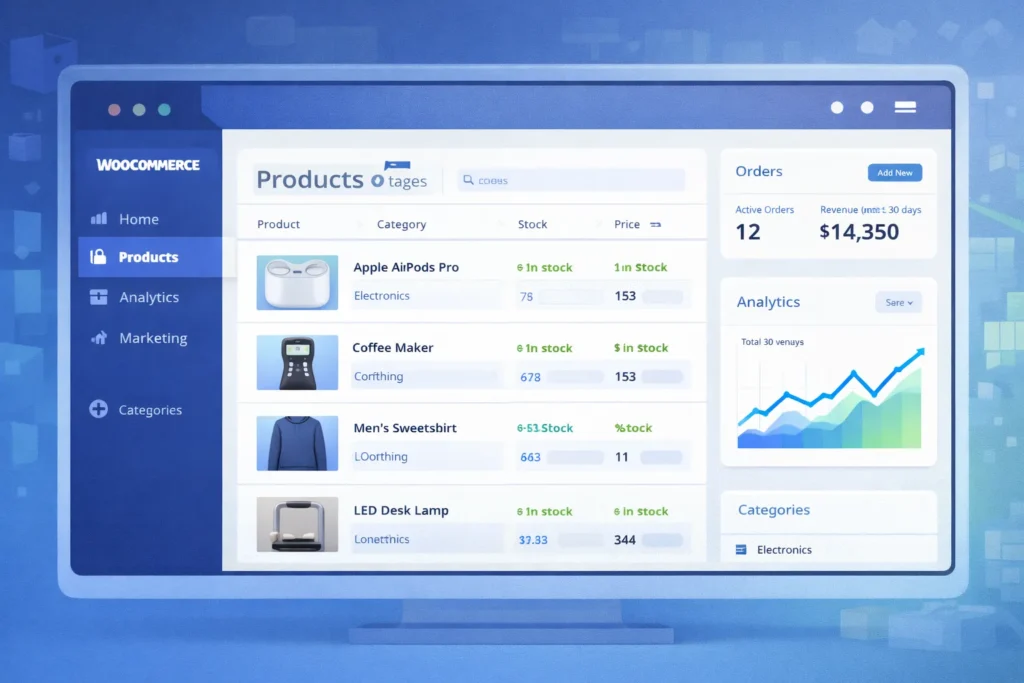
WooCommerce Store Development means building a fully customised online shop on top of WordPress. It is open-source, highly flexible, and powers over 36% of all eCommerce websites worldwide. Consequently, a vast developer ecosystem and thousands of plugins are available to you.
A professional WordPress Website Design Service can transform a basic WooCommerce install into a high-converting storefront. Design freedom is nearly unlimited because you control every line of code. Additionally, you own your hosting, your data, and your complete store architecture.
WordPress eCommerce Development also integrates deeply with SEO tools like Yoast and Rank Math. Firstly, your blog and product pages sit under one domain. Secondly, you can build topic clusters and internal links that Amazon never allows.
Key WooCommerce Features
- 100% open-source with no monthly SaaS licence fee
- Unlimited product variations and custom attributes
- Deep integration with WordPress SEO Optimization Service tools
- Hundreds of payment gateway options including Stripe, PayPal, and local gateways
- Full control over checkout flow and customer data
- Built-in blogging for content marketing and SEO
- Amazon FBA fulfilment plugins for seamless order sync
WooCommerce Setup Requirements
- Purchase reliable managed WordPress hosting (e.g., Kinsta, WP Engine, or SiteGround)
- Install WordPress and activate the WooCommerce plugin
- Choose and configure a high-quality WooCommerce theme
- Set up payment gateways and shipping zones
- Install SEO, security, and performance plugins
- Migrate or import your Amazon product catalog
- Connect Amazon FBA inventory sync tools
Shopify: What It Offers
Shopify is a fully hosted eCommerce platform designed for simplicity and speed to launch. It handles hosting, security, and updates automatically, so you focus entirely on selling. However, that convenience comes with a monthly fee and significant customisation restrictions.
Shopify’s App Store offers over 8,000 integrations, including direct Amazon channel selling tools. Furthermore, Shopify Payments removes third-party gateway fees for eligible merchants. Most importantly, the drag-and-drop store builder requires zero technical knowledge to operate.
In contrast to WooCommerce, Shopify limits your SEO control and charges transaction fees if you use external payment gateways. Consequently, sellers with large catalogs or complex needs often find Shopify too restrictive over time.
Key Shopify Features
- Fully hosted with 99.9% uptime guarantee
- Fast setup — store live within hours
- Built-in Amazon sales channel app
- Mobile-optimised themes out of the box
- Shopify Payments for simplified checkout
- Basic SEO tools with limited customisation
- 24/7 customer support via chat and phone
Head-to-Head Comparison: WooCommerce vs Shopify
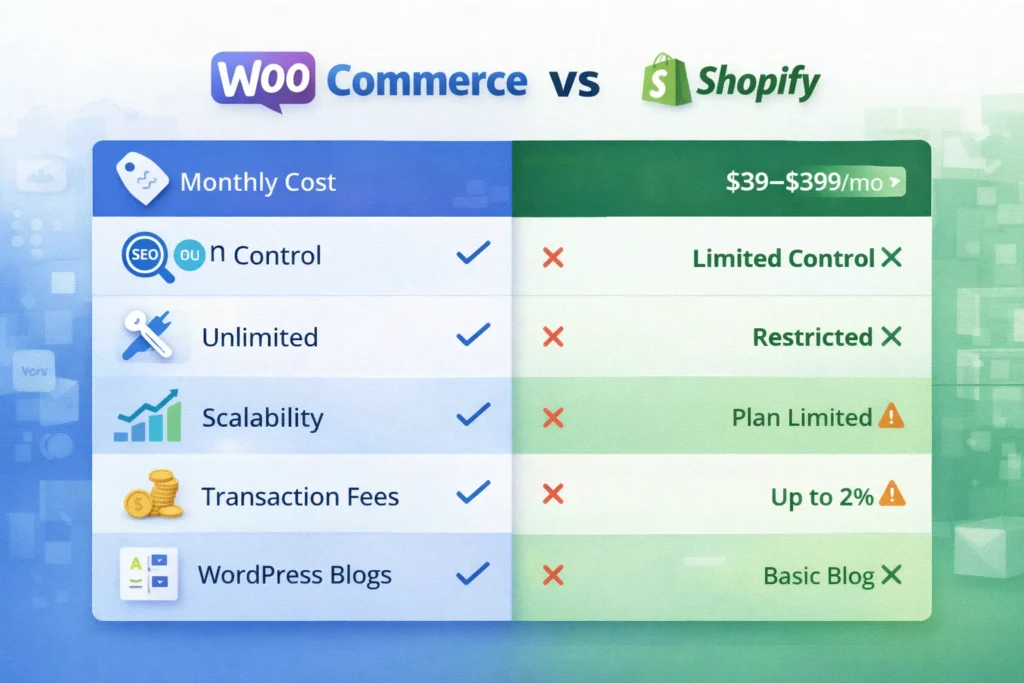
The table below compares both platforms across the metrics that matter most to Amazon sellers. Use this to identify which solution aligns with your growth goals and technical resources.
Table: WooCommerce Store Development vs Shopify — Key Metrics for Amazon Sellers
| Feature / Metric | WooCommerce (WordPress) | Shopify |
|---|---|---|
| Monthly Platform Cost | Free plugin (hosting ~$20–$80/mo) | $39–$399/mo (Basic to Advanced) |
| Transaction Fees | None (gateway fees only) | 0.5%–2% unless using Shopify Payments |
| SEO Control | Full — custom meta, schema, URLs | Limited — URL structures locked |
| Customisation Flexibility | Unlimited with code/plugins | Restricted to theme/app framework |
| Amazon FBA Integration | Via plugins (WooCommerce Amazon Fulfillment) | Built-in Amazon sales channel |
| Content Marketing (Blog) | Full WordPress CMS power | Basic built-in blog |
| Data Ownership | 100% yours | Stored on Shopify servers |
| Setup Difficulty | Moderate — needs technical help | Easy — beginner-friendly |
| Scalability | Unlimited with right hosting | Limited by plan tier |
| Payment Gateways | 100+ options globally | ~100 but penalises non-Shopify Payments |
WooCommerce Pros for Amazon Sellers
WooCommerce Store Development gives Amazon sellers unmatched control over their brand experience. You design every page element, set every SEO parameter, and own your complete customer database. In contrast, Shopify locks you inside its proprietary framework.
Furthermore, WooCommerce is genuinely free to use as a plugin. Your only recurring costs are hosting and any premium plugins you choose. Therefore, sellers with high order volumes save significantly compared to Shopify’s percentage-based transaction fees.
A professional WordPress Website Design Service can also create a visually unique brand that stands out in your niche. Additionally, WordPress eCommerce Development lets you build rich content ecosystems — long-form guides, category pages, and comparison articles — that rank on Google and drive organic traffic.
Pro Tip: Pairing your WooCommerce store with a dedicated Free Amazon Consultation from Advertpreneur helps you map the right integration strategy between your Amazon FBA account and your new website storefront.
SEO Advantages of WooCommerce
A WordPress SEO Optimization Service leverages Yoast SEO, Rank Math, and Google Search Console integration to maximise organic visibility. You can fully customise title tags, meta descriptions, canonical URLs, and structured data for every product. Consequently, your store can rank for thousands of long-tail keywords that Shopify’s URL structure restricts.
Additionally, WordPress’s native blog is the most powerful content marketing platform available. You can build topic clusters, internal link networks, and buyer intent content that Amazon sellers rarely exploit. As a result, your website generates consistent free traffic alongside your paid campaigns.
Cost Savings at Scale
Consider a seller generating $50,000 per month in off-Amazon revenue. On Shopify Advanced ($399/mo plus 0.5% transaction fees), that seller pays roughly $649 per month in platform costs. In contrast, a WooCommerce store on premium hosting costs under $100 per month with zero transaction fees. Therefore, the annual saving exceeds $6,500 — enough to fund significant marketing campaigns.
WooCommerce Cons for Amazon Sellers
WooCommerce Store Development requires a higher initial time investment than Shopify. You must manage hosting, plugin updates, security patches, and site performance yourself. Consequently, sellers without technical experience should work with an expert agency from day one.
Additionally, the setup process is more complex than Shopify’s one-click install. Firstly, you need to select and configure hosting. Secondly, you must choose a compatible theme, configure WooCommerce settings, and install necessary plugins. However, a skilled WordPress eCommerce Development partner makes this process fast and stress-free.
Finally, WooCommerce’s built-in Amazon sales channel integration is less native than Shopify’s. You must install third-party plugins like WP-Lister or WooCommerce Amazon Fulfillment to sync inventory. For example, incorrect plugin configuration can cause stock discrepancies between channels.
Warning: Never launch a WooCommerce store on shared hosting if you expect significant traffic. Cheap hosting causes slow load times, which directly harms your SEO rankings and conversion rates. Always invest in managed WordPress hosting from the start.
Maintenance Responsibilities
- Monthly plugin and theme updates are mandatory for security
- Regular database optimisation keeps site speed fast
- SSL certificates must be renewed annually
- Backups should run daily to prevent data loss
- Security scans protect against malware and intrusions
Shopify Pros and Cons for Amazon Sellers
Shopify’s biggest advantage is speed and simplicity. A seller with no technical background can launch a professional-looking store in under 24 hours. Furthermore, Shopify’s built-in Amazon sales channel lets you list and sync products directly from your Shopify dashboard.
However, Shopify’s SEO limitations are a serious concern for long-term growth. URL structures include mandatory subdirectories that you cannot remove. Additionally, Shopify’s blogging tool is far weaker than WordPress, limiting your content marketing potential significantly.
Most importantly, Shopify’s transaction fees add up fast at scale. For example, a seller using PayPal on the Basic Shopify plan pays an additional 2% per transaction on top of PayPal’s standard fees. As a result, high-volume sellers consistently migrate to WooCommerce Store Development as their revenue grows.
When Shopify Makes Sense
Shopify is a strong choice if you need a store live immediately with minimal setup effort. It suits sellers with small catalogs (under 200 products) who prioritise ease over customisation. Additionally, Shopify works well as a temporary storefront while you plan a more robust WooCommerce Store Development migration.
Note: Many Amazon sellers start on Shopify for speed, then migrate to WooCommerce once their monthly revenue justifies the investment in a more powerful, scalable platform. Plan this migration early to avoid SEO disruption.
When WooCommerce Store Development Is the Best Choice
WooCommerce Store Development is the superior choice for serious Amazon sellers who want full brand ownership and long-term scalability. If you generate over $10,000 per month in revenue, the cost savings and SEO benefits outweigh the setup complexity. Furthermore, WordPress eCommerce Development gives you a publishing platform powerful enough to compete with major eCommerce content sites.
Additionally, WooCommerce is ideal if you sell internationally. You can configure multi-currency, multi-language stores that Shopify restricts behind expensive plan upgrades. Consequently, global sellers consistently choose WooCommerce to serve diverse customer bases without paying premium subscription tiers.
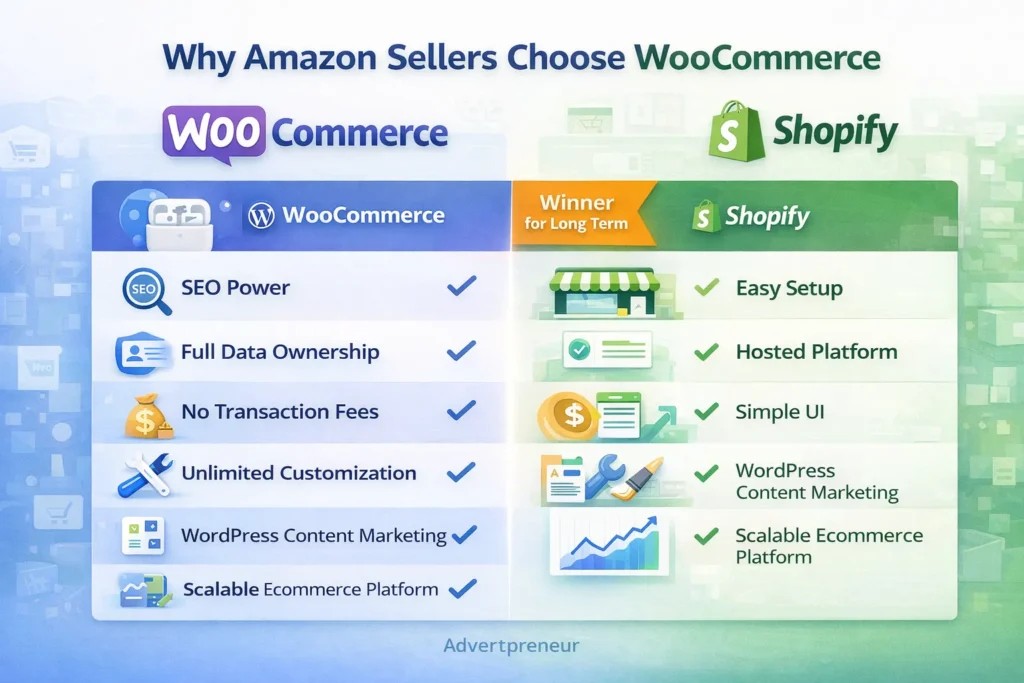
Finally, if SEO-driven organic traffic is central to your growth strategy, WooCommerce is non-negotiable. A dedicated WordPress SEO Optimization Service combined with WooCommerce’s full technical SEO capabilities can generate compounding organic revenue for years. In summary, WooCommerce Store Development is the long-term winner for Amazon sellers serious about building a brand.
According to W3Techs usage statistics, WordPress powers 43% of all websites on the internet — evidence of its unmatched reliability, developer support, and ecosystem maturity for any serious eCommerce project.
- You want full SEO control and content marketing capabilities
- Your monthly revenue exceeds $10,000 and transaction fees are significant
- You need a highly customised user experience or checkout flow
- You plan to build a brand with a long-term organic traffic strategy
- You sell internationally and need flexible multi-currency support
- You want 100% ownership of your customer data and purchase history
Frequently Asked Questions
Is WooCommerce or Shopify better for Amazon sellers who are just starting out?
Shopify is faster to launch for complete beginners, but WooCommerce Store Development offers far more long-term value. If you have a small budget and need a store live immediately, Shopify works for the short term. However, most sellers migrate to WooCommerce once they outgrow Shopify’s limitations around SEO, customisation, and transaction fees. Starting with WooCommerce from day one, with the help of a professional agency, saves you the cost and disruption of migrating later. How much does professional WooCommerce Store Development cost?
WooCommerce Store Development costs vary based on the scope of your project. A basic store with 50–100 products typically ranges from $800 to $2,500. A fully custom store with advanced integrations, SEO setup, and Amazon sync tools can range from $3,000 to $8,000 or more. Ongoing monthly maintenance and a WordPress SEO Optimization Service add $150–$500 per month depending on your needs. These costs are significantly offset by the platform savings compared to Shopify’s monthly fees and transaction charges at scale. Can I connect my WooCommerce store directly to Amazon FBA?
Yes, you can connect WooCommerce to Amazon FBA using plugins like WooCommerce Amazon Fulfillment, WP-Lister Pro, or Sellbrite. These tools sync your WooCommerce inventory with your Amazon seller account and automatically route orders to FBA for fulfilment. Furthermore, they update stock levels in real time across both channels. Consequently, you avoid overselling and maintain accurate inventory without manual management. Does WooCommerce or Shopify rank better on Google?
WooCommerce on WordPress consistently outperforms Shopify in SEO potential. WordPress gives you full control over URL structures, meta tags, schema markup, and site architecture — all critical ranking factors. Additionally, WordPress’s powerful blogging capabilities let you build content clusters that drive sustained organic traffic. Shopify’s locked URL structures and weaker blog tools limit your SEO ceiling significantly. A dedicated WordPress SEO Optimization Service further amplifies WooCommerce’s natural SEO advantages. What is a WordPress Website Design Service and do I need one?
A WordPress Website Design Service is a professional service that designs, develops, and launches a WordPress-based website tailored to your brand and business goals. It typically includes custom theme design, page layout creation, mobile optimisation, plugin configuration, and performance tuning. Amazon sellers benefit significantly from this service because a professionally designed WooCommerce store converts visitors far better than a default template. Furthermore, a proper design service ensures your brand identity transfers consistently from Amazon to your independent store. How long does WooCommerce Store Development take?
A standard WooCommerce Store Development project typically takes 3–6 weeks from kickoff to launch. Simple stores with under 50 products can go live in 2–3 weeks. Complex stores with custom design, advanced integrations, and large product catalogs may take 6–10 weeks. Working with an experienced WordPress eCommerce Development team shortens timelines significantly because they avoid common setup errors and follow proven workflows. Advertpreneur delivers full WooCommerce store projects with SEO setup included in the launch package.
Ready to Build Your WooCommerce Store and Grow Beyond Amazon?
Get a free strategy call with Advertpreneur — Pakistan’s leading Amazon and eCommerce growth agency. We design, develop, and launch high-converting WooCommerce stores built to rank and scale.Book Your Free Consultation
Conclusion
Both WooCommerce and Shopify offer genuine value for Amazon sellers looking to expand off-platform. However, for sellers who prioritise SEO, scalability, data ownership, and long-term cost efficiency, WooCommerce Store Development is clearly the stronger investment. Furthermore, combining WordPress eCommerce Development with a professional WordPress SEO Optimization Service creates a powerful organic growth engine that compounds over time.
Shopify suits sellers who need speed and simplicity right now. In contrast, WooCommerce Store Development suits sellers who are building a serious brand for the long term. Additionally, the cost savings at scale — especially on transaction fees — consistently justify the higher upfront setup investment for growing businesses.
In summary, the best platform is the one aligned with your business goals, technical resources, and growth timeline. If you want expert guidance on whether WooCommerce Store Development is right for your Amazon business, Advertpreneur is ready to help you make the right decision and execute it flawlessly.