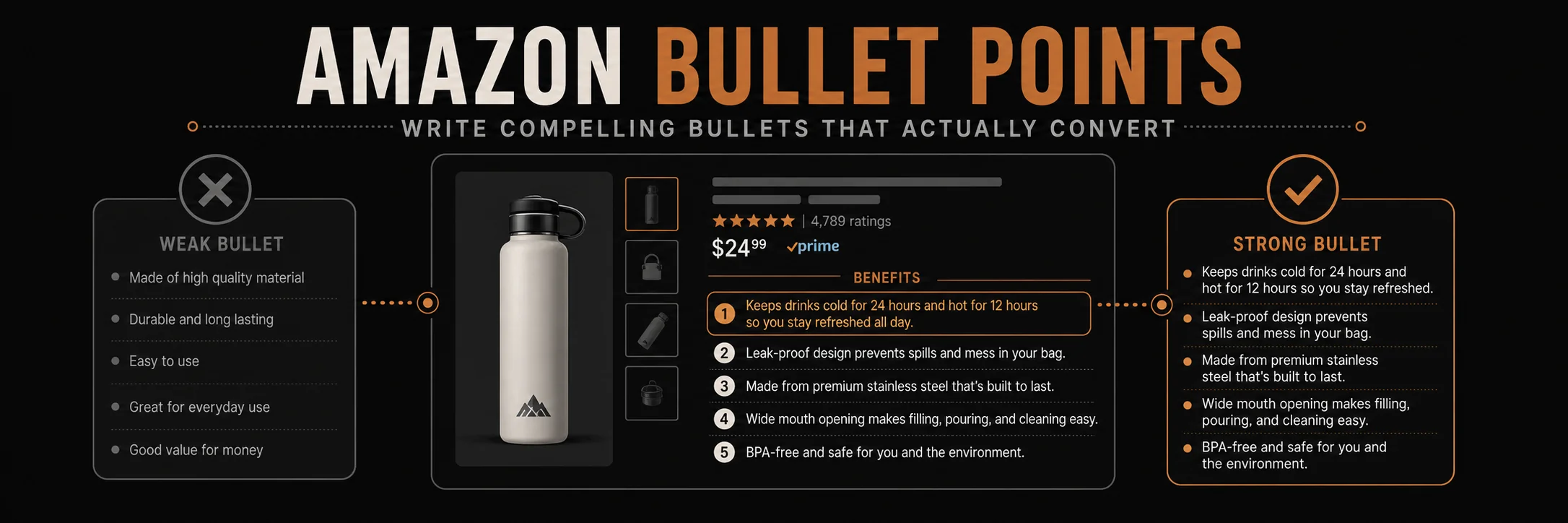
Amazon bullet points are your product’s sales pitch in 200 characters or less. They’re the first thing customers read after your title, and they can make or break a sale. This guide will teach you how to write compelling bullet points that convert browsers into buyers.
Amazon bullet points are read by both the algorithm and the shopper. Writing them well means satisfying both at the same time. This guide shows you exactly how.
Why Amazon Bullet Points Matter
Impact on Sales
- Bullet points are read by 80% of shoppers before making a purchase decision
- Well-written bullets can increase conversion rates by 20-30%
- Bullets help customers quickly understand product benefits
- They’re crucial for mobile shoppers who scan content quickly
SEO Benefits
- Bullet points are indexed by Amazon’s A9 algorithm
- Keywords in bullets improve search visibility
- Help products rank for long-tail keywords
- Support overall listing optimization
Amazon Bullet Point Requirements
Character Limits
- Maximum: 200 characters per bullet point
- Recommended: 150-180 characters for optimal readability
- Minimum: Use at least 100 characters to maximize SEO value
Number of Bullets
- Maximum: 5 bullet points per listing
- Minimum: Use all 5 bullets for maximum impact
- Best Practice: Fill all 5 bullets with valuable information
Formatting Rules
- No HTML formatting allowed
- No special characters (bullets, arrows, etc.) in first character
- Plain text only
- Can use capital letters for emphasis
- Line breaks are automatically added
Structure of High-Converting Bullet Points
The Formula
Feature + Benefit + Proof/Detail = Conversion
Each bullet should:
- Lead with the feature (what it is)
- Explain the benefit (why it matters)
- Add proof or detail (credibility or specifics)
Example Structure
Bad: “Wireless headphones” Good: “WIRELESS FREEDOM: Bluetooth 5.0 technology provides stable connection up to 33 feet, perfect for workouts and daily commutes without tangled cords”
What to Include in Each Bullet Point
Bullet 1: Primary Benefit or Unique Selling Proposition
- Your product’s main differentiator
- The #1 reason to buy
- What makes you stand out from competitors
- Most important feature/benefit
Bullet 2: Key Features and Specifications
- Important technical details
- Size, dimensions, capacity
- Material quality
- Technical specifications
Bullet 3: Use Cases and Applications
- Who it’s for
- When to use it
- Problem it solves
- Ideal customer scenarios
Bullet 4: Quality and Durability
- Build quality
- Material quality
- Longevity and durability
- Premium features
Bullet 5: Additional Value or Guarantee
- Bonus features
- Included accessories
- Warranty information
- Customer support
- Money-back guarantee
Writing Techniques for Compelling Bullets
1. Lead with Keywords
Start each bullet with your most important keyword:
- “WIRELESS BLUETOOTH HEADPHONES: Advanced 5.0 technology…”
- “PREMIUM LEATHER WALLET: Genuine Italian leather construction…”
2. Use Power Words
Incorporate words that create emotion and urgency:
- Premium, Professional, Advanced, Ultimate, Exclusive
- Guaranteed, Proven, Tested, Certified, Award-Winning
- Instant, Fast, Quick, Easy, Simple
3. Be Specific
Avoid vague claims. Use numbers and specifics:
- Bad: “Long battery life”
- Good: “40-HOUR BATTERY LIFE: Rechargeable lithium battery provides up to 40 hours of continuous playback on a single charge”
4. Focus on Benefits, Not Just Features
Always explain why the feature matters:
- Feature: “Waterproof IPX7 rating”
- Benefit: “WATERPROOF DESIGN: IPX7 rating means you can use these headphones in the rain, at the pool, or during intense workouts without worry”
5. Address Objections
Anticipate and answer common concerns:
- Quality concerns → Emphasize materials and construction
- Size concerns → Provide dimensions and comparisons
- Use concerns → Explain use cases and applications
- Value concerns → Highlight included accessories and value
Amazon Bullet Point Templates
Template 1: Feature-Focused
[KEYWORD]: [Feature description] provides [benefit] for [use case], making it perfect for [target customer]
Example: “NOISE CANCELLATION: Advanced active noise cancellation technology blocks up to 95% of ambient noise, creating an immersive listening experience perfect for travelers and office workers”
Template 2: Problem-Solution
[PROBLEM SOLVED]: [Product feature] eliminates [problem] by [how it works], ensuring [benefit] for [target customer]
Example: “TANGLED CORD SOLUTION: Tangle-free cable design with reinforced connectors eliminates frustrating cord tangles, ensuring reliable performance during workouts and daily use”
Template 3: Comparison
[COMPETITIVE ADVANTAGE]: Unlike [competitor feature], our [product feature] delivers [benefit] through [unique method], providing [result]
Example: “SUPERIOR COMFORT: Unlike standard memory foam, our gel-infused memory foam adapts to your body temperature, providing personalized support that reduces pressure points by 40%”
Keyword Optimization in Bullet Points
Primary Keywords
Include your main keyword in at least 2-3 bullet points:
- Natural integration (not keyword stuffing)
- Vary placement (beginning, middle, end)
- Use variations and synonyms
Long-Tail Keywords
Incorporate long-tail keywords naturally:
- “wireless bluetooth headphones for running”
- “waterproof phone case for swimming”
- “ergonomic office chair for back pain”
Related Keywords
Include semantically related terms:
- For “headphones”: audio, sound, music, listening, earbuds
- For “laptop”: computer, notebook, portable, productivity
Common Bullet Point Mistakes
Mistake 1: Being Too Vague
Bad: “High quality product” Good: “PREMIUM CONSTRUCTION: Aircraft-grade aluminum body with reinforced corners withstands drops up to 6 feet, ensuring durability for years of daily use”
Mistake 2: Focusing Only on Features
Bad: “Bluetooth 5.0 technology” Good: “LATEST BLUETOOTH 5.0: Advanced wireless technology provides stable connection up to 33 feet with zero audio lag, perfect for workouts without phone in pocket”
Mistake 3: Ignoring Character Limits
- Going over 200 characters gets cut off
- Too short (under 100) wastes valuable space
- Aim for 150-180 characters for optimal impact
Mistake 4: Not Using All 5 Bullets
- Missing opportunities to convert
- Wasting SEO value
- Appearing less professional
- Always use all 5 bullets
Mistake 5: Copying Competitors
- Your product is unique
- Copying doesn’t highlight your advantages
- Create original, benefit-focused content
- Stand out from the competition
Mobile Optimization for Bullet Points
Mobile Considerations
- Shorter sentences: Easier to read on small screens
- Clear structure: Each bullet should stand alone
- Scannable format: Use capital letters for keywords
- Quick benefits: Mobile users scan quickly
Mobile Best Practices
- Lead with the most important benefit
- Keep sentences concise
- Use numbers and specifics
- Make each bullet independently valuable
A/B Testing Bullet Points
What to Test
- Different keyword placements
- Benefit-focused vs. feature-focused
- Emotional vs. rational appeals
- Length variations
- Power word usage
How to Test
- Create two versions of bullet points
- Run both versions for 2-4 weeks
- Measure conversion rates
- Implement winning version
- Continue testing and optimizing
Bullet Points for Different Product Categories
Electronics
- Focus on technical specifications
- Highlight compatibility
- Emphasize performance metrics
- Include connectivity features
Home & Kitchen
- Emphasize ease of use
- Highlight durability
- Focus on convenience
- Include safety features
Clothing & Accessories
- Focus on materials and quality
- Highlight fit and comfort
- Emphasize style and versatility
- Include care instructions
Health & Personal Care
- Focus on benefits and results
- Highlight safety and ingredients
- Emphasize ease of use
- Include usage instructions
Bullet Points and Amazon A9 Algorithm
How Bullets Affect Ranking
- Keywords in bullets are indexed
- Better bullets = higher conversion = better ranking
- Bullets support overall listing optimization
- Help rank for long-tail keywords
SEO Best Practices
- Include primary keyword in 2-3 bullets
- Use related keywords naturally
- Incorporate long-tail keywords
- Maintain keyword density (2-3% natural)
Writing Process for Bullet Points
Step 1: Research
- Analyze competitor bullet points
- Identify unique selling propositions
- List all features and benefits
- Research target keywords
Step 2: Prioritize
- Rank features by importance
- Identify top 5 benefits
- Determine unique differentiators
- Select most valuable keywords
Step 3: Write
- Use templates for structure
- Focus on benefits over features
- Include specifics and numbers
- Address customer objections
Step 4: Optimize
- Check character count
- Verify keyword inclusion
- Ensure mobile readability
- Test for clarity and impact
Step 5: Refine
- Remove unnecessary words
- Strengthen power words
- Improve flow and readability
- Final keyword check
Checklist: Amazon Bullet Point Optimization
Common Questions About Amazon Bullet Points
Can I use emojis in bullet points?
No, Amazon doesn’t allow emojis or special characters in bullet points. Use plain text only.
How often should I update bullet points?
Review quarterly or when you notice conversion issues. Update immediately if you receive customer feedback about clarity.
Should I use all caps for keywords?
Using all caps for the first few words can help with scanning and emphasis, but don’t overdo it. Use strategically.
Do bullet points affect Amazon ranking?
Yes, indirectly. Better bullets improve conversion rates, which positively impacts ranking. Keywords in bullets are also indexed.
Conclusion
Amazon bullet points are a critical conversion tool that can significantly impact your sales. By focusing on benefits, using specific details, optimizing for keywords, and addressing customer needs, you can create bullet points that not only inform but also persuade.
Take time to craft compelling bullet points. The investment in well-written bullets will pay off through improved conversion rates, better search visibility, and increased sales.
Need help optimizing your Amazon listings? Contact advertpreneur for expert Amazon listing optimization services. We create conversion-focused bullet points and product descriptions that boost sales.
Architect Signature
Hasnain
Runs Amazon SEO and listing optimization for the Advertpreneur portfolio. He researches keywords and rebuilds listing architecture at the intersection of algorithm understanding and conversion copywriting.