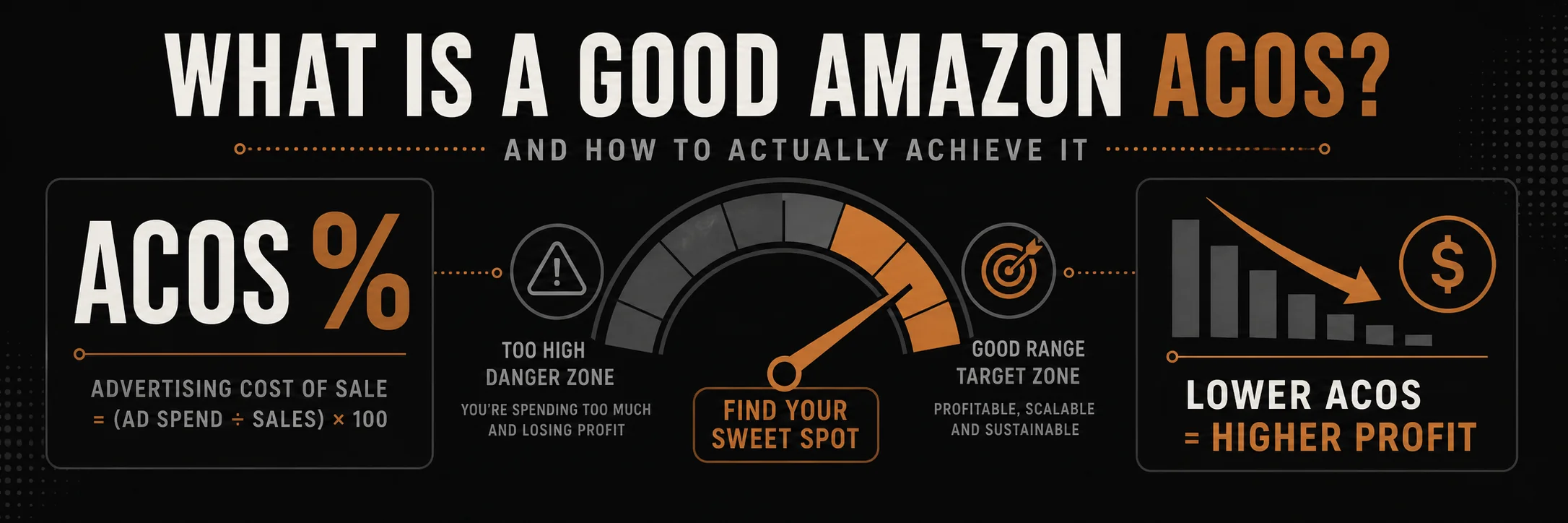
ACoS (Advertising Cost of Sale) is the most important metric in Amazon PPC advertising. Understanding what ACoS means and how to achieve profitable ACoS is the difference between profitable advertising and wasted ad spend.
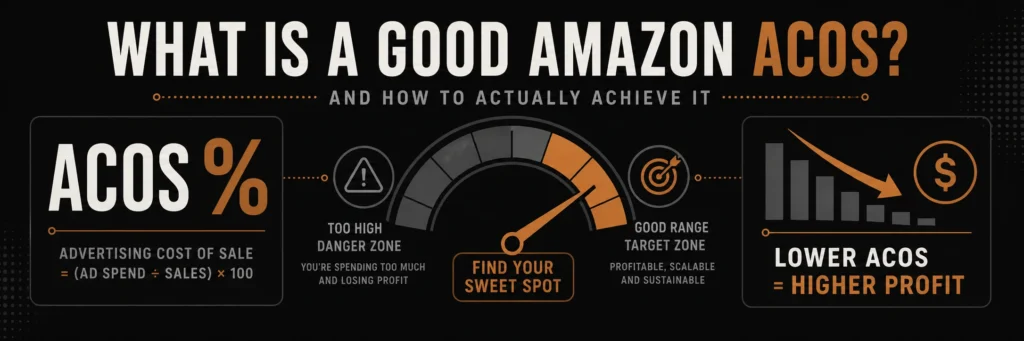
A good ACoS depends on your margin, not a universal number. This guide explains how to calculate your target ACoS and build a campaign strategy around it.
Many Amazon sellers struggle with ACoS because they don’t understand:
- What ACoS actually means
- What a “good” ACoS is for their product
- How to calculate target ACoS
- How to optimize campaigns to achieve it
In this comprehensive guide, we’ll demystify Amazon ACoS. You’ll learn how to calculate it, determine your target, and implement strategies to achieve profitable ACoS that drives sustainable growth.
What is Amazon ACoS?
ACoS Definition:
ACoS = (Advertising Spend ÷ Advertising Revenue) × 100
In simple terms: ACoS is the percentage of your ad sales that goes to advertising costs.
ACoS Example:
Scenario:
- You spend $100 on Amazon ads
- Those ads generate $500 in sales
- ACoS = ($100 ÷ $500) × 100 = 20%
This means: For every $1 in ad sales, you spent $0.20 on advertising.
ACoS vs ROAS:
ACoS (Advertising Cost of Sale):
- Lower is better
- Shows cost as percentage of sales
- Example: 20% ACoS = $0.20 cost per $1 sale
ROAS (Return on Ad Spend):
- Higher is better
- Shows revenue per $1 spent
- Example: 5x ROAS = $5 revenue per $1 spent
- Conversion: ROAS = 1 ÷ (ACoS ÷ 100)
Example:
- 20% ACoS = 5x ROAS
- 25% ACoS = 4x ROAS
- 33% ACoS = 3x ROAS
What is a Good ACoS on Amazon?
The Answer: It Depends on Your Profit Margin
There’s no universal “good” ACoS because it depends on your product’s profit margin. Here’s how to determine your target:
ACoS by Profit Margin:
| Product Profit Margin | Target ACoS | Healthy Range | Maximum ACoS |
|---|---|---|---|
| 50%+ | 25-35% | 20-40% | 40% |
| 40-50% | 20-30% | 15-35% | 35% |
| 30-40% | 15-25% | 10-30% | 30% |
| 20-30% | 10-20% | 5-25% | 25% |
| 10-20% | 5-15% | 0-20% | 20% |
| Under 10% | 0-10% | 0-15% | 15% |
General Rule:
Target ACoS = Profit Margin – 10-15%
Example:
- Product profit margin: 35%
- Target ACoS: 35% – 10% = 25%
- Healthy range: 20-30%
Why This Formula Works:
At target ACoS:
- You maintain profitability
- Leave room for other costs
- Allow for fluctuations
- Enable sustainable growth
How to Calculate Your Target ACoS
Step 1: Calculate Your Profit Margin
Profit Margin Formula: Profit Margin = ((Selling Price – Total Costs) ÷ Selling Price) × 100
Total Costs Include:
- Product cost
- Amazon fees (referral, FBA)
- Shipping costs
- Advertising (current)
- Returns and refunds
- Other overhead
Example:
- Selling Price: $50
- Product Cost: $15
- Amazon Fees: $7.50 (15%)
- FBA Fees: $5
- Shipping: $2
- Returns (2%): $1
- Total Costs: $30.50
- Profit: $19.50
- Profit Margin: ($19.50 ÷ $50) × 100 = 39%
Step 2: Determine Target ACoS
Target ACoS = Profit Margin – 10-15%
From example above:
- Profit Margin: 39%
- Target ACoS: 39% – 12% = 27%
- Healthy Range: 22-32%
Step 3: Set Campaign Targets
Campaign Structure:
- Brand Campaign: Lower ACoS (15-20%) – Brand searches convert well
- Generic Campaign: Target ACoS (25-30%) – Category keywords
- Competitor Campaign: Higher ACoS (30-35%) – Competitive but valuable
- Discovery Campaign: Highest ACoS (35-40%) – Finding new keywords
Factors That Affect ACoS
1. Product Profit Margin
Higher margin = Higher ACoS tolerance:
- 50% margin can sustain 30-35% ACoS
- 20% margin needs 10-15% ACoS
- Calculate your margin first
2. Competition Level
High competition = Higher ACoS:
- Competitive niches require higher bids
- Lower competition = lower ACoS possible
- Research your competition
3. Keyword Intent
Commercial intent = Better ACoS:
- Brand keywords: Lower ACoS (high intent)
- Generic keywords: Higher ACoS (broader)
- Long-tail keywords: Lower ACoS (specific)
4. Listing Quality
Better listing = Better ACoS:
- High conversion rate = Lower ACoS
- Poor listing = Wasted clicks = Higher ACoS
- Optimize listing for conversions
5. Seasonality
Peak seasons = Higher ACoS:
- Holiday seasons: More competition
- Off-season: Lower competition
- Adjust targets seasonally
How to Lower Your Amazon ACoS
Strategy 1: Optimize Your Listing
Impact: Can improve ACoS by 10-20%
How:
- Improve conversion rate
- Better images
- Compelling copy
- Social proof (reviews)
- Clear value proposition
Why it works:
- Higher conversion = More sales per click
- Lower cost per sale = Lower ACoS
Strategy 2: Use Negative Keywords
Impact: Can reduce ACoS by 10-15%
How:
- Export Search Terms Report weekly
- Identify high-impression, zero-sale terms
- Add as negative keywords
- Prevent wasted clicks
Example:
- Search: “headphones repair” (100 impressions, 0 sales)
- Add “repair” as negative
- Save money on irrelevant clicks
Strategy 3: Optimize Bids
Impact: Can improve ACoS by 15-25%
Bid Strategy:
- High ACoS keywords: Lower bids 20-30%
- Low ACoS keywords: Raise bids 10-20%
- Break-even keywords: Test adjustments
- New keywords: Start conservative
Bid Adjustment Formula:
- If ACoS is 40% and target is 25%: Lower bid by 30-40%
- If ACoS is 15% and target is 25%: Raise bid by 20-30%
Strategy 4: Focus on Converting Keywords
Impact: Can improve efficiency by 20-30%
How:
- Pause high-ACoS, low-converting keywords
- Scale low-ACoS, high-converting keywords
- Focus budget on winners
- Test new keywords regularly
Strategy 5: Improve Match Type Strategy
Impact: Better control = Lower ACoS
Approach:
- Exact Match: Lower ACoS (precise targeting)
- Phrase Match: Moderate ACoS (balanced)
- Broad Match: Higher ACoS (discovery)
Strategy:
- Use Exact for converting keywords
- Use Phrase for testing
- Use Broad for discovery only
Strategy 6: Product Targeting
Impact: Can lower ACoS by 10-20%
How:
- Target competitor ASINs
- Target complementary products
- Lower competition than keywords
- Often higher conversion
Strategy 7: Seasonal Optimization
Impact: Maintain profitability year-round
How:
- Adjust targets for peak seasons
- Increase budgets strategically
- Focus on high-converting keywords
- Plan for seasonality
ACoS by Campaign Type
Brand Campaign ACoS:
Target: 15-20%
- Brand searches have high intent
- Lower competition
- Higher conversion rates
- Can sustain lower ACoS
Generic Campaign ACoS:
Target: 25-30%
- Category keywords
- Moderate competition
- Balanced intent
- Standard target range
Competitor Campaign ACoS:
Target: 30-35%
- Competitive keywords
- Higher bids required
- Still valuable for visibility
- Accept higher ACoS
Discovery Campaign ACoS:
Target: 35-40%
- Finding new keywords
- Testing new terms
- Acceptable for learning
- Optimize after data
Common ACoS Mistakes
1. Chasing Unrealistic ACoS
❌ Mistake: Trying to achieve 10% ACoS on 20% margin product ✅ Solution: Set realistic targets based on margin
2. Ignoring Profit Margin
❌ Mistake: Using same ACoS target for all products ✅ Solution: Calculate target per product based on margin
3. Focusing Only on ACoS
❌ Mistake: Pausing all high-ACoS keywords ✅ Solution: Consider total profit, not just ACoS
4. Not Accounting for Organic Boost
❌ Mistake: Ignoring organic ranking improvements from PPC ✅ Solution: Factor in long-term organic value
5. Seasonal ACoS Confusion
❌ Mistake: Same ACoS target year-round ✅ Solution: Adjust for seasonality and competition
Advanced ACoS Optimization
1. Total Profit Analysis
Look beyond ACoS:
- Total Profit = Revenue – Costs
- High ACoS keyword might still be profitable
- Low ACoS keyword might have low volume
- Focus on total profit, not just ACoS
Example:
- Keyword A: 30% ACoS, $1000 sales = $300 profit
- Keyword B: 20% ACoS, $200 sales = $160 profit
- Keyword A is better despite higher ACoS
2. Lifetime Value (LTV) Consideration
Factor in repeat customers:
- First purchase might have high ACoS
- Repeat customers = no ad cost
- Calculate LTV, not just first sale
- Accept higher ACoS for new customers
3. Organic Ranking Boost
PPC improves organic:
- Sales from ads boost organic rankings
- Organic sales = no ad cost
- Factor in organic value
- Accept higher ACoS for ranking boost
4. Break-Even Analysis
When to accept higher ACoS:
- New product launches
- Competitive positioning
- Market share growth
- Long-term strategy
Measuring ACoS Success
Key Metrics to Track:
- Overall ACoS
- Total ad spend ÷ Total ad sales
- Primary profitability metric
- Monitor daily
- ACoS by Campaign
- Track per campaign type
- Identify best/worst performers
- Optimize accordingly
- ACoS by Keyword
- Individual keyword performance
- Pause high-ACoS, low-converting
- Scale low-ACoS, high-converting
- ACoS Trends
- Improving or declining?
- Seasonal patterns?
- Optimization impact?
- Total Profit
- Revenue – Total Costs
- More important than ACoS alone
- Focus on profitability
ACoS Optimization Checklist
Calculation Phase
Optimization Phase
Monitoring Phase
Conclusion: Achieve Profitable ACoS
Amazon ACoS is the key to profitable PPC advertising. Understanding what ACoS means, calculating your target based on profit margin, and implementing optimization strategies will transform your advertising from a cost center into a profit driver.
Key Takeaways:
- ACoS depends on profit margin – No universal “good” ACoS
- Target = Margin – 10-15% – Ensures profitability
- Optimize continuously – Daily monitoring, weekly optimization
- Focus on total profit – Not just ACoS percentage
- Factor in long-term value – Organic boost, LTV, market share
Remember: ACoS is a tool, not a goal. The goal is profitability and growth. Use ACoS to guide optimization, but always consider total profit and long-term value.
Need Help Achieving Profitable ACoS?
Our Amazon PPC management service helps you achieve and maintain profitable ACoS targets. We’ll optimize your campaigns, manage bids strategically, and scale profitable keywords that drive sustainable growth.
Architect Signature
Haseeb
Leads all web development and design at Advertpreneur. With a background in graphic design since 2009, he builds storefronts that rank on Google and convert the traffic they earn through speed and SEO-structured architecture.